New Delhi
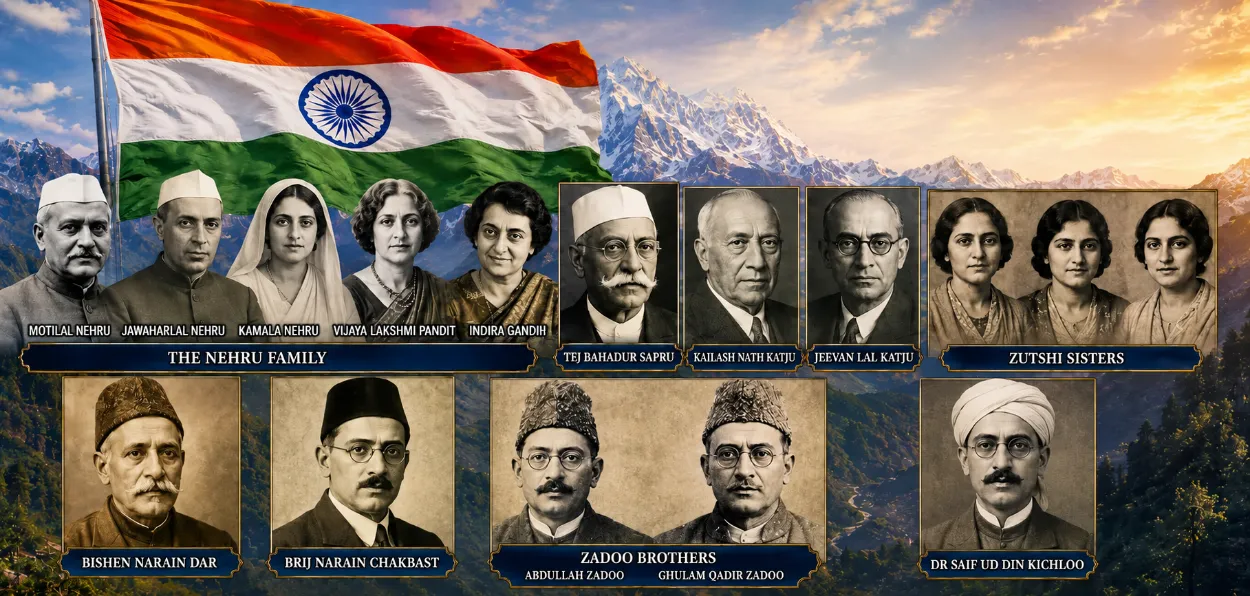
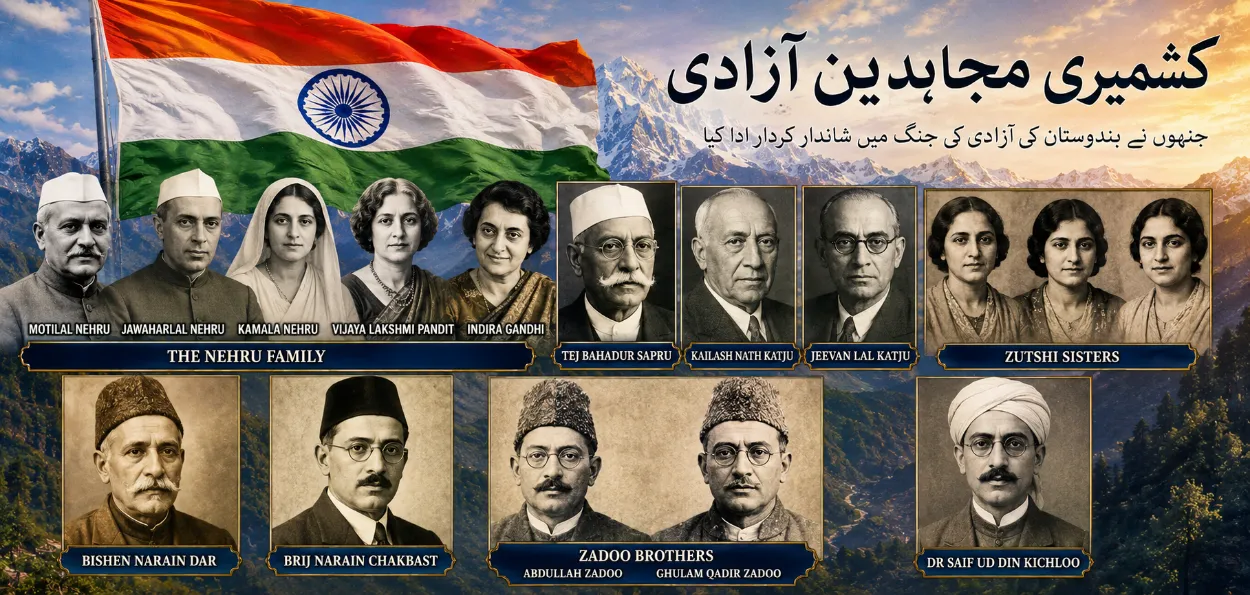
Hindus and Muslims of Kashmir, who lived in different parts of the country during the Indian freedom movement, have made their contribution in securing freedom. History bears witness to the fact that Kashmiri families living in Allahabad, Lucknow, Lahore, Faizabad, Delhi, Amritsar, and other cities rendered outstanding service in the freedom struggle. Among them, while most are Kashmiri Pandits, who not only participated in the freedom struggle but also played a leadership role at crucial junctures.
The most prominent among them are:
The Nehrus
The Nehru family of Allahabad was one of the most prominent Kashmiri families to play a significant role in India’s freedom struggle and, later, in leading the newly independent nation. The family traced its roots to the Kashmir Valley. Raj Kaul, a member of the Nehru family, was among the first to migrate from Kashmir to Delhi in the early 18th century. The family later settled in Allahabad.
The Nehru clan produced several illustrious figures who not only fought against British rule but also endured long periods of imprisonment for their participation in the freedom movement. Pandit Motilal Nehru, Pandit Jawaharlal Nehru, Swarup Rani Nehru, Kamala Nehru, Vijayalakshmi Pandit, Krishna Nehru Hathi Singh, Ganutham Hathi Singh, Ranjit Sitaram Pandit and Indira Gandhi were among the prominent members of the family who rendered memorable services to the cause of India’s freedom.
Ranjit Sitaram Pandit translated Kalhana’s celebrated historical work, Rajatarangini, into English while imprisoned in Naini Jail, where he was incarcerated along with Pandit Jawaharlal Nehru for participating in protests against British rule. Gautham Hathi Singh gave up a successful business career to join the freedom movement and fought alongside Pandit Jawaharlal Nehru.
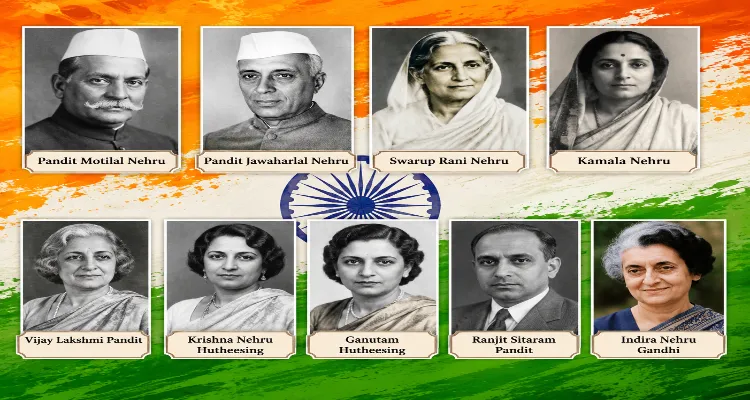
The Nehru family also dedicated their magnificent residences, Anand Bhawan and Swaraj Bhawan, as well as their lands and jewellery, to the freedom movement.
From the Lahore Congress session of 1929 until his death in 1964, Pandit Jawaharlal Nehru remained one of the most prominent leaders of Indian politics and the freedom struggle. He went on to become independent India’s first Prime Minister. Later, his daughter Indira Gandhi and grandson Rajiv Gandhi also served as Prime Ministers of India.
Tej Bahadur Sapru
Tej Bahadur Sapru belonged to a prominent Kashmiri Pandit family. He was born in Aligarh. He received his early education in Mathura, UP, while his higher education was completed at Agra College and later at Allahabad University where he obtained higher degrees in law. He was a renowned jurist, politician and pro-independence leader. Although he was in favor of complete autonomy, he considered the struggle within the constitutional framework to be the right path.
Sapru raised his voice strongly for the protection of civil liberties, freedom of expression and the rights of the press. When Mahatma Gandhi was arrested in 1922, he resigned from his post in protest. In 1928, he played a key role in the preparation of the Motilal Nehru Committee report. This report later proved to be an important document for the constitutional future of India.
He was a strong supporter of Hindu-Muslim unity and was a staunch opponent of the partition of India. On the announcement of the partition of the subcontinent, he had said that he feared that partition would not be the end of problems but the beginning of new crises and that future generations would pay a heavy price for this decision.
Kailash Nath Katju
Kailash Nath Katju, a Kashmiri Pandit, lived in the present-day state of Madhya Pradesh. After receiving his early education in Lahore, he came to Allahabad in 1905 for his law studies. He started practising law in Kanpur in 1908 and later moved to Allahabad. He was considered one of the most successful lawyers of his time. Numerous examples of his intelligence and power of argument in court are still remembered today. During the independence movement, he prosecuted the cases of several revolutionaries and political activists.
He also rendered important legal services in the Meerut Conspiracy case and the cases of officers of the Azad Hind Army. He had to go to jail several times due to his active participation in the non-cooperation and civil disobedience movements. He was imprisoned for eighteen months during the Civil Disobedience Movement and was also under house arrest for about nine months during the Quit India Movement of 1942. After independence, Katju also played a prominent role shaping of modern India.
Hriday Nath Kunzru
Hriday Nath Kunzru, who was from a highly educated Kashmiri Pandit family of Allahabad, was a close associate of Pandit Madan Mohan Malviya and played a very important role in national life. He founded the Bharat Scouts and Guides and worked tirelessly to instill a sense of public service and national responsibility in the youth. From 1946 to 1950, he was a member of the Constituent Assembly and played an important role in the framing of the Constitution of India.
Initially, he was associated with the Congress, but later, along with Tej Bahadur Sapru and Madan Mohan Malviya, he founded the National Liberal Federation . In 1934, he was elected the president of this party. He single-handedly collected six lakh rupees for the construction of Sapru House, the headquarters of the prominent international affairs organization , the Indian Council of World Affairs, which was a huge amount at that time.
The Zutshi Sisters of Lahore
The four Zutshi sisters—Man Mohini, Shyama, Janak Rani and Chandra Kumari—belonged to a prosperous Kashmiri Pandit family of Lahore and played an active role in India’s freedom struggle. Highly educated and among the modern women of their time, they were inspired by Mahatma Gandhi’s speeches to join the national movement.
Man Mohini led protests during the Salt Movement of 1930 and was arrested several times. Shyama, who briefly became the first Kashmiri Pandit woman to work in films, soon left the profession to join the freedom struggle. The sisters also protested against British rule, supported the cause of Bhagat Singh, Sukhdev and Rajguru, and mobilised students against colonial policies.
When Janak Rani’s sister was arrested, she resigned from her teaching job and joined the movement. The Zutshi sisters demonstrated that Kashmiri women, too, played a courageous and significant role in India’s freedom struggle.
Pandit Bishan Narayan Dar belonged to a prominent Kashmiri Pandit family of Lucknow. After studying law in England, he became aware of the denial of political rights to Indians under British rule and resolved to join the freedom struggle.
On returning to India, he mobilised public opinion against colonial rule through his writings and speeches. He was elected President of the Indian National Congress in 1911 and played an important role in the national movement.
His family also contributed to the freedom struggle. His relative Teka Ram Dar secretly printed and distributed anti-British pamphlets and later continued his activities from Benares after coming under British scrutiny.
Jeevan Lal Katju
Jivanlal Katju belonged to an educated Kashmiri Pandit family of Lucknow. For some time, his family also lived in Lahore, but later he returned to Lucknow again. The British government had given him an important administrative post, but after the awakening of national consciousness, he resigned from government service and joined the Congress and became part of the freedom movement.
He was considered one of the prominent Congress leaders of Uttar Pradesh and also endured the hardships of imprisonment several times during the freedom struggle. His family was closely related to the Nehru family, and his wife Kailashwati was the sister of the famous Urdu poet and Allahabad High Court judge Anand Narayan Malla.
Brij Narayan Chakbast
Brij Narayan Chakbast is considered one of the great poets of Urdu. He was born in Faizabad in a Kashmiri Pandit family, but later his family moved to Lucknow. He was a lawyer by profession but was equally interested in literature, social service and national politics. He founded the Kashmiri Youth Organization. Participated in the establishment of a library and played an active role in various national movements. He openly raised his voice against the oppressive laws of the British government, especially the Rowlatt Act.
He expressed deep regret over the atrocities committed in Punjab and severely criticized the government in his articles. He was an active supporter of the Home Rule Movement and also fought the cases of freedom fighters. Love for the homeland, the yearning for national unity and freedom are prominent in Chakbast's poetry. He did not only make Urdu literature a subject of beauty and love, but also made it a means of awakening national consciousness.
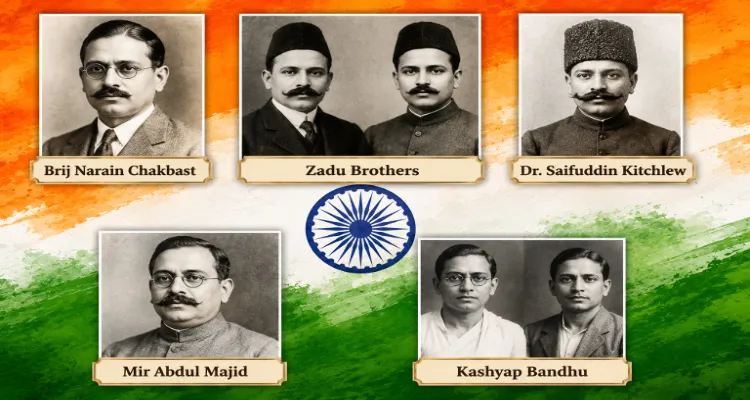
Zadu Brothers
Dinanath Zadu and Kantichandra Zadu, Kashmiri Pandits, joined Netaji Subhash Chandra Bose's Azad Hind Fauj. Dinanath Zadu held the rank of captain and fought against the British forces on the Malaya front. Kantichandra Zadu was Netaji's personal secretary. It is said that he was on board the same plane in 1945 in which Netaji Subhash Chandra Bose is claimed to have died.
The patriotism of this family continued even after independence. In 1947, when tribal invaders under the auspices of Pakistan entered Kashmir, Professor Krishna Misri Zadu joined the women's volunteer organisation and participated in defence activities, while her brother Pushkar Zadu was martyred in the same war. This family is a symbol of the fact that Kashmiris made sacrifices for the defence of the homeland not only during the freedom movement but also after independence.
Dr. Saifuddin Kutchlu
Dr. Saifuddin Kutchlu belonged to a respected Kashmiri Muslim family of Amritsar. He received his higher education from Cambridge University, and after receiving his doctorate from Germany, he returned to his homeland and started practicing law. Since his student days, the spirit of freedom had awakened in him and he actively participated in the activities of Indian students abroad. During this time, he was also friends with Pandit Jawaharlal Nehru.
Dr. Kutchlu was also the General Secretary of the All India Congress Committee and the President of the Punjab Congress. His arrest before the Jallianwala Bagh massacre created great anger and resentment throughout Punjab and this protest later led to the tragic Jallianwala Bagh incident. He spent more than fourteen years in different jails against the British government. He was a strong supporter of Hindu-Muslim unity and was a staunch opponent of the partition of India.
He said that partition based on religion would be in favour of neither Muslims nor Hindus. According to him, such a division would erect a new wall of hatred and violence for the coming generations. He established Swaraj Bhavan in Amritsar, which became a center of national unity. He was also among the founder members of Jamia Millia Islamia. After independence, he also rendered important services for the promotion of world peace and Indo-Russian friendship, in recognition of which he was awarded the Lenin Peace Prize.
Mir Abdul Majeed
Mir Abdul Majeed's ancestors had migrated to Lahore from the Fateh Kadal area of Srinagar. His family was associated with the profession of shawl weaving, but Mir Abdul Majeed made journalism and national politics his field. He published the Urdu newspaper Mantak Kush and participated in the activities of the Young Bharat Sabha along with Bhagat Singh, Sukhdev, Comrade Dhanwantri and other revolutionary leaders. He was also the vice-president of this organization.
He, along with Dr. Saifuddin Kutchlu, Dr. Satya Pal and Abdul Salam Rafiqi, launched a public movement across Punjab against the Rowlatt Act. As a result of this struggle, he was arrested several times. The British government made him an accused in the Peshawar Conspiracy Case and later in the Meerut Conspiracy Case and sentenced him to imprisonment. On April 13, 1919, when thousands of people gathered at Jallianwala Bagh, Mir Abdul Majeed was also among the speakers of the rally. Before General Dyer was shot, he addressed the public. Thus, he was also an eyewitness to this historic tragedy.
A K Hangal
Avtar Krishna Hangal, known to the world as A.K. Hangal, was born in a Kashmiri Pandit family in Peshawar. Later, his family moved to Karachi. He participated in the freedom movement from his student days. He led students in protests against the Jallianwala Bagh massacre. In Karachi too, he remained active against the British government and was arrested several times.
After the partition, he came to Mumbai, where he participated in social awareness plays through the Indian People's Theatre Association and later became a prominent actor in Hindi films. In recognition of his national service and outstanding role in the field of art, the government awarded him the Padma Bhushan.
Kashyap Bandhu
Kashyap Bandhu, whose real name was Pandit Tara Chand Bulbul, was born in Tral, Kashmir. During his youth, he spent some time in Lahore, where he came into contact with freedom fighters and Arya Samaj workers. He organised Kashmiri workers in Lahore and helped establish the Kashmiri Mazdoor Board, becoming its first secretary under the guidance of Allama Iqbal. A major meeting organised by the Board in Ludhiana was addressed by Pandit Motilal Nehru.
Returning to Kashmir in 1930, Kashyap Bandhu devoted himself to social reform, education, public awareness and welfare. He emerged as an important figure in the reform movement among Kashmiris.
ALSO READ: Grateful nation honoured Lt Balwan Singh for Tiger Hill operation with MVC
His life represents the wider contribution of Kashmiris to India’s freedom struggle. Kashmiri Pandits and Muslims alike played their part—through political activism, journalism, legal support, social reform and personal sacrifice. Alongside figures such as the Nehru family, Tej Bahadur Sapru, Kailash Nath Katju, Dr Saifuddin Kitchlew, Mir Abdul Majeed and A.K. Hangal, Kashyap Bandhu and many lesser-known Kashmiris helped strengthen the national movement.
Their contribution remains an important chapter in India’s history, reflecting the values of freedom, unity, public service and human dignity.
(This is the edited version of story which appeared on https://autarmota.blogspot.com/ Chinar Shades)








.webp "Representational Image")