New Delhi
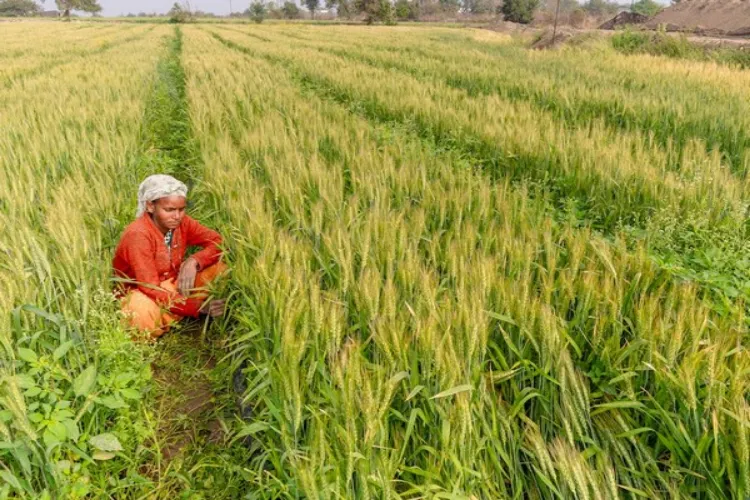
Delayed arrival and sluggish progress of the southwest monsoon have significantly slowed kharif sowing across the country, with the total area under cultivation declining by nearly 23 per cent compared to the corresponding period last year, according to data released by the Agriculture Ministry.
As of June 25, kharif crops had been sown across 182.72 lakh hectares, down from 236.46 lakh hectares during the same period in 2025. The decline has been recorded across most major crops, including paddy, pulses, oilseeds, coarse cereals and cotton.
Paddy, the country's principal kharif crop, registered a 25.17 per cent fall in acreage, with sowing covering 25.75 lakh hectares compared to 34.41 lakh hectares a year ago.
Pulses also witnessed a sharp decline, with acreage falling 30.47 per cent to 14.92 lakh hectares from 21.46 lakh hectares last year. Among pulse crops, tur (arhar) sowing stood at just 3.56 lakh hectares against 8.45 lakh hectares during the same period last year.
Oilseed cultivation recorded the steepest decline, dropping 53.33 per cent to 16.99 lakh hectares from 36.41 lakh hectares. Groundnut acreage declined to 8.87 lakh hectares from 15.29 lakh hectares, while soybean sowing fell sharply to 6.92 lakh hectares from 19.97 lakh hectares.
Area under coarse cereals also declined to 31.84 lakh hectares from 36.07 lakh hectares in the corresponding period last year.
Cotton sowing fell by 34.61 per cent, with acreage declining to 29.66 lakh hectares from 45.36 lakh hectares.
In contrast, sugarcane registered a marginal increase in cultivated area, rising to 57.31 lakh hectares from 56.64 lakh hectares. Jute and mesta also recorded a slight increase, with acreage reaching 6.25 lakh hectares compared to 6.13 lakh hectares last year.
The southwest monsoon, which typically triggers the beginning of kharif sowing in June, has remained substantially below normal this season. According to the India Meteorological Department (IMD), cumulative rainfall was 42 per cent below the long-period average as of June 24.
Central India reported the highest rainfall deficit at 59 per cent, followed by East and Northeast India at 41 per cent. The South Peninsula recorded a 28 per cent shortfall, while Northwest India remained 22 per cent below normal.
The IMD has also indicated that El Niño conditions are currently prevailing over the equatorial Pacific Ocean and are likely to strengthen further during the June-September monsoon period.
Meanwhile, water availability in major reservoirs continues to remain under pressure. Data from the Central Water Commission (CWC) showed that live storage across 166 key reservoirs stood at 48.405 billion cubic metres (BCM) as of June 25, equivalent to 26.37 per cent of their full reservoir capacity.
Current storage is 73.21 per cent of the level recorded during the same period last year but remains slightly above the long-term average at 105.67 per cent of normal.
READ MORE: Bait-ul-Maal: A Muharram beacon of Hindu-Muslim harmony
Of the 166 reservoirs monitored, 111 contained more than 80 per cent of their normal storage levels, while 55 reservoirs were below that benchmark. Among them, 29 reservoirs were storing less than half of their normal water levels.
















.webp)