New Delhi
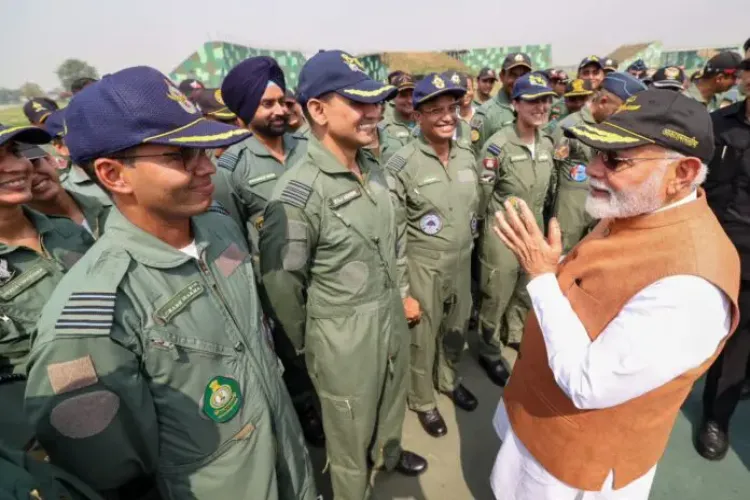
A parliamentary panel on defence has lauded the IAF for its "commendable role" during Operation Sindoor, and said by executing precision strikes with advanced aerial platforms and integrating indigenous technologies, the air force demonstrated "exceptional professionalism and operational readiness".
In its report, presented in Parliament on Wednesday, the committee also commended the Indian Army's "decisive role" in safeguarding national security during the decisive operation, and said it expected that "our expenditure should be in proportion to the increase in defence spending of our neighbours".
Therefore, the panel feels that the capital budget of the Army should be sufficient to have a "deterrent capacity to ward off adversaries in case of any hostility," the report said.
The committee further said post Operation Sindoor, emergency procurement provisions were accorded in 2025 for capital and revenue procurement to further enhance capability to development.
"The Committee are also happy to know that emergency procurements are being utilised for acquiring drones, counter-drones, weapon systems, precision ammunition, electronic warfare and surveillance systems," it says.
The report is titled -- Demands for Grants of the Ministry of Defence for the year 2026-27 on Army, Air Force, Navy, Joint Staff, Ex-Servicemen Contributory Health Scheme and Director General of Armed Forces Medical Services.
The panel praised the Indian Army's "decisive role" in safeguarding national security during Operation Sindoor last year, and emphasised the need for sustained investment in defence preparedness.
It urged that future budgets should "prioritise induction of state-of-the-art weapon systems and the development of requisite infrastructure", so that the Army's hallmark swiftness and coordinated response to diverse security scenarios can be maintained and further strengthened.
The panel also praised the Indian Air Force for its "commendable role during Operation Sindoor. By executing precision strikes with advanced aerial platforms and integrating indigenous technologies, the Air Force demonstrated exceptional professionalism and operational readiness".
Its swift deployment, accurate targeting, and seamless coordination with ground forces ensured the success of the mission, "significantly degrading hostile infrastructure," it added.
The Committee emphasised upon the defence ministry that such capabilities underscore the importance of continued investment in modern air power to maintain India's strategic edge and safeguard national security.
It urges upon the ministry to make all necessary efforts for providing adequate financial support for acquiring latest advanced aircraft, weapons and equipments required to meet the challenges of present geopolitical scenario so that preparedness and combat capability of the air force are "enhanced to a significant level".
In the report, the panel also noted that with a view to fast track the process of theaterisation, a dedicated team of officers from all three Services has been formed under the Chief of Integrated Staff to Chairman Chiefs of Staff Committee (CISC).
The Committee also note that three Joint Staff Officers undertake study of global military organisations as well as organise discussions among the three Services to streamline the process of reorganisation.
The Joint Staff has been able to take forward the process of theaterisation to an "advanced stage," it said.
The Committee said it is happy to note that all the three Services are working towards one common goal and enhancing their integration through pursuits in common operational planning process, technology development, harmonising intelligence surveillance and reconnaissance resources, aggregating remotely piloted assets, joint standard operating procedures and formulation of joint military civil fusion doctrine.
In a separate report, 'Review of Sainik Schools, Rashtriya Indian Military College (RIMC) and Rashtriya Military Schools', also presented in Parliament on Wednesday, the panel flagged that the average dropout rate during the last five years in the Sainik Schools, Rashtriya Military School and Rashtriya Indian Military College is 6.93 per cent, 6.96 per cent and 7.1 per cent, respectively.
The Committee said it feels that the seats which fall vacant after the cadets leave these institutions midway remain vacant until the next entrance examination is held.
"This has a rippling effect as on one side the precious resources of the Government go waste due to idling of seats, on the other side it curtails the opportunities of candidates who intends to join the NDA course. The Committee, therefore, urges upon the Ministry to address this dropout issue on priority basis," it said.
The Committee also urge the ministry to reinforce its commitment and take all necessary steps in a time bound manner for providing requisite infrastructure including administrative infrastructure, dormitories and related facilities for girls cadets in RIMC, which would eventually result in enhancement of their physical and mental faculties for preparation and induction into the armed forces of the nation.
ALSO READ: Colonel Ishrat Ahmed is the pride of Kayamkhanis and Rajasthan
It also recommend that the ministry should review or revisit its existing policy, particularly relating to land criteria required for establishment of new Sainik Schools, first of which came up in 1961, and currenly number 33 across the country.













.webp "Defence Minister Rajnath Singh")