Kuala Lumpur
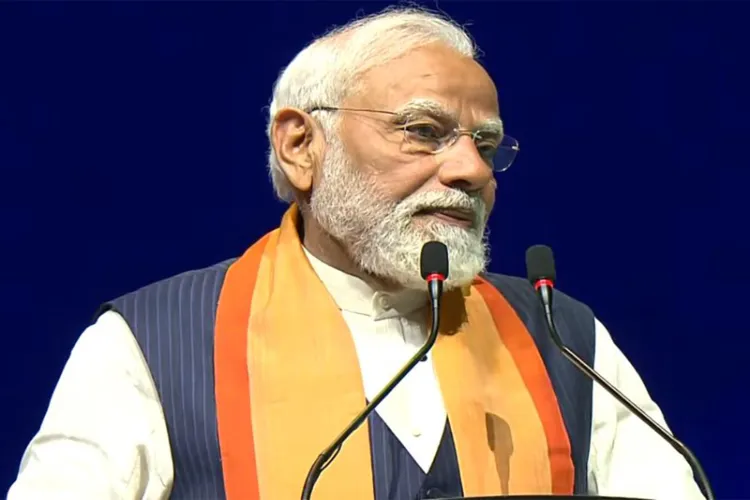
Prime Minister Narendra Modi on Saturday highlighted the strength and shared vision of India–Malaysia relations, stating that India’s progress is closely intertwined with Malaysia’s growth and, by extension, the success of Asia. He said the bilateral partnership is guided by the vision of IMPACT—India-Malaysia Partnership for Advancing Collective Transformation.
Addressing the Indian diaspora in Kuala Lumpur during his two-day visit to Malaysia, the Prime Minister said both countries take pride in each other’s achievements. He also acknowledged Malaysian Prime Minister Anwar Ibrahim’s warm gestures, including his message congratulating India on the success of Chandrayaan-3.
“We celebrate each other’s achievements as our own. I was deeply touched by Prime Minister Anwar Ibrahim’s wishes after the success of Chandrayaan-3. I fully agree with you, my friend—India’s success is Malaysia’s success, and it is Asia’s success,” PM Modi said.
Explaining the framework guiding bilateral ties, the Prime Minister said IMPACT reflects the spirit and ambition of the relationship.
“IMPACT stands for India-Malaysia Partnership for Advancing Collective Transformation. It represents the speed of our cooperation, the scale of our aspirations, and the benefits we seek for our people. Together, our partnership can contribute to the greater good of humanity,” he said.
Highlighting expanding economic and technological collaboration, PM Modi noted that India and Malaysia are working closely across key sectors, with more than 100 Indian IT companies currently operating in Malaysia, generating significant employment.
“It is a matter of pride that India has contributed to setting up Malaysia’s first and Asia’s largest insulin manufacturing facility. Over a hundred Indian IT firms are active here, creating thousands of jobs,” he said.
The Prime Minister also pointed to growing digital cooperation between the two countries, announcing that India’s Unified Payments Interface (UPI) will soon be introduced in Malaysia.
“The Malaysia–India Digital Council is opening new avenues for digital collaboration. I am pleased to share that UPI will be coming to Malaysia very soon,” he said, drawing applause from the audience.
Emphasising that people-to-people ties form the foundation of bilateral relations, PM Modi spoke of the shared maritime geography and cultural bonds linking the two nations across the Indian Ocean.
“We are connected by the same blue waters of the Indian Ocean. Across this ocean, we enjoy visiting one another,” he said, inviting members of the diaspora and their Malaysian friends to travel to India.
The Prime Minister also highlighted India’s rapid progress in infrastructure and connectivity over the past decade, noting the sharp rise in the number of airports, the accelerated pace of highway construction, and the growing global recognition of modern trains such as Vande Bharat.
“In recent years, India has witnessed unprecedented growth in infrastructure. Our airports have doubled in number in a decade, highways are being built at record speed, and trains like Vande Bharat are gaining international acclaim. I urge you to visit Incredible India and bring your Malay friends along, because people-to-people contact is the backbone of our friendship,” he said.
Speaking on India’s broader economic transformation, PM Modi said the country has made remarkable progress in a short span.
“Within one decade, India has undergone a massive transformation. We were once the world’s 11th largest economy; today, we are knocking on the doors of the top three. India is also the fastest-growing major economy,” he said.
He added that flagship initiatives such as Make in India have matured, with India now emerging as the world’s second-largest manufacturer of mobile phones.
READ MORE: Muslims must prioritise education for girls: Ex-Maha minister Anees Majeed Ahmed
Prime Minister Modi is on a two-day visit to Malaysia aimed at further strengthening the India–Malaysia Comprehensive Strategic Partnership, with enhanced cooperation across economic, digital, cultural, and people-to-people sectors.







.webp "Union Home Minister Amit Shah")
.webp "Union Minister of Parliamentary Affairs Kiren Rijiju")

_(1).webp)