Rita Farhat Mukand
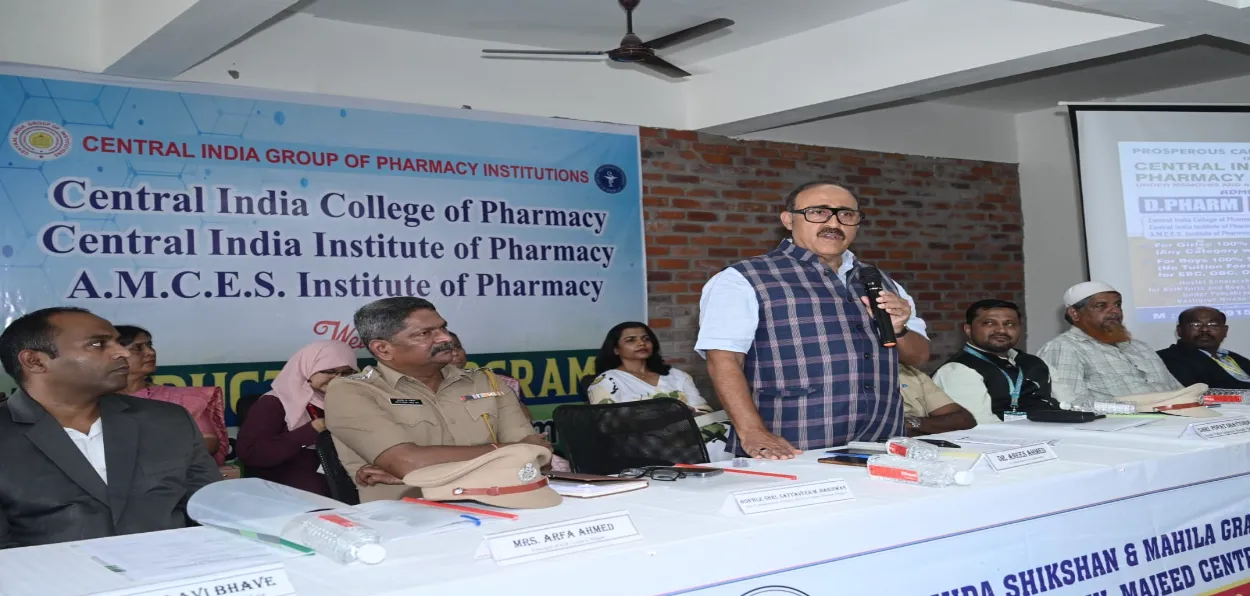
Dr Anees Majeed Ahmed from Nagpur is a former minister, educationist, and social reformer who has taken up the mission of Muslim education. He recently set up the Central Province Physiotherapy College (CPPC) and the Central India College of Pharmacy in Lonara, Nagpur. He was the first Muslim to be elected as President of the Nagpur University Students’ Union. He is also the first Muslim education minister of Maharashtra who made Maharashtra one of India’s most computer-literate states.
Awaz-the-Voice spoke to him about his experiences in an exclusive interview. Excerpts:
Tell us about your early journey and what led you to push for higher-quality education fervently.
For me, literacy has never been an abstract ideal or a political slogan. It has always been a lived question, which is shaped by the privilege I inherited, the deprivation I witnessed around me, and the responsibility I consciously chose to carry. Over the years, my journey has been an ongoing reflection on how education shapes not only individual mobility but also a nation's direction.
As an educationist, social reformer, and former political leader, I focused on literacy, minority upliftment, and inclusive education, particularly among Muslims and other marginalised communities in Maharashtra.
My rise from student leader in the University, and later as a Minister in the Maharashtra government, was never about personal advancement; it was about understanding where the system fails those who have no access, and how this can be corrected.
Tell me about your shift from politician to passionate educator?
I was born into an affluent household; my mother was from Bangalore, and my father was from Nagpur. I was educated in a missionary English-medium school. I later trained in law and earned an MBA. From an early stage, I was aware of the advantages I had. Studying with people like Nitin Gadkari sharpened my understanding of how early exposure, institutional access, and networks shape destiny. As a student leader with the National Students' Union of India (NSUI), my instinct was simple but decisive: what I had gained through circumstance should not remain exclusive. To me, leadership meant the redistribution of opportunity.
The minority and rural students are trapped in a cycle of deprivation due to financial constraints. Poor people are pushed towards the poorly resourced municipal schools. They get limited career opportunities and become unskilled labour. The absence of education was the silent architect of inequality.
How did you deal with that setback?
In 2008, as Maharashtra’s first minority education minister, I introduced a commission-based scholarship scheme that provided up to Rs. 2 lakh per student to minorities, including Muslims, Christians, Jains, and Sikhs. With annual allocations of Rs. 400–500 crores, which enabled thousands of students to pursue higher education and secure employment across India. Decades later, its impact continues to unfold.
“Students from rural communities started moving to cities, living in hostels, and aspiring to professional careers. Among minority communities, the transformation of the girl child stood out most clearly. Young women are pursuing higher degrees, succeeding in competitive examinations such as NEET, and entering technical and emerging fields like computer science, artificial intelligence, physiotherapy, and healthcare. To me, this confirms a simple truth -- when barriers are removed, aspiration recalibrates naturally.
"Through a charitable trust established in my parents’ names, I contributed to institution-building in healthcare, nursing, physiotherapy, and legal education. As Vice Chairman of the Maharashtra Knowledge Corporation, I worked toward making Maharashtra one of the most computer-literate states in the country. While Kerala remains India’s literacy benchmark, I have always believed that digital literacy is the next frontier -one capable of democratizing opportunity at scale.
I see a direct connection between literacy, leadership vision, and social stability. States such as Kerala, Karnataka, Telangana, Maharashtra, and Gujarat attract educated workforces and sustain thriving IT ecosystems. Others lag. Crime, communalization, and social fragmentation in parts of Bihar, Madhya Pradesh, and Uttar Pradesh are not accidental but symptoms of long-term educational neglect because leaders lack the vision to make that change. Literacy remains the most reliable predictor of national growth, and education budgets must be viewed not as expenditure, but as investments in social cohesion.
Do you feel the Muslims face obstacles that differ from those faced by other minority communities?
For Muslims in particular, the obstacles are layered -economic backwardness, lack of institutional support, and systemic exclusion. Parents aspire for their children to study, but financial hardship often prevents continuity in education. Parents still push for early marriage over higher education for daughters. This mindset must change.
My foremost goal has always been to bring Muslims into the mainstream through education. Muslims have played a profound role in India’s history -contributing wealth, sacrifices, and lives in the freedom struggle. Yet today, many feel marginalised and targeted. In developed countries, minorities receive equal opportunities; unfortunately, this is a challenge in India.
What are the pivotal steps for change?
I firmly believe that the Muslim community must prioritise education for girls. As the saying goes, “If you educate a woman, you educate a family; if you educate a girl, you educate the future.” Girls today are outperforming boys across disciplines. The community needs to place education, especially girls’ education, at the epicentre of progress.
Literacy is not optional; it is essential. It is the strongest weapon we have to compete globally, strengthen our nation, and secure a just and prosperous future for all.
ALSO READ: Rouble Nagi awarded Nobel of Teaching for educating kids in Mumbai slums
"Twenty-five years on, as students educated through these interventions carry the legacy forward, my conviction remains unchanged: education is the most powerful - and perhaps the only - durable instrument for inclusive nation-building.









.webp)