.webp "Maharashtra Navnirman Sena (MNS) chief Raj Thackeray")
Mumbai
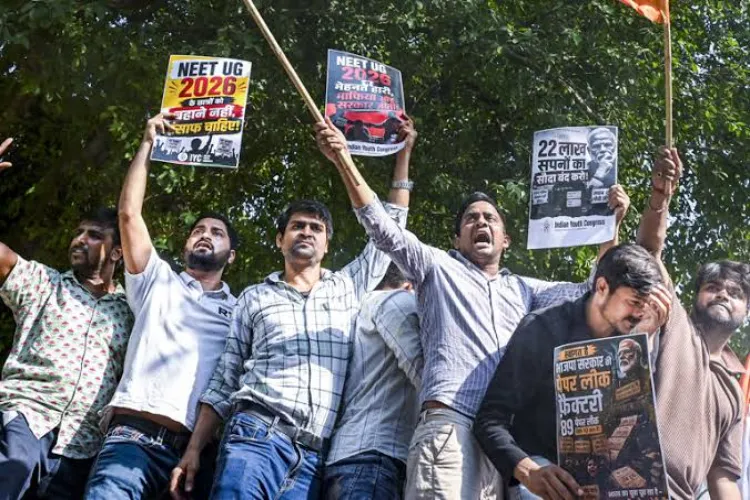
Maharashtra Navnirman Sena (MNS) chief Raj Thackeray on Friday alleged that the Delhi police's crackdown on the Cockroach Janta Party's 'Sansad Chalo' march seemed like an act of "revenge" rather than crowd control.
Thackeray, in a post on X, questioned the alleged use of force against students protesting the NEET paper leak, and remarked that if teachers face action for meting out corporal punishments, the same should apply to the police who assaulted students and those who ordered them to do so.
I have a question: if teachers face disciplinary action for hitting students in school, why is no action taken against the police officers in Delhi who beat students, or against those who issued such orders?
— Raj Thackeray (@RajThackeray) July 24, 2026
During the ongoing student protests in Delhi, the police have been… pic.twitter.com/tpStkZg6Qd
"One can understand if the police had resorted to mild lathi-charge to disperse protesting students, but what was witnessed appeared like some kind of revenge," he wrote.
He claimed that videos circulating on social media showed not only protesting students but also several bystanders being beaten during the police action, alleging that such force would not have been used without orders from higher authorities.
The CJP's 'Sansad Chalo' protest turned violent on July 20 after police lathi-charged and tear-gassed the protesters when they attempted to march towards the Parliament, on the first day of the Monsoon session.
The MNS chief said that police personnel, whether in Maharashtra or elsewhere, often have no option but to carry out orders issued to them, and hence, they alone cannot be held responsible.
Who authorised the system to issue such "merciless" orders, he said, and questioned if those giving such directions considered themselves above the Constitution.
Thackeray further pointed out that the United Nations had laid down principles governing the use of force, including that it should be lawful, necessary, proportionate and accountable.
He noted that countries such as Norway, Germany, Sweden, Finland, Denmark and New Zealand conduct stringent inquiries into the use of police force, with greater scrutiny on those issuing the orders, and said India should adopt a similar approach.
Thackeray also criticised the response of constitutional institutions, alleging that the present government had failed to address the concerns of young people, forcing them to take to the streets.
He urged civil society to deliberate on the issue and called on MPs to demand a discussion in Parliament.
READ MORE: Teenage poet Fariha Anjum enters Asian Book of World Records
The issue was not whether the state possessed the authority to use force against citizens, but whether a constitutional democracy exercised restraint in using that power, he said.
The maturity of a democracy should be judged by how it handles dissent with restraint rather than by how harshly it suppresses opposition, Thackeray added.

_(1)_(1).webp "Jagannath Rath Yatra")