Saquib Salim
The records of the First War of Indian National Independence in 1857 show names of Muslims and Hindus that are no longer in use. For example, when the revolution started in Meerut after the English East India Company sentenced 85 Indian sepoys to jail terms on 9 May 1857, its leader was Havildar Mata-Deen.
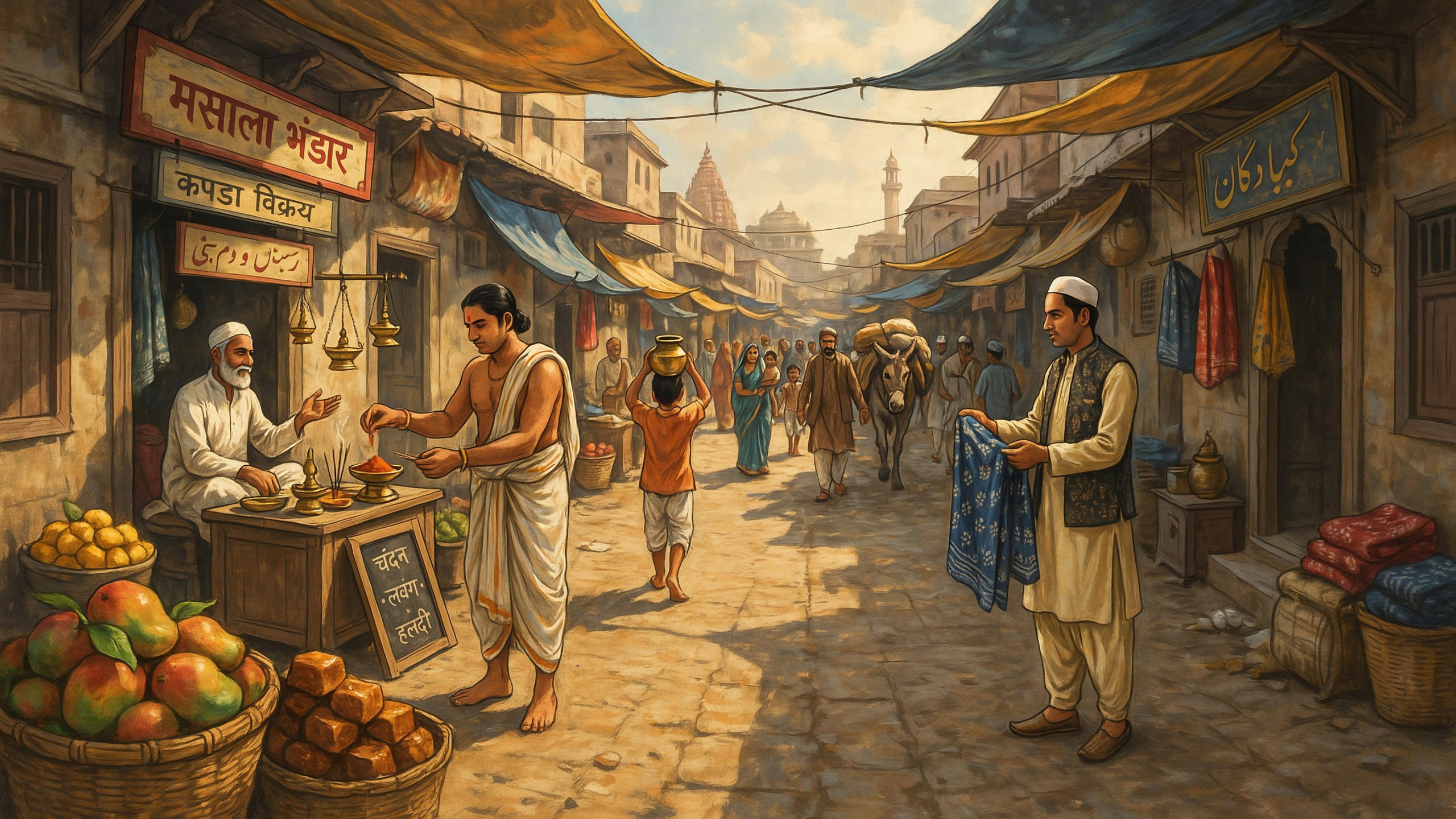
In the 19th century, this name was given to children in both religious communities. We have Matadeen Mir and also Matadeen Pandey from that era; both worked for the English army. This was no exception; among these 85 sepoys we had - ‘Sheikh Nandoo’, ‘Nadju Khan’, ‘Kalla Khan’, ‘Zabardast Khan’ and other names which, apart from suffix or prefix, did not help in identifying their religious faith. Elsewhere in Bihar, Sheikh Ghasita and Sheikh Bikhari led the 1857 revolution, and Sheikh Gulab would lead the indigo peasant agitation in 1907. All these names were common to Hindus and Muslims.
It’s not that Indian Muslims didn’t give Arabic or Quranic names to their children, but a vast majority used names with no connection with Arabic and could not be identified as Islamic. Some names like Ghasita, Nandoo, Matadeen, etc. were not used by lower-class people; they held respectable jobs and had a social standing. So, we can safely argue that such names cut across the caste and class lines.
What was this phenomenon? How did it end? These questions have intrigued me for several years now.
Recently, when I was reading The Indus Saga by Ahtzaz Ahsan, a former Pakistani minister, this question rekindled in my mind. He pointed out that Pakistan “has almost no Muslim inhabitants with pre-Islamic names. This is quite peculiar. In this, Indus is a unique area. Even Saudi Arabia, the birthplace of Islam, does not share this attribute with Indus. We know that Omar, Usman, and Ali were pre-Islamic names. Omar was Omar before he became a Muslim. On conversion, he did not feel compelled to change his name. So was the case with Usman and Ali, Sufyan and Khalid.
As Islam spread to Persia, it encountered Persian names. These, too, were neither Arabic nor, as the obscurantists of that age would have chosen to allege, 'Islamic'. These were names peculiar to a heathen order. Rustam, Sohrab, Jamshed, Parvez are pre-Islamic Persian names. A Rustam, Sohrab, Jamshed, or Parvez didn’t have to change his names upon conversion to Islam.
What compelled the Sobash and the Mohanlal of Indus to discard their names as they embraced Islam? Muslims of India have adopted Arabic names gradually over a period of centuries.
Tariq Rahman in his book Names writes, “So important is the giving of Islamic names as boundary markers of the Islamic community that Maulana Ilyas (1885-1944), the founder of the Tablighi Jamaat (a movement for the preaching of Islam), considered the Meos of Mewat (Alwar, Bharatpur, and Gurgaon in Haryana in India) with their Hindu appearance and names in the 1920s, an affront to his Muslim sensibilities, although many of them had converted to Islam. About their names, the gazette of 1878 declares: They call themselves by Hindu names, with the exception of ‘Ram’; and ‘Singh’ is a frequent affix, though not so common as ‘Khan’ (Captain Powlett, 1878: 38. Quoted from Ibbetson 1883: 135). As the Islamization of the Meos progressed, the components of names shared with the Hindus decreased and then disappeared.”
It is to be noted that this zealous effort to assert a distinct religious identity for Muslims as well as Hindus, Sikhs and Christians started in the early 20th century. Government of India Act 1919 started a process where each religious group wanted to come out with a higher number in its ranks to claim a higher share in representation in legislatures and services. This is the reason that the 1920s saw the emergence of Tabligh, Tanzim and Shudhi movements by Muslims and Hindus in opposition to each other to win more and more converts. The target was the people who, like Meos and Gujjars, were loosely following Islam as well as Hinduism.

Mattison Mines, in his study, established a similar process to that of Meos in Muslims of Tamil Nadu as well. He wrote in Islamisation and Muslim Ethnicity in South India, “A similar process of Islamisation is observed in Tamil Nadu. The Edaikottai Muslims have emerged from their Hindu environment, have left the village for the city, and have Islamised…. The Meos have lost their pre-Partition social position as a result of radical political and economic change emanating from the division of India and Pakistan. But the Muslim Tamils have not experienced similar change and are able to respond more flexibly to different social environments. There appears to be no pressure from the dominant Hindus forcing Tamilnadu's Muslims to Islamise. On the contrary, urban Muslims have consciously chosen to Islamise their customs…. Muslim identity in the village, however, is corporate so that religious identity is ascribed, but social status and prestige are achieved.”
Names have become one of the important markers for community formation in a post-colonial world. It affects the way the state looks at its subjects and how, in turn, a citizen looks at themselves. Muslims of India didn’t remain unaffected.
Annemarie Schimmel, in her influential book, Islamic Names, has argued that “several fatwas against the mixing of Islamic and Indian names are given, and especially Islamicised Tamil and Telugu names are criticised. She also notes, “a recent fatwa urged Indian Muslims to call their daughters after the 'mothers of the faithful', that is, the Prophet's wives.”
What Schimmel was looking at is a phenomenon which has come into effect in the 20th century, and before that a Matadeen or Ghasita could have been as much a Muslim as Abdullah was.
In the same book, Schimmel points out that the name Bilal “became fashionable among Indian Muslims and in Pakistan owing to Iqbal's two Urdu poems about this faithful companion of the Prophet. It seems also that the name Tariq became widely used in the same part of the world, after Tariq's memory was evoked in one of Iqbal's poems that celebrated the hero who crossed the straits of Gibraltar, which still bear his name.”
The names to mark an identity of the Muslim community are a 20th-century phenomenon which is again limited to South Asia (subcontinent).
This has given rise to putting surnames which can help Indian Muslims “to identify themselves as members or even as descendants of the nucleus of the community of the faithful.” Like, the Ansari surname stresses that the person is a descendant of Ansars of Medina or a Siddiqui traces lineage to Abu Bakr, and similarly a Mansuri, Salmani, Faruqi traces his roots to one early companion of the Prophet or the other.
In India, the process of Islamisation of surnames has been arrested by certain groups who keep caste surnames of their Indian forefathers like Tyagi, Gaur, Tomar, Pundir, Chauhan, Naik, Rao, etc.
If you look at other societies like Indonesia, Iran, Turkey, etc., this doesn’t seem obligatory to name a kid from the Quran like Indians do.
In fact, this orthodoxy mixed with ignorance sometimes becomes hilarious. Schimmel tells us that numerous Muslims “open the Qur'an at random to select their child's name; and their eyes had fallen on Sura 61/13. This custom is widespread in the Indian subcontinent and in other, predominantly non-Arab, countries; and in many cases it leads to strange combinations, as the parents usually do not know enough Arabic to understand the implications of certain expressions. The biographer of the eighteenth-century Indian poet and scholar Aziid Bilgrami tells us that one day someone knocked at Azad's door in Aurangabad and when asked his name, replied: 'Ba'du bi'd-din', whereupon the scholar refused to talk to him because of the evil connotation of the words (Sura 95/7: 'And what makes you deny after that the Judgment?').”
Prof. Nadeem Hasnain sees this contestation over names as an ongoing process. He writes, “Perhaps, the more important change of far-reaching importance is the adoption of unusual names in the style of Arabs. As Muhammad Masud (2009) rightly points out, “names in any culture may entail links to social, political, economic and religious institutions...” The naming ceremony is performed in a variety of ways among the Muslims of South Asia. The Aqiqa ceremony is most common for this purpose. The usual practice of choosing a name to be given to the child has been to go for an adjective of Allah, Muhammad, Caliphs, Sahaba (Muhammad’s companions) and for the Shias, their twelve Imams, all of the above except the names or titles of the Caliphs and those Sahaba who were hostile to Ali. The Shia Saiyyeds trace their lineage to one of these Imams, and the popular titles/surnames are Husaini, Abidi, Taqvi, Rizvi, Naqvi, etc. Now, among a section of people, naming is being done in typical Arab style - Yaseen bin Zuhair, Anab bint Siraj, etc. This is something unprecedented. Such a style and names were never there. This is yet another instance of ‘Arabization’ of South Asian Islam in a direction of severing religio-cultural ties with South Asia.”
ALSO READ: How the eclipse of Ihsan dimmed Muslim civilisation's radiance
oday, there are a few Indian Muslims who cannot be identified with names, and the same is true for Hindus. This is something peculiar to South Asia. In fact, our first Prime Minister, Jawaharlal (Jawahar means pearls or jewels; Lal means a red, precious stone), born in 1889, had a non-Sanskrit name with Persian roots. But today in the younger generation, there are few Ram Baksh among Hindus or Lallan Khan among Muslims. Though caste surnames are still holding on among a large population.

.webp "Union Home Minister Amit Shah")






.webp)