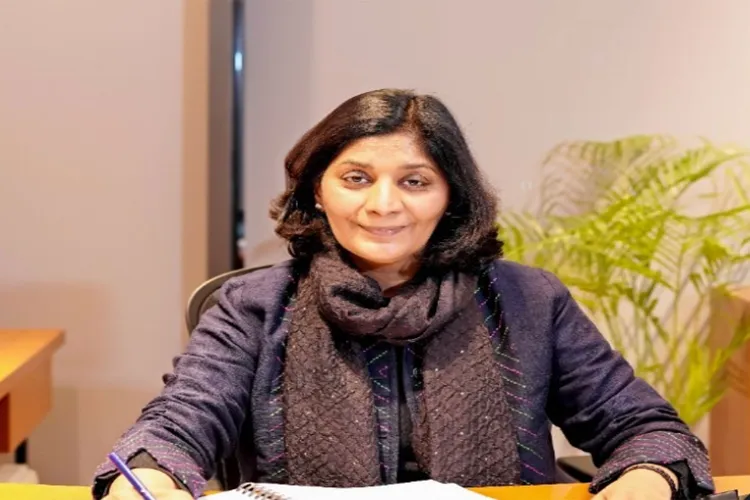
New Delhi
India’s aspiration to become a high-income economy by 2047 will depend not only on national macroeconomic policies but increasingly on how effectively states design and implement growth strategies suited to their individual strengths, Poonam Gupta said on Monday.
Speaking at the Columbia Indian Economy Summit 2026, Gupta said sustaining—or even surpassing—India’s recent growth momentum would require extending economic frameworks to the subnational level, with policy priorities varying significantly across states at different stages of development.
Representing the Reserve Bank of India, Gupta said that if growth trends seen over the past two decades continue, the average per capita income of Indian states could approach high-income thresholds by 2046–47.
She noted that lower-income states are expected to contribute significantly to this expansion, indicating a shift from earlier periods of income divergence toward a more broad-based and inclusive growth trajectory.
For economically advanced states, Gupta said priorities should include:
These states, she said, are expected to drive India’s competitiveness in technology, capital markets and global supply chains.
For lower-income states, Gupta outlined a different growth roadmap, focused on:
Gupta highlighted that while the Union government formulates major macroeconomic policies—including monetary policy, trade, industrial policy and financial regulation—states control several critical growth levers.
These include:
She said strengthening these areas through a holistic framework would be essential to accelerating prosperity across states and improving national economic performance.
Gupta also pointed to signs of convergence in welfare indicators, saying income divergence between richer and poorer states has narrowed over successive decades.
She added that convergence has been even stronger in areas such as:
According to Gupta, India’s development journey is no longer about whether the country will prosper, but how quickly, how broadly and how equitably that prosperity is shared.
READ MORE: 10 Muslims women academicians of India
She stressed that achieving the vision of Viksit Bharat 2047 would require state-specific strategies rooted in local strengths, structural realities and stages of economic development.










.webp "Prime Minister Narendra Modi")
.webp "Prime Minister Narendra Modi")


_(1).webp)