New Delhi
The idea behind setting up the Open Quantum Institute by Geneva Science and Diplomacy Anticipator (GESDA) along with CERN, is to make sure that when quantum computing is out in the future, it will be "accessible to all", the Switzerland-based foundation said.
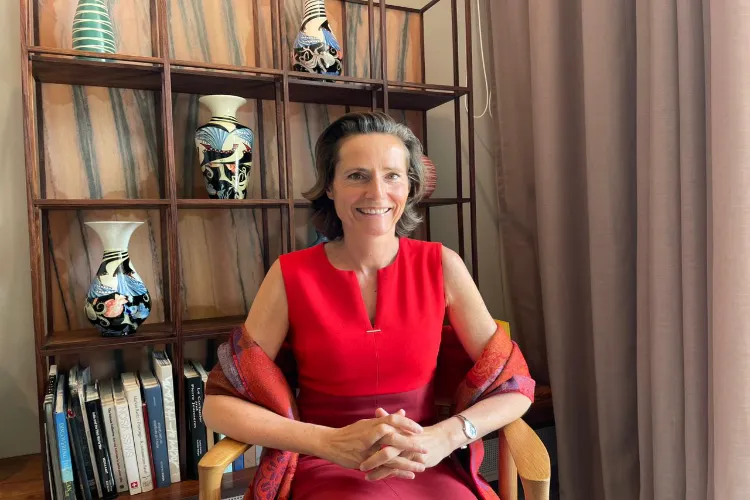
GESDA's director general, Marilyne Andersen, who is currently visiting India to take part in the Raisina Dialogue here, also said that science and diplomacy have to work together, in the sense that they "influence positively" each other, or are needed by each other.
In an interview with PTI at the Swiss Embassy here on Friday, she spoke about the vision of the foundation set up in 2019, and its mission to anticipate emerging scientific discoveries and translate them into concrete actions for the benefit of society.
Andersen, trained as a physicist, has been conducting pioneering work at the interface between science and engineering, design, society and culture.
Illustrating how science and diplomacy can come together in a meaningful collaboration, she cited the establishment of CERN in the 1950s as a premier global institution for research on particle physics.
"There is an example that probably everybody knows already, which is not related to GESDA directly, but it's a partner of GESDA, CERN. CERN was born out of international cooperation, bringing all the scientists and all the science together to look at the origins of the universe and understand where humanity comes from in the broadest sense. So, this is a very strong and powerful example of a successful merge of science and diplomacy," Andersen told PTI in an interview.
She said at GESDA, they were actually currently working with CERN in the field of quantum.
"So, this is the next frontier of information encoding, which will work hand in hand with artificial intelligence, which is something that is very much talked about, and is in a very quickly rising trend as well. And quantum has this very special nature... quantum computers don't exist formally yet, but lab experiments are being run. There are industries and businesses working on quantum computing already," Andersen said.
But that means one can still work with the diplomacy sector to prepare for what this will mean for the world later, she said, and cited GESDA's motto -- "Use the Future to build the Present" -- to buttress her point.
"And this is what we incubated at GESDA in the name of the Open Quantum Institute together with CERN. It's supported by the private sector, through UBS, the Swiss bank. The idea there is to make sure that when quantum computing is out, it will be accessible to all. There will be enough effort to build the capacities to embrace it. And also that it will bring around the table all the actors that are needed," she underscored.
The embassy on Friday evening hosted an 'Anticipatory Leadership Lab' in collaboration with the GESDA and the office of the principal scientific advisor to the Government of India.
It brought together around 60 leaders from the fields of science, governance, diplomacy, business and civil society in a structured, multi-stakeholder dialogue to strengthen their collective capacity to anticipate and govern emerging scientific and technological breakthroughs, officials said.
The GESDA Science Breakthrough Radar -- an annual report that maps the research advances expected to transform society and the planet over the next five, 10 and 25 years -- was also discussed at the event.
Andersen said quantum computing as a next frontier science is highlighted in GESDA's Radar.
The Open Quantum Institute (OQI) is part of GESDA's initiative "Quantum for All". It is a multilateral governance initiative that promotes global and inclusive access to quantum computing and the development of applications for the benefit of humanity, according to the website of the foundation.
Born at GESDA and supported by UBS, the OQI is hosted at CERN for the pilot phase (2024-2026).
"Recognising the urgent need to align quantum innovation with societal impact, GESDA convened world-leading scientists, diplomats, private sector partners, and multilateral institutions to co-design the OQI. Today, GESDA's commitment continues through GESDA's strategic guidance in the institute's governance, co-chairing its Advisory Committee, and leading the diplomatic engagement," it said.
The statement also underlined that India has played a "pioneering role" as a member of the advisory committee of the OQI - GESDA's anticipatory governance initiative designed to address the societal implications of quantum technologies before they reach full maturity and widespread deployment.
Andersen said science can provide the "evidence-based foundation" for decisions to be made or for what is important to look at, either now or in the future.
"Just that we look more into what is coming next, in terms of emerging science. But for that, decisions now already also have to account for this. And this merging of the two worlds is also important, or its reverse, is that science benefits from international cooperation and from different countries working with one another, or different sectors working with one another.
"So, it is a mutually beneficial relationship that has to sort of flourish through evidence-based grounding of policymaking," she said.
READ MORE: Mumtaz Thaha, Thrissur’s first Muslim woman Councillor
GESDA was established by the Federal Government of Switzerland, the Republic and Canton of Geneva, and the City of Geneva to ensure that Switzerland and Geneva remain a prime location for multilateralism.
Inspired by the long-standing tradition of International Geneva as a hub for diplomacy, science, and multilateral cooperation, GESDA operates at the intersection of science, diplomacy, and societal impact.








.webp "President Droupadi Murmu")





.webp)