.webp "Holi being played in the premises of Dewa Sharif dargah")
Ghulam Rasool Dehlvi
Every spring, the town of Dewa in Barabanki district, just 25 kilometres from Lucknow, comes alive with the colours of Holi. At the dargah of 19th-century Sufi saint Haji Waris Ali Shah, the festival is far more than playful colours. It is celebrated as Eid-e-Gulabi, the “Pink Eid,” a spiritual expression of love, devotion, and interfaith harmony that draws thousands of Hindus and Muslims together in an age-old syncretic Sufi tradition.
Holi at Dewa Sharif embodies the concept of “Allah’s colour” or Sibghatullah, as mentioned in the Holy Quran, where colours serve as a metaphor for divine guidance and spiritual transformation. Just as dye permeates cloth, divine love and faith colour the heart and actions of the believer. Each splash of gulal and abeer reminds participants that spiritual joy and surrender to Allah transcend creed and community.
Dewa Sharif is known for its Hindu-Muslim unity and social bonhomie. The shrine’s sajjadanashins (custodians) wear traditional yellow robes (pitambar), while devotees shower one another with rose petals, gulal, and abeer, creating a riot of colour infused with devotion. The Holi celebration at Dewa Sharif is believed to be over a century old.
Actor-politican Raj Babbar offered prayers at the dargah on the ocassion:
एकता, भाईचारा, सद्भावना और सौहार्द के प्रतीक देबा शरीफ (बाराबंकी) के दर पर.. अमन-चैन और प्रेम के लिए मांगी दुआ.. pic.twitter.com/AbAz6kYAGj
— Raj Babbar (@RajBabbar23) September 17, 2016
Wamiq Warsi, head of Halqai Fuqrai Warsi Astana Aliya Dewa Sharif, explains. “Dewa Sharif is a place of universal brotherhood and peace. The message of Paigham-e-Mohabbat (message of love) from Haji Waris Ali Shah has been clear since his time: whoever loves us belongs to us. Thousands come to celebrate Holi here, and this tradition continues to inspire unity and harmony today."
The day begins with the Holi juloos (procession), starting at Qaumi Ekta Dwar. Colourful flowers, chants, and devotional music accompany the march as it winds through the town. By noon, the procession reaches the mausoleum of Haji Waris Ali Shah, where devotees play Holi with rose petals, gulal, and abeer, creating a spectacle of joy and spirituality.
Anurag Tiwari, a local participant, says: "Devotion and love are part of all faiths. At Haji Sa’ab’s dargah, we express our love for an elder who has watched over us for more than a century. Here, we share our joys, fears, and grief with him, and the colours remind us of the spiritual unity that binds us all."
دیوا شریف میں ہولی۔ جب رنگ مذاہب سے بالاتر ہو کر دلوں کو جوڑ دیتے ہیں#holi #devasharif pic.twitter.com/6rM5pi5Swc
— Awaz-The Voice URDU اردو (@AwazTheVoiceUrd) March 5, 2026
Born into the 26th generation of Imam Hussain, Waris Piya was a revered Sufi saint and the founder of the Warsi Silsila, a major lineage in modern Indian Sufism. He travelled widely, performed Hajj multiple times, and visited Europe, meeting dignitaries including the Sultan of Turkey, Bismarck of Berlin, and Queen Victoria.
Waris Piya is known for his inclusive spiritual guidance, welcoming disciples from all backgrounds. He participated in Hindu festivals like Holi, emphasising that love, devotion, and spiritual connection transcend religion. His disciples included Hindu kings, zamindars, and scholars, standing alongside Muslim bureaucrats and jurists, all spiritually united under his guidance.
He also encouraged gender inclusivity, allowing women to participate fully in the dargah.
Now, contrast between India’s inclusive culture and countries where religious hatred and internal conflicts divide communities. By sheer mercy of Allah, we live in India, where the culture involves playing Holi with colours, not blood.
Muslim societies around the world must learn from India’s example of unity through festivals like Holi, invoking the teachings of Shri Ram and Shri Krishna—who are considered by many Sufi mystics as early prophets of Islam in India—as models for peace and harmony.
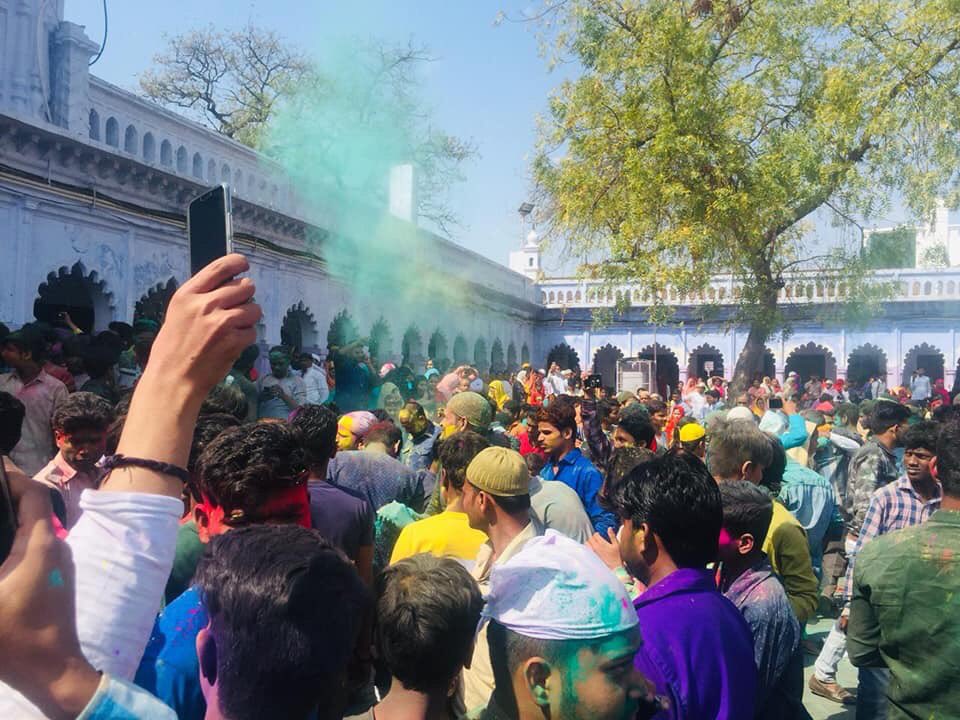 Scene of Holi in Dargah Dewa Sharif
The celebration of Eid-e-Gulabi at Dewa Sharif is not just a festival of colours; it is a living embodiment of our national and cultural values of unity, devotion, and love beyond boundaries. In today’s India, where religious divisions often catch the imagination, this celebration offers a powerful lesson in communal harmony and interfaith respect.
Holi at Dewa Sharif reminds us that joy, devotion, and love are universal, binding communities in shared celebration and spiritual consciousness.
The Sufi Holi or Eid-e-Gulabi is more than a festival; it is a festival of the soul, where human hearts, like colours, merge into a tapestry of divine love, echoing the Sufi ideal of Paigham-e-Mohabbat—a message of universal unity that continues to inspire generations. In a world often divided, Holi at Dewa Sharif is a reminder of the Qur’anic teaching:"The believers are but brethren." (Surah Al-Hujurat 49:10)
ALSO READ: Kausar Jahan's election as Hajj Committee chief defied stereotypes
More to the point, the Qur’an also reminds believers of the universal guidance of Allah: "And We have made you into nations and tribes so that you may know one another." (Surah Al-Hujurat 49:13)
Ghulam Rasool Dehlvi is an author and scholar of Indian Sufism.

.webp "Union Home Minister Amit Shah")