Kolkata
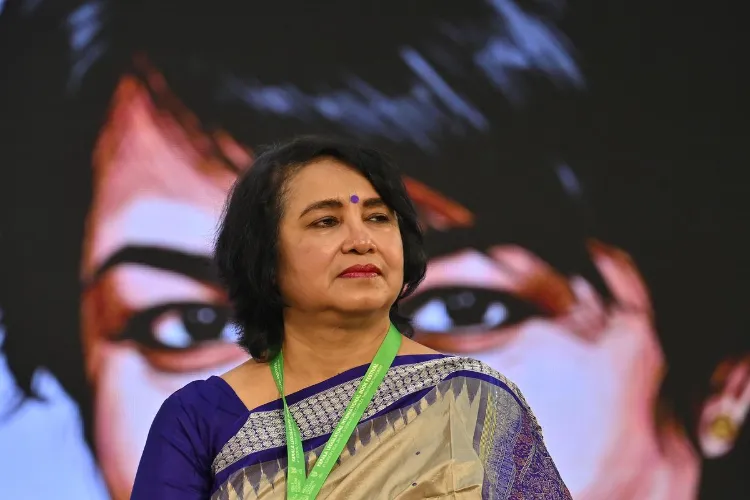
Exiled Bangladeshi author Taslima Nasreen on Friday returned to Kolkata after nearly 19 years, describing the visit as an emotional homecoming to a city she still considers her own.
Her arrival comes ahead of a literary event on Saturday that has acquired political resonance under West Bengal's new BJP government.
With folded hands, Nasreen greeted those waiting to receive her at the Netaji Subhas Chandra Bose International Airport and said, "I am feeling very good to be back."
Her return marks her first visit to Kolkata since November 2007, when she was compelled to leave the city following violent protests over her writings, ending what she had often described as the closest thing to home after her exile from Bangladesh.
The author will make her first public appearance here at an anti-fundamentalism literary programme at Rabindra Sadan, where she is expected to recite poetry.
Chief Minister Suvendu Adhikari and renowned author Shirshendu Mukhopadhyay are among those expected to attend.
Though conceived as a literary gathering, the event has inevitably assumed political significance, coming months after the BJP formed the government in West Bengal and amid renewed debate over freedom of expression, secularism and the state's approach towards religious sensitivities.
Ahead of her visit, Nasreen had told PTI that returning to Kolkata felt like coming back to "my own country".
"I feel as though I am returning to my own country. Bengal has never been divided in my heart by a border or a barbed-wire fence. The door to the eastern part of Bengal remains closed to me, so for now, this part of Bengal is my home," she had said.
She said she was returning "with joy, but also with pain", recalling that Kolkata had given her a home, friends, readers and a sense of belonging before she was forced to leave.
Calling the visit more than a personal homecoming, Nasreen said it symbolised the return of a voice that religious fundamentalists had once tried to silence.
She also thanked the organisers and the present West Bengal government for facilitating her visit and providing security, while asserting that a writer's freedom should remain a fundamental right irrespective of the ideology of the government in power.
Nasreen's return revives one of the most debated chapters in the state's contemporary political and cultural history.
After fleeing Bangladesh in 1994 following death threats over her novel 'Lajja', she settled in Kolkata in 2004, embracing the Bengali-speaking city as her cultural refuge in exile.
That association ended abruptly in November 2007 after violent protests erupted over portions of her memoir 'Dwikhandito', which had already been banned by the then Left Front government in 2003 for allegedly hurting the sentiments of sections of the Muslim community.
As the protests escalated and the Army had to be deployed to restore order in parts of Kolkata, the Buddhadeb Bhattacharjee government asked Nasreen to leave the city.
She was shifted to Jaipur and later Delhi before eventually moving abroad, though she repeatedly expressed her desire to return to Kolkata, if only to participate in literary events.
For nearly two decades, that return remained elusive despite periodic appeals from writers and civil society and occasional political interventions.
The issue resurfaced nationally last year when BJP Rajya Sabha MP and current West Bengal BJP president Samik Bhattacharya urged the Centre in Parliament to facilitate her return, describing Nasreen as a fearless voice against Islamist fundamentalism.
The BJP has since sought to portray her homecoming as the correction of what it calls a long-standing failure of successive Left Front and Trinamool Congress governments to defend free speech in the face of religious pressure.
Those governments, however, had maintained that administrative decisions taken in 2007 were dictated by the need to preserve public order amid escalating communal tensions.
Organisers have maintained that Saturday's programme is intended to celebrate Nasreen's lifelong opposition to religious fundamentalism and reaffirm the principle of freedom of expression rather than serve as a political platform.
Even so, the symbolism surrounding her return is difficult to miss.
READ MORE: CWG medalist Mohammed Basil once sprinted alongside normal athletes
Nearly nineteen years after she left a city that had become both sanctuary and exile, Taslima Nasreen is back in Kolkata under a dramatically altered political dispensation, turning what is formally a literary event into a moment that also reflects the changing vocabulary of politics, secularism and free speech in West Bengal.

_(1)_(1).webp "Jagannath Rath Yatra")







.webp "Jammu and Kashmir Chief Minister Omar Abdullah")
.webp "Hirakud Dam, Odisha")
.webp "Supreme Court of India")

_(2).webp)