 Kingshuk Chatterjee
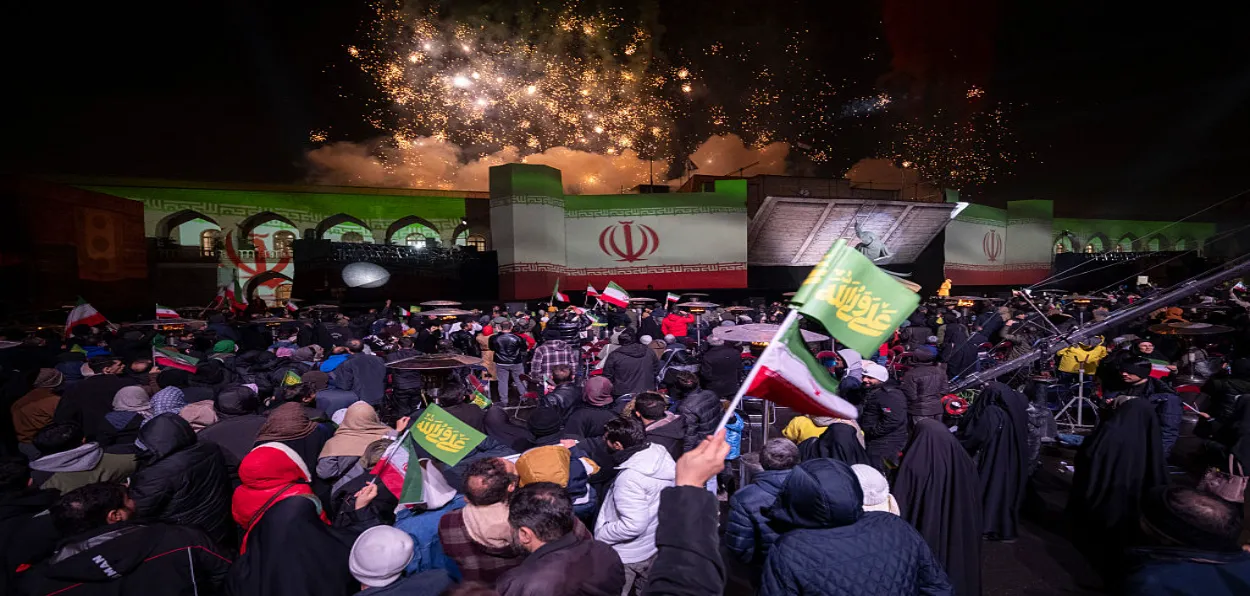
Iranians have taken to the streets once again, and as protests are growing across the country, it's bothering the government. Also, while the crackdown on protesters is going on, at least a section of the regime is trying to handle the public disaffection with consideration. Whether the disturbances snowball into something bigger or not remains to be seen, but they are likely to undermine the regime’s powers of endurance at a time when its chips are down after being badly bruised in war with Israel.
The present round of protests was triggered by sharp falls in the price of Rial (currently trading at 1.45 million rial to 1 USD), and with some tweaking of the preferential currency exchange rates, which are allowed for certain commodities and organisations, and are considerably lower than the market rates.
People feel that such preferential treatments have always benefitted only a handful of people due to corruption or abuse of power. Heavily dependent on the import of many commodities of daily use, Iran’s economy has been subjected to sanctions by the USA (since 1979) and an even more crippling regime by the US and EU together, on suspicion of Iran’s nuclear programme since 2010.
Despite the partial and temporary reprieve provided during 2015-18 under the JCPOA, the Iranian economy and its people have been subjected to extreme hardship. The strong inflationary pressure has caused double-digit inflation for the last several decades in the Islamic Republic, downgrading people's purchasing power.
The current round of protests began when the merchants of the bazaar (i.e. bazaaris) of Tehran (the biggest wholesale market in the country) called for a strike against the persistent weakening of the rial. They were quickly joined by bazaaris of the provincial centres (viz Esfahan, Shiraz, Qazvin) followed by Iranians from more than 75 towns from 23 of the 31 provinces, with the youth in the forefront.
The present round of protests is the fourth in the last two decades against the ruling dispensation. The first major manifestation of popular disaffection was in 2009, when President Mahmoud Ahmadinejad won a highly controversial election. At that time, a large section of urban Iran (with the largest demonstrations in Tehran) came out against what they called the Entekhab-e gumshudeh (missing election), and were brought down firmly.
A second series of protests broke out in the winter of 2017-18 across more than 80 cities and towns in virtually all the provinces of the country, against rapidly rising prices and persistent economic hardship during the second term of President Rouhani. Subjected to brutal subjugation, these protests caused the death of over 1,500 people.
The most severe round of popular unrest in the Islamic Republic then occurred after the death in custody of Mahsa Jina Amini, arrested on charges of infringing the laws of mandatory hijab. The anti-hijab protests (as they are often called) spread across the country in more than 140 cities and towns, resulting in fewer deaths (551) but far more arrests (over 19,000), and involving the broadest mobilisation of different classes of people since 1979.
The present round of protests seems to be the work of a similar broad social coalition, almost as if resuming the unfinished business of 2022-23, sensing the weakness of the regime left vulnerable by the 12-Day War with Israel in June 2025. Beginning on 28th December 2025 and causing around forty deaths as this piece went to the press, they are distinctly ominous in one respect despite their lower casualties. Unlike any of the three previous protests, the ongoing turmoil in the Islamic Republic was kicked off by the bazaaris (traders), a bastion of support for the Shi‘i ‘ulema.
The social alliance between the two was a major factor in the ‘ulema’s ascendancy to political power during the Islamic Revolution of 1979. Thus, while individual merchants may have participated in the disturbances of the previous years, the bazaaris as a class have tended to stay away from protests against the Islamic Republic.
Equally significantly, whenever political change has successfully come about in modern Iranian history – viz, during the tobacco protests of 1892, the MashrutehRevolution of 1906, the Oil Nationalisation crisis of 1952 and the Islamic Revolution of 1979 – the bazaaris have tended to play important roles in favour of change by joining the forces of opposition. It is tempting to argue that the absence of the bazaaris during the protests of 2009, 2017-18 and 2022-23 may have been a factor in their successful subjugation.
It is probably being mindful of this very factor that clerical voices in Tehran have simultaneously tried to harshly crack down on the protesting youth in the cover of the night, while the Reformist President Pezeshkian tried to appease economic grievances of the bazaaris by abolishing preferential exchange rate systems, and providing financial support across the board. This would seem to be in the hope of keeping the bazaaris from joining forces with the other protesters with a more radical agenda of overthrowing the regime.
The point is, there is no certainty that this would work. During the 2017-18 protests, for the first time, the ire of the people began to be directed against the Supreme Leader, Ali Khamenei, with slogans being shouted “Marg baDiktatur” (Death to the Dictator). The same slogan rang out from the youth and women of Iran alongside the cries of Zan, Zindagi, Azaadi (Woman, Life, Freedom) in 2022-23. Quite ominously, from the very first day of the bazaar’s entry into the protests this time, the cries of “Marg ba Diktatur” are ringing out yet again alongside calls for “Azaadi.”
ALSO READ: Nawabzada Mohammad Asif Ali shows the humble side of royalty
The sanctions-ridden economy has left the bazaar badly bruised and grumbling against the regime. If these traditional allies of the ‘ulema and the regime are not won over very soon, the repercussions could be quite serious once they close ranks with those opposed to the regime.
Kingshuk Chaterjee is Faculty, Department of History, Calcutta University