 Saquib Salim
The Indian media, in the last few weeks, is discussing Pakistan’s claims on Harappan, or Indus Valley Civilisation. Contrary to popular notion, this flirtation with pre-Islamic history is part of its perennial confusion with history since its formation 79 years ago. At times Pakistanis own their pre-Islamic past while on other occasions they claim Muhammad Bin Qasim was the first Pakistani. However, whatever they believe, their dislike (read hate) for Vedic Hindu civilisation has remained constant.
A nation state has to draw its legitimacy from an imagined shared history and culture on the basis of which they can claim a separate identity and hence polity, a point further reiterated by Iranian exploits in the recent war.
Pakistan also needed a ‘shared history’ or civilisation which could act as glue for its nationhood. For Pakistan, this task was difficult. The history its people shared was also a history of India, which in turn was a history of Hindus. The whole idea of Pakistan as advocated by the Muslim League was based on an opposition of Hindu culture and a fear of ‘Hindu Raj’. So, any shared history with Hindus de-legitimises the very foundation of Pakistan.
Despite all this, Pakistan took its first shot at claiming a civilizational legitimacy which, according to them, was not shared with the history of Hindus of India, soon after coming into existence.
Soon after India relieved Mortimer Wheeler from the post of Director General of the Archaeological Survey of India (ASI) in 1948, Pakistan offered him a post of Archaeological Adviser to the Government of Pakistan. One of the tasks given to him was to claim the Indus Valley civilisation for Pakistan and separate it from Hindu culture. Wheeler came out with a book, Five Thousand Years of Pakistan: An Archaeological Outline in 1950.
Stuart Piggott, another British archaeologist, later wrote, “His Five Thousand Years of Pakistan (1950) was, as its title makes clear, admittedly propaganda.” No wonder Fazlur Rahman, the Education Minister of Pakistan, wrote the preface of the book.
 Haprappan Civilisation excavations
In the book, Wheeler claimed, “Pakistan is a new Islamic state but is, nevertheless, like its older neighbours, a product of historical processes of which Islam itself is only the most recent and emphatic.”
The book, which was commissioned by the Government of Pakistan, argued that ancient history and not the advent of Islam would define the nation. But then, how would one alienate this history, and even later one, from Hinduism, the opposition to which is the very foundational stone of Pakistan.
To counter this paradox, the book argued, “And from time to time the pendulum has swung the other way. Enterprising Mauryas and Guptas from the Ganges valley have thrust westwards towards the Hindu Kush, and a Gangetic faith (read Hinduism) has pervaded along that path into the midst of Asia. But on the whole these plainsmen have not greatly troubled our Western Pakistan. Not that courage was innately lacking. To underrate the recorded valour of the Hindu defenders of Sind in the eighth century A.D. would be to underrate the achievement of their Arab conquerors.
On occasion, well led, the Hindu warrior fought well. Save, however, under the rare stimulus of imperial ambition, he had no great concern with the lands which lay towards the hills and the desert. He suffered no land-hunger in his own fertile plains; his religion was not of the proselytising sort; and when, as a man of commerce and an unprovocative coloniser, he looked abroad, he tended to look eastward, to rich jungle-countries comparable with his own. Thus, it may be interpolated, Western Pakistan has received mostly from the north and west, and has received constantly from those directions. In that historical fact is deeply rooted the individuality which has now expressed itself politically.”

With these arguments, Wheeler tried to establish that the region where Pakistan now stands received more from Persia or Iraq rather than a ‘Hindu’ India which lived in present U.P, Bihar or beyond. He further contended that Pakistan “is marked out as an integral unit no less by nature than by men.” For him, the Arabian Sea in the south-west, Balochistan and Himalayas in the west and north, and Thar desert in the south-east marked the natural boundaries for Pakistan.
Statue of Priest King
The founders of Pakistan wanted to own up to the pre-Islamic past sans Hinduism to claim a civilizational legitimacy. Wheeler did the job where he tried to prove that people in the region of Pakistan, viz., Sindh, Balochistan, Punjab, Gujarat, etc. had more contacts with people from Persia and Arab lands than with people from the Indo-Gangetic plains, simply put Hindus.
Later, in the mid-1950s, there was a greater thrust on Islamization of Pakistan by the military regime. Under the influence of Jamat-i-Islami and other such organisations, Pakistan concentrated on erasing any history which predated Islam. The history in textbooks started with Muhammad Bin Qasim, an early 8th-century Arab conqueror, in Sindh. Pakistan’s history started with Qasim and ended with M. A. Jinnah ‘winning’ that country from Hindus.
Pakistani Anthropologist, Haroon Khalid, in an article published in 2018, points out about the history writing in Pakistan, “India is projected to be an "impure," "uncivilised" land that first saw "light" with the arrival of the Muslims…..
"The situation worsened in Pakistan in the 1970s under Zulfikar Ali Bhutto...The new populist state emerging under Bhutto, instead of being reflective of changing circumstances, adhered to a reactionary approach. History as a subject — which included stories of Ram, Buddha, Ashoka and Kanishka along with Mahmoud Ghaznavi and the Mughals — was abolished and Pakistan Studies was introduced, with the sole purpose of instilling a Pakistani identity.”
It is the exact time when Pakistan started turning back to Indus Valley civilization. Not as a history of its people but to construct a history which can counter the Hindu past of its people.
Khalid writes, “In this new order that emerged, the Indus Valley civilisation acquired a unique significance, for this was not as "Hindu" as some of the other historical sites and buildings in the country…. At the time of the Indus Valley civilisation, Brahminism, popularly associated with Hinduism, had still not emerged…. Divorced from their Hindu influence, these cities became acceptable. Their archaeological digging continued while the museum at these sites remained open.”
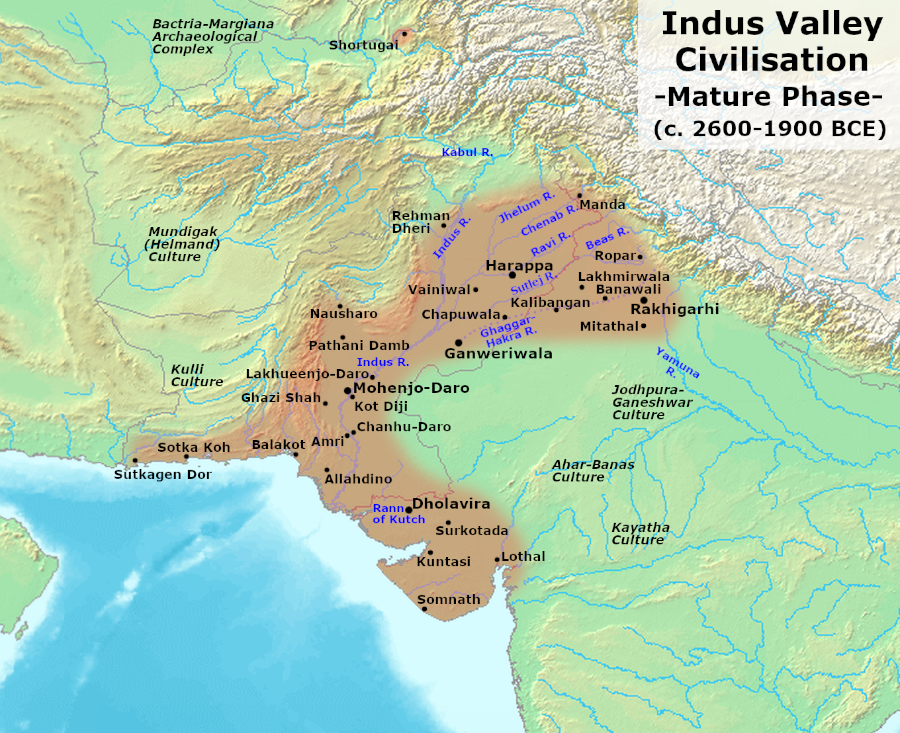 Map of Indus Valley civilisation
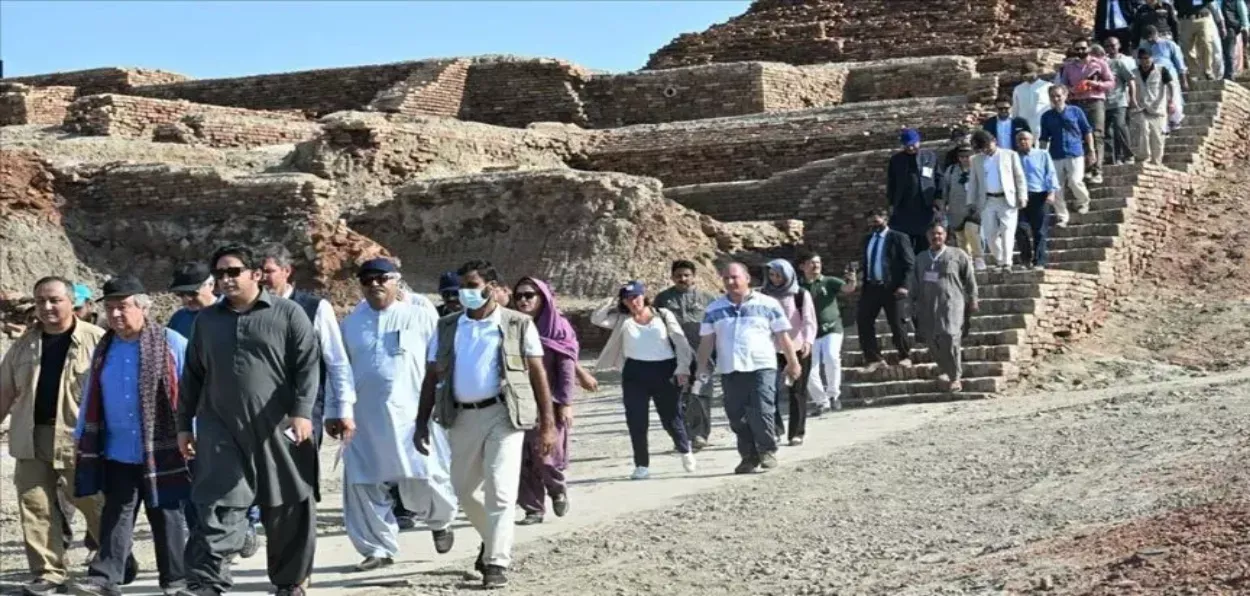
It is no coincidence that the grandson of Z. A. Bhutto, Bilawal Bhutto, invoked the past of Indus Valley civilisation most vehemently in recent years. In 2014, he organised a Sindh Festival at the Mehenjo-Daro site and since then kept calling Pakistan a custodian of the Indus Valley civilisation.
One of the most influential political propaganda works on this subject after Wheeler is a book written by Aitzaz Ahsan, a very senior politician and former minister from Bhutto’s party. Published in 1996, The Indus Saga and The Making of Pakistan had a deep impact on the psyche of Pakistan since then. His arguments, in a nutshell, can be put as: i) The Indus Valley Civilisation area was confined to modern-day Pakistan, and historically, except for a brief period in the last 5000 years, this area and present India were never part of the same polity. ii) The present Pakistan is a geographical unit distinct from India. iii) Indus Valley civilisation was not Hindu and Vedic geography is different from this region. iv) Indus Valley civilisation was destroyed by Aryans (Hindu) raiders.
The book, according to Ahsan, was written “to address itself to the controversy concerning the Pakistani's identity. It is about what many have called the Pakistani's 'identity crisis'.” And, I must appreciate his honesty that he didn’t ask his reader to take the book seriously. Ahsan said, “I cannot claim to be a historian, less so a historiographer….. Other historians.may come down heavily upon me for treading in the territory of their discipline. But that, besides being their prerogative, is a jeopardy that I cannot avoid in my quest for the roots of the ancient civilisations that are reflected today in the material and tangible shape of Pakistan.”
Ahsan’s greatest contribution, if we can call it a contribution in a real sense of the word, was the introduction of a new identity called ‘Indus person’. He did not call any Muslim Pakistani, as claimed by Jinnah with the slogan - “Pakistan ka matlab kya, La Ilaha Ilallah” but only those people who can trace their roots to the Indus Valley civilisation. For him, it is a living culture that existed along with Hindu culture for at least 3000 years.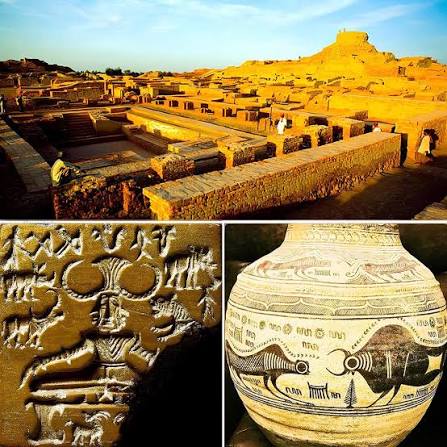 Relics excavated from the Hrappan Civilisation
We must read what Ahsan wrote about his idea. He said, “In attempting to piece together the Indus person, however, it is necessary not merely to define his own attributes. It is also essential to describe how he is different from others. The features and attributes broadly common to all Indus persons, inter se, would make them a distinct nation only if these were also dissimilar to the · features and attributes of other people, at least other people with whom they had been interacting.
"In 'assembling' the Indus person of today (the Pakistani) it is necessary, therefore, not merely to show the distinctness of Indus as a geographical region, it is also imperative to address the question how the Indus person is different from the European ruler whose governance he rejected and from the Hindu community with whom he was not prepared to coexist in one single state encompassing the entire subcontinent…… the Indus region has maintained a rare individuality and distinctness. The Indus state is thus a primordial and natural state with its roots in prehistory. It is no freak or accident of recent circumstances, nor the product of any 'divide and rule' policy of alien rulers. In other words, and regardless of the uncertainties of history and of geopolitical diplomacy and conflict, there always has been and always will be a Pakistan.”
You can find several Pakistanis subscribing to these ideas, where they trace Indus Valley culture to medieval times if not to the present.
One should read Romila Thapar, one of the authorities on ancient Indian history, on this theory that some Aryan (read Hindus) invaders destroyed the urban centres of the Indus Valley.
She writes, “If the Aryans had conquered northwestern India and destroyed the cities, some archaeological evidence of the conquest should have been forthcoming…. The decline of the Indus cities is generally attributed to extensive ecological changes…. The earlier hiatus between the Indus civilisation and the Vedic culture is no longer acceptable, and the Indus civilisation now has to be seen as the bedrock of early Indian culture.”
It is a fact that the theory that an invading Aryan race destroyed Indus Valley civilisation stands vindicated now.
ALSO READ: Sharifa Khanam built a court of hope for Muslim women
Another factor, which Ahsan and others should know, is that the sites of the Indus Valley civilisation are not limited to Pakistan. Several cities of this civilisation, including as big as Rakhigarhi, have been excavated in what we call the Indo-Gangetic plains.
In the long run, Pakistan is not doing justice to history by trying to silence its Hindu past. But this narrative will be even more dangerous for its muhajir community, who had migrated to Pakistan from U.P, Bihar, M.P, Hyderabad, etc. in 1947. By claiming a distinct, unbroken culture and an Indus identity, Pakistan is laying the ground to exclude all those who had chosen the country in the name of Islam and do not qualify as ‘Indus Person’. In its blind hate for a Hindu past, Pakistan is on a path to commit a horrendous blunder.

_(1).jpg "Visitors gather at the Santosh Mitra Square Durga Puja pandal, themed on the 150th anniversary of Vande Mataram and its historic role in India's freedom movement, ahead of the festival, in Kolkata")
.jpg "Gujarat’s women entrepreneurs bring their craftsmanship to life during Navratri")









.webp)