.webp "Elderly in Kerala (For representational purposes only)")
Sreelatha M/Thrissur
Kerala, where nearly one in every five people is elderly, is the only Indian state with a comprehensive policy dedicated to senior citizens, particularly palliative care—one of the most pressing needs of an ageing population. With projections indicating that one in four Keralites will be over 60 within the next decade, the state is confronting a demographic transition unlike anywhere else in India.
Kerala is also among the few places in the world where government-supported palliative care is available to people living with incurable illnesses. Senior citizens form a major beneficiary group of these services.
The issue is part of the election manifestoes of the political parties. This is why the Congress-led UDF government which took charge this year, it announced setting up of a Department for the Elderly.
The state has pursued elderly welfare for nearly two decades. Its first Old Age Policy was introduced in 2006, followed by successive revisions. The latest State Policy for Senior Citizens was approved by the previous Left Democratic Front (LDF) government in February 2026, which also enacted the Kerala State Elderly Commission Act and prepared a long-term action plan under Vision 2030.
The newly elected United Democratic Front (UDF) government has since taken a significant step by creating a dedicated Department for Elderly Care and increasing the monthly social security pension from ₹2,000 to ₹3,000. However, it is yet to unveil its broader vision for the department or explain how it intends to build upon the existing framework.
Officials from the new department were unavailable for comment.
Former Social Welfare Minister R. Bindu, who led the previous government's initiatives, said she hoped the new administration would carry forward the work already completed.
"The culture of consumerism promotes use-and-throw. Elderly care, however, is a social responsibility," she said. "We introduced several schemes and prepared a detailed Vision 2030 action document for social justice, with elderly care as a major component. Extensive consultations went into these documents, and the new government can readily build upon them."
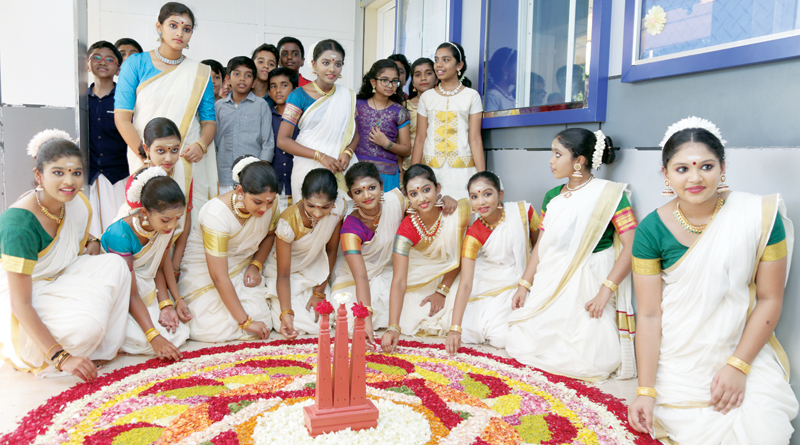 Onam time: Young women make a Pookolam
According to Bindu, the central objective was to create a strong support system for senior citizens.
"The elderly need social support and assisted living," she said.
She pointed out that senior citizens broadly fall into two categories—those who can afford care and those who cannot. While the government must shoulder responsibility for the economically vulnerable, those who can pay should be served through partnerships between the public and private sectors.
Kerala's successful collaboration between government agencies and civil society organisations in palliative care, she suggested, could serve as a model for elderly care as well.
For noted demographer and migration expert S. Irudaya Rajan, chairman of the International Institute for Migration and Development, Kerala's ageing population is not merely a social issue but also a political reality.
"Today, elderly voters outnumber every other major vote bank in Kerala—whether Christians or individual Hindu communities," he said.
"I have often said that if the Congress wanted to return to power, it needed the support of elderly voters. They constitute a formidable electoral force."
Political parties, he observed, may think in five-year electoral cycles, but demographic change unfolds over decades.
Rajan identifies two distinct groups among Kerala's elderly: those who have spent their entire lives in the state and those returning after working elsewhere, particularly in the Gulf, to spend their retirement at home.
"Any meaningful intervention for senior citizens translates into electoral support," he said. "During the Covid-19 pandemic, elderly voters largely backed the LDF. The Congress appears to have recognised the significance of this constituency in the recent election."
According to Rajan, Kerala's elderly already constitute around 20 per cent of the population and are expected to account for 25 per cent within a decade.
"Whatever you do for the elderly matters," he said.
Why Kerala Is Growing Older
Rajan attributes Kerala's ageing population to three factors: increasing longevity, falling fertility and sustained migration.
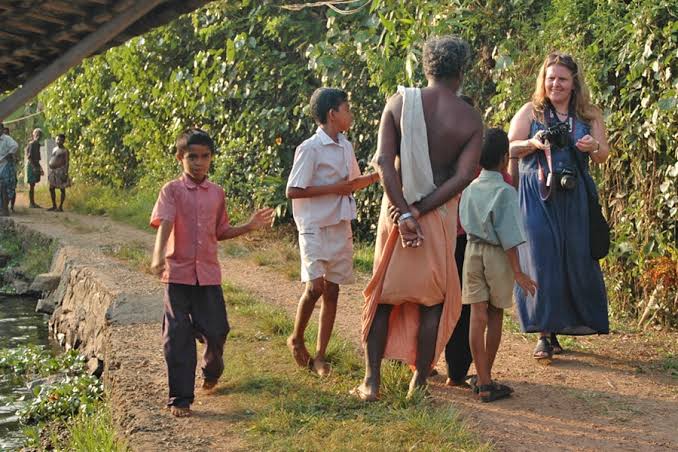 An elderly man watching children with a foreingn tourist
Improved healthcare and living standards have significantly increased life expectancy. At the same time, fertility has fallen well below replacement levels.
"Nearly 40 per cent of couples now choose to have only one child," he explained. "A couple that should ideally be replaced by two children is now being replaced by just one."
The third factor is migration.
Around two million working-age Keralites live in Gulf countries, while large numbers of young people continue to migrate abroad for education and employment. As a result, many homes are occupied only by elderly parents—often by a single elderly woman living alone.
After four decades of research at the Centre for Development Studies, Rajan believes Kerala today has a better understanding of its demographic future than any other Indian state.
"I've spent years creating awareness about this demographic shift," he said. "Our surveys are now routinely used for planning government initiatives, including elderly budgeting."
He had earlier predicted that Kerala's population growth would turn negative by 2026 but has since revised that estimate.
"Large-scale migration from other Indian states will keep Kerala's population stable until around 2041, even though ageing will continue," he said.
Loneliness: The Biggest Illness
While healthcare remains a priority, Rajan argues that loneliness has emerged as the greatest challenge facing Kerala's elderly.
About five per cent of senior citizens live completely alone, while another 15 per cent are elderly couples with no younger family members at home. Nearly 30 per cent of the state's elderly population, he estimates, requires sustained social protection through measures such as meals-on-wheels, palliative care, mental health outreach and community support.
He welcomed the UDF government's decision to establish a dedicated Department for Elderly Care, calling it a significant institutional reform.
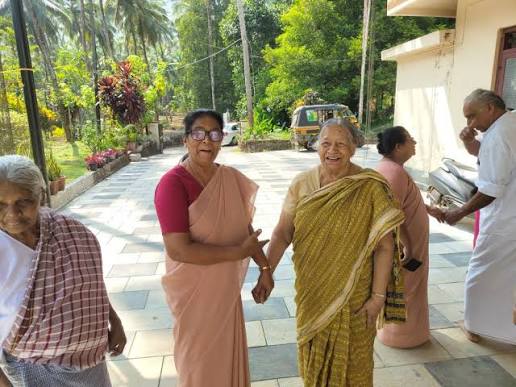 Women in Kerala
"The first task should be identifying the most vulnerable among the elderly," he said.
Rajan cautions against viewing longer life expectancy as an achievement in itself.
"Living longer is not always a blessing," he said, pointing to cases of suicide among people in their eighties and nineties.
He recalled the words of an 80-year-old resident of Thiruvananthapuram: "All my five children live abroad. If I die, my body may remain in a mobile mortuary for four days until they arrive."
Another elderly woman told him she was simply "waiting for the final call."
"These are not people enjoying old age," Rajan said. "There is little point celebrating longevity unless we make those extra years worth living."
Kerala Must Find Its Own Model
As Kerala searches for solutions, comparisons are often drawn with Japan and European countries that have ageing populations.
Rajan rejects those parallels.
"Japan and Norway became wealthy before they grew old. Kerala is ageing before becoming rich," he said. "We cannot simply copy their models. Kerala will have to develop solutions suited to its own economic and social realities."
The encouraging aspect, he says, is that Kerala has recognised the challenge early. Initiatives such as Pakal Veedu day-care centres in every taluk, an extensive palliative care network and successive policy interventions demonstrate sustained commitment across governments.
ALSO READ: Gram Sevak Aslam Shaikh behind the most awarded Thikekarwadi Panchayat
The real challenge now is not acknowledging that Kerala is ageing. It is ensuring that its elderly can live those longer lives with dignity, care and companionship.