 Rajeev Narayan
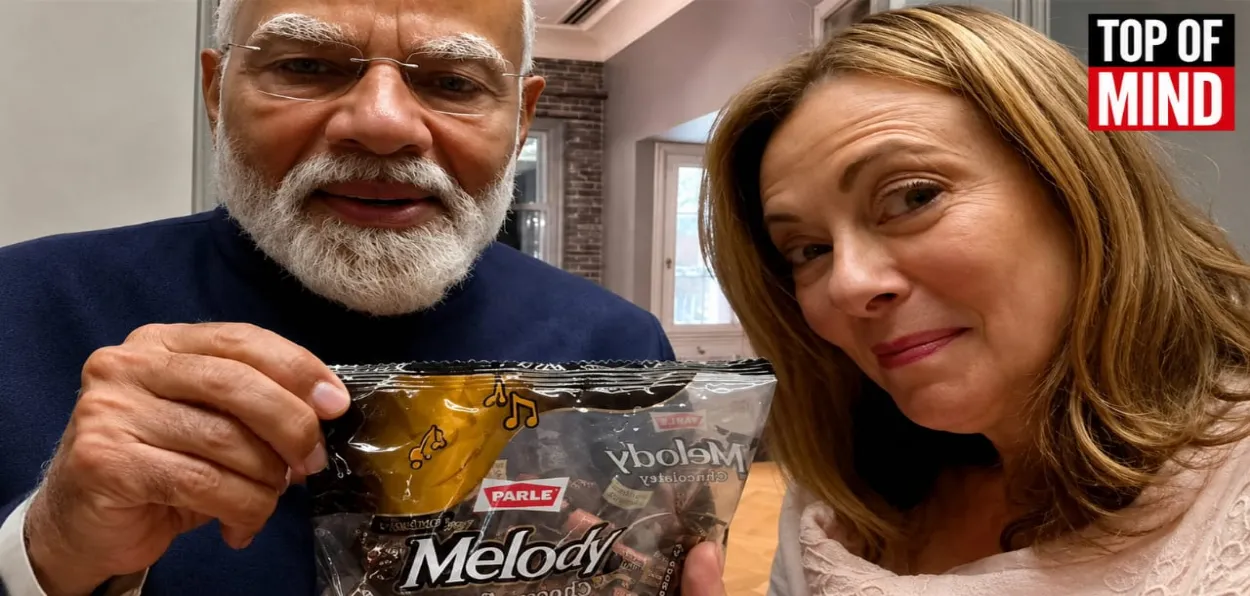
This week, the world watched a humble toffee become geopolitics. When Prime Minister Narendra Modi presented Italian Prime Minister Giorgia Meloni with a packet of India’s iconic Melody candies during his visit to Rome, social media erupted instantly. Memes flooded timelines. The now-popular ‘Melodi’ moniker – the Internet’s fusion of Melonyi and Modi – suddenly acquired a visual metaphor. A simple confectionery exchange became a global talking point.
But behind the humour and virality lies something far more consequential. What unfolded in Rome was not just an alluring public-relations moment, but a glimpse of how diplomacy itself is changing in the 21st century. For perhaps the first time so visibly, geopolitics arrived wrapped in a meme and presented to millions as shared Internet culture. The symbolism matters because power now travels not only through treaties, military partnerships or economic leverage, but also through images, atmospheres and emotional resonance.
To dismiss the ‘Melodi’ phenomenon as trivial theatre, therefore, would be to misunderstand the new grammar of international politics.
Digital Diplomacy
Narendra Modi has long displayed an instinctive understanding of this transformation. He recognises that diplomacy in the digital age no longer unfolds only within guarded conference rooms or formal communiqués. Today’s leaders operate in two arenas: the strategic and the symbolic. Giorgia Meloni appears to understand this as well. Also, the visible ease between the two leaders reflects a deep convergence between two nations that see themselves not only as economic actors but as civilizational states navigating an uncertain world order.
India and Italy elevated ties to a ‘Special Strategic Partnership’, expanding cooperation across sectors that can shape global influence in the coming times – defence manufacturing, Artificial Intelligence, critical minerals, maritime infrastructure, clean energy, innovation and education. The two nations have also outlined ambitions to deepen bilateral trade and investment. These developments may appear technical to some, but they form the true architecture of long-term strategic alignment.
Ancient Routes
Those in the know reveal that the India-Middle East-Europe Economic Corridor (IMEC) has loomed prominently over recent discussions. When realised, the corridor could reshape trade geography by linking India to Europe through the Gulf and the Mediterranean. Italy, strategically positioned at Europe’s southern gateway, becomes central to that vision.
Appena atterrato a Roma, ho avuto l'opportunità di incontrare il Primo Ministro Meloni a cena, seguita da una visita all'iconico Colosseo. Abbiamo scambiato opinioni su una vasta gamma di argomenti. Attendo con interesse i nostri colloqui di oggi, durante i quali proseguiremo la… pic.twitter.com/12yt8UipaJ
— Narendra Modi (@narendramodi) May 20, 2026
There is historical symmetry in this, too. Long before ‘globalisation’ became fashionable as a term, the Mediterranean and the Indian Ocean formed interconnected realms of commerce and cultural exchange. Indian spices, textiles and ideas travelled westward through maritime routes older than many modern nation-states. Today, amid wars, energy insecurity, supply-chain hiccups and tech rivalry, those ancient routes are again acquiring renewed strategic significance. The Rome visit thus represents more than diplomacy. It reflects the return of geography to global politics.
New Global Order
The true significance of the India-Italy partnership lies in the changing structure of the international order itself. The post-Cold War realities that governed geopolitics are weakening rapidly. American dominance remains formidable, but it is no longer cast in stone. China’s growing assertiveness has unsettled large parts of Asia and Europe, while Russia continues to disrupt global equilibrium. In turn, Europe faces internal anxieties over competitiveness, migration and political cohesion.
In such a fluid environment, middle powers are acquiring unprecedented importance. India and Italy now recognise that strategic flexibility matters more than rigid ideological alignment. Partnerships are being shaped less by old blocs and more by overlapping economic, technological and geopolitical interests.
India’s own foreign policy reflects this balancing act. New Delhi engages deeply with Washington while maintaining ties with Moscow. It strengthens outreach across Europe and West Asia without binding itself permanently to any single camp. India’s ambition is increasingly clear: to emerge not merely as a participant in global affairs, but as an independent pole in a multipolar world. Clearly, this ambition requires not only economic or military strength, but narrative sophistication too.
Power of Narratives
The ‘Melodi’ moment succeeded as it translated a complex geopolitical development into something emotionally accessible for the world. In an era shaped by collapsing attention spans and hyper-accelerated media cycles, symbolism has become strategic infrastructure. Gestures now travel faster than policy papers ever can.
Critics dismissed the episode as a ‘spectacle’, saying diplomacy risks turning into a performance in the age of social media. Such criticism misses a reality – that politics and mass culture are no longer separable. Public perception now shapes diplomatic influence as much as formal agreements do. The crucial question is whether symbolism is backed by substance.
In the case of India and Italy, the answer appears to be yes. What appeared online as a playful exchange between two leaders was layered atop serious discussions on connectivity, manufacturing, technology, maritime strategy and trade diversification. The sweetness of the moment concealed the hard realism behind it.
Concluding a very productive visit to Italy. My discussions with Prime Minister Giorgia Meloni covered a wide range of sectors. A key outcome of the visit was our decision to elevate India-Italy ties to a Special Strategic Partnership, which will add new momentum to our… pic.twitter.com/3zjtt6uVeL
— Narendra Modi (@narendramodi) May 20, 2026
This century’s geopolitical language is still being written. But some realities are unmistakable. Connectivity will matter as much as ideology. Supply-chain resilience will matter as much as military alliances. Technology partnerships, maritime corridors and critical minerals will shape the balance of power. And diplomacy itself will become inseparable from digital storytelling.
India appears to have understood this transition earlier than many others. The nation’s rise in the coming decades will depend not only on GDP growth or demographic scale, but also on its ability to shape imagination – to communicate confidence, stability and strategic purpose in a manner that resonates globally.
ALSO READ: Bakrid 2026: Farmer wishes to sell Rs 15-lakh ‘Crescent Goat’ to Salman Khan
This is why the ‘Rome Moment’ has to be viewed as more than Internet entertainment. A candy became diplomacy because diplomacy itself is evolving. The meme was not a distraction from geopolitics; it was geopolitics reframed for a digital civilisation. Behind the ‘Melodi’ lies a simple truth… In an increasingly fractured world, nations capable of combining hard strategic interests with soft cultural fluency may be the ones to shape the rest of this century.
The writer is a veteran journalist and communications specialist.
_(1).jpg "Visitors gather at the Santosh Mitra Square Durga Puja pandal, themed on the 150th anniversary of Vande Mataram and its historic role in India's freedom movement, ahead of the festival, in Kolkata")

.jpg "Gujarat’s women entrepreneurs bring their craftsmanship to life during Navratri")







.webp)