 Rajeev Narayan
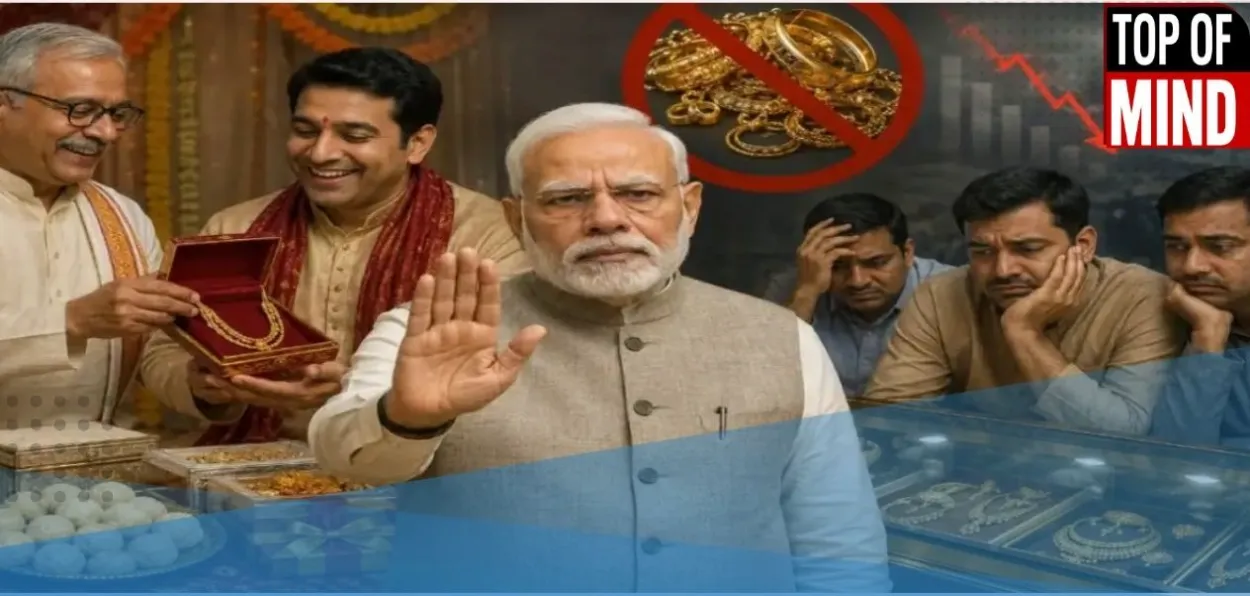
There are moments in a nation’s journey when economics ceases to be the preserve of policymakers and enters everyday life. Not through taxation or regulation, but through collective choices – what citizens buy, consume, import and conserve. Or postpone buying in the national interest. We debate this aspect today, a week after Prime Minister Narendra Modi urged Indians to avoid excessive gold purchases, limit non-essential foreign travel, conserve fuel and reduce avoidable imports. Initial political reactions and social media chatter have been drumbeats that are just about settling down.
In focus is the question underlying the Prime Minister’s appeal, and why it matters more than when it was first stated. The call was not coercive; it did not seek dramatic sacrifice. Instead, it reflected an attempt to build economic resilience at a time when instability is testing economies worldwide.
The backdrop is unmistakable. Crude oil prices have surged past $110-per-barrel amid rising tensions in West Asia and uncertainty around the Strait of Hormuz, among the world’s most critical energy corridors. For India, which imports most of its crude oil requirements, every spike in energy prices translates into pressure on foreign exchange reserves, inflation and the weakening rupee. Given this backdrop, the PM’s message carries a larger logic: in an interconnected world, national strength is shaped not only by policy, but also by how societies respond during periods of external stress.
Predictably, critics have called the appeal “too little, too late”, highlighting the optics of large official cavalcades and state expenditure that appear inconsistent with calls for public restraint. Optics matter in public life. And governments worldwide must recognise that appeals for moderation carry credibility only when accompanied by visible personal prudence. Yet, the economic rationale behind the message cannot be dismissed just because its timing or presentation invites criticism. The vulnerabilities confronting the economy remain real regardless of political debate.
India’s Gold Story
Few commodities capture India’s imagination quite like gold. For generations, it has represented prosperity, security, tradition and emotional continuity. It is interwoven with weddings, festivals, inheritance and household savings. In homes in semi-urban and rural India, gold inspires greater trust than financial markets or paper assets.
 A woman tries on a golden earring in a jewelery shop in Patna (File)
Yet, gold occupies a unique place in the economy. India is among the world’s largest consumers of gold but produces very little of it, forcing heavy imports paid for in dollars. According to the World Gold Council, India’s gold imports rose sharply in early 2026, with first-quarter imports increasing by 58 per cent year-on-year to 186 tonnes. Importing a tonne of 24-karat gold costs Rs 1,520 crore. During stable periods, such demand reflects confidence and rising incomes. But during volatility, high imports intensify pressure on forex outflows.
This is why gold was central in the PM’s appeal. Internationally, geopolitical tensions and currency uncertainties have driven central banks to increase gold reserves. India’s RBI also holds over 880 tonnes of gold reserves as part of its monetary strategy. Because gold thrives during uncertainty, moderating public demand during a global crisis becomes economically significant.
The PM’s appeal goes beyond gold. It also touches upon fuel consumption, overseas travel, edible oils and imported fertilisers; all of which significantly affect India’s import bill. India imports close to 90 per cent of its crude oil. When prices rise sharply, import costs surge, straining inflation and the rupee. Travel by Indians has also expanded in recent years – 3.27 crore Indians travelled overseas in 2025, resulting in expenditure of nearly $32 billion in FY 2023-24, or roughly Rs 3.04 lakh crore.
While healthy in a growing economy, such trends underline an economic reality: every imported barrel of oil and every non-essential foreign currency outflow influences the stability of finances. The objective, therefore, is not to discourage aspiration, but to encourage temporary moderation during an uncertain global phase.
That said, no conversation around austerity can overlook another India – the India of migrants, daily wagers and low-income households. High LPG prices, inflation-hit essentials and rising costs have forced those who migrated to metros to return to their villages. For them, urban living no longer adds up. Stories are emerging of families leaving cities after battles with rent, fuel and food costs, saying they would rather endure hardship at home than hunger and humiliation in unfamiliar cities.
The memories are reminiscent of the COVID-19 lockdowns, when millions walked back to their villages under extreme distress. Any national call for economic restraint must recognise that resilience cannot become the burden of the poor alone.
ఈ రోజు ప్రపంచవ్యాప్తంగా ఏర్పడిన సవాళ్లను మనం అధిగమించాలి. విదేశీ మారక ద్రవ్యాన్ని ఆదా చేయడానికి ఏ మార్గాలైనా ఉంటే, వాటిని తప్పకుండా అనుసరించాలి. pic.twitter.com/okLgcEkecs
— Narendra Modi (@narendramodi) May 10, 2026
India has experienced moments before when economic prudence became a national necessity. The 1991 balance-of-payments crisis remains a defining reminder of how external vulnerabilities can reshape economic fortunes. Admittedly, India is stronger today, with forex reserves at $690 billion, a larger economy and a more diversified industrial base.
But the global economy functions through interconnected shocks. Conflict in West Asia affects fuel prices in India. Shipping disruptions influence inflation. Currency movements hit import costs almost instantly. In such an environment, public participation in economic resilience becomes critical.
This is not unique to India. During energy crises and geopolitical disruptions, countries across Europe and Asia have urged citizens to conserve energy, reduce discretionary consumption and temporarily adopt restrained lifestyles to navigate national challenges. India is not demanding sacrifice in the dramatic sense. But it is calling for awareness that individual behaviour, multiplied across millions of households, can influence national economic outcomes.
The most critical aspect of the PM’s appeal lies in what it reveals. India’s dependence on imported energy, edible oils, fertilisers and precious metals exposes vulnerabilities despite the country’s lofty rise. The challenge is not to curb ambition, but to align growth with strategic resilience.
ALSO READ: Naima Khatoon, AMU's first woman VC is injecting dynamism in varsity's culture
Most importantly, it will remind the country of an enduring truth: that national strength is not built in boardrooms, ministries or stock markets alone. It is also built through millions of everyday decisions taken in homes, markets, airports and fuel stations. India’s economic rise has been powered by aspiration and confidence. Navigating a more uncertain world may now require an additional virtue… Collective Economic Wisdom.
The writer is a veteran journalist and communications specialist

.webp "Pilgrims on the way to Amarnath shrine")











.webp)

.webp)