Amir Suhail Wani
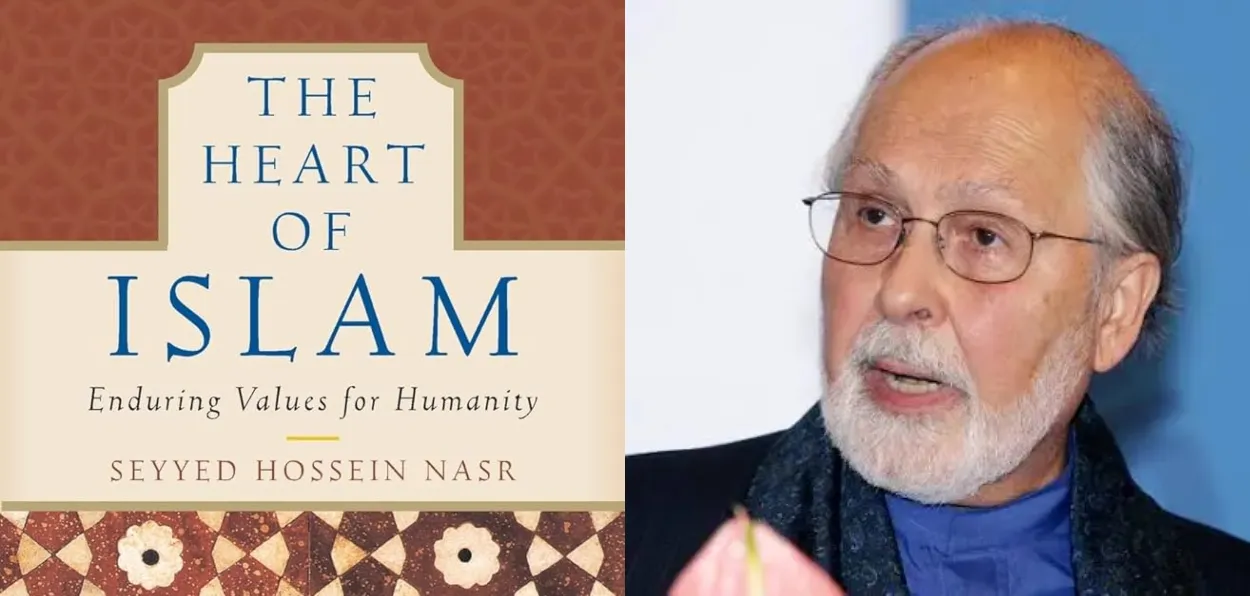
The Heart of Islam by Seyyed Hossein Nasr is a deeply reflective work that seeks to recover the spiritual and intellectual essence of Islam when the religion is being reduced to political headlines and misrepresentations. Written in the aftermath of the 9/11 attacks, the book is a scholarly attempt to present Islam from within its own sacred and philosophical framework.
Book Review
Nasr is not only trying to address misunderstandings, but he seeks to reintroduce readers—particularly in the West—to a tradition that has long been seen from an outsider's eyes.
As one of the leading scholars of Islamic philosophy, Nasr has devoted his life to articulating the metaphysical unity underlying the religious traditions. Educated in Iran and the United States, he taught for decades at major Western universities. Through his works, Nasr has acted as a bridge between civilisations. His role in promoting interfaith dialogue is not confined to institutional participation—though he has been actively involved in Muslim-Christian engagements—but is deeply embedded in his project.
He argues that genuine dialogue is not superficial tolerance; it must be grounded in an understanding of different traditions, while distinct in form, converge in their ultimate orientation toward truth. This vision places him among the most serious and philosophically grounded voices in contemporary interreligious discourse.
The Heart of Islam unfolds as a comprehensive exploration of Islam’s central teachings, beginning with the principle of divine unity (tawhid), which Nasr presents as the axis around which all aspects of Islamic life revolve. From this foundation, he moves to discuss law, ethics, social responsibility, and spirituality, demonstrating how these dimensions are not separate compartments but interconnected expressions of a unified worldview.
His treatment of Sharia is particularly noteworthy, as he portrays it not as a rigid or punitive system, but as a moral and spiritual path intended to guide human beings toward justice, balance, and harmony.
A big part of the book addresses misconceptions about Islam, especially its perceived association with violence. Nasr approaches sensitive topics such as jihad with nuance and historical awareness, distinguishing between its ethical and spiritual meanings and its modern distortions.
Rather than engaging in polemics, he patiently reconstructs the conceptual framework within which such ideas must be understood, thereby allowing readers to see the gap between authentic teachings and their distortion.
Equally important is Nasr’s emphasis on the inner dimension of Islam, most fully expressed through Sufism. For him, it is this spiritual core that holds the key to both personal transformation and interfaith harmony. By highlighting the universal themes of love, remembrance of God, and the purification of the soul, he draws implicit parallels with other religious traditions, suggesting that it is at this inner level that genuine dialogue becomes possible.
This perspective resonates strongly with efforts toward broader religious harmony, including Hindu-Muslim understanding, as it shifts the focus from doctrinal differences to shared spiritual aspirations.
At the same time, Nasr does not idealise either the Muslim world or the modern West. He offers a balanced critique, urging Muslims to remain faithful to the ethical and spiritual teachings of their tradition while also calling on modern societies to confront their own crises of meaning and moral fragmentation. His critique of modernity is philosophical, rooted in the belief that the loss of the sacred has led to a diminished understanding of both humanity and the cosmos. In this sense, The Heart of Islam is as much a commentary on the modern condition as it is a presentation of Islam.
Nasr does not seek to persuade through rhetoric or to simplify complex ideas for easy consumption. Instead, he invites the reader into a deeper engagement with a living tradition, one that cannot be understood without reference to its metaphysical and spiritual foundations. While this may make the book demanding for some readers, it also ensures its lasting value as a serious and authentic exposition.
ALSO READ: Shah Taj Khan: The scribe who brought Science fiction to Urdu
In the final analysis, The Heart of Islam stands as both a scholarly achievement and a moral intervention. It reflects Seyyed Hossein Nasr’s lifelong effort to foster understanding across religious and cultural boundaries, not by erasing differences, but by illuminating the deeper unity that underlies them. At a time when religion is often invoked as a source of division, Nasr’s work offers a compelling reminder that its true purpose lies in guiding humanity toward truth, compassion, and ultimately, oneness.