




 Pallab Bhattacharyya
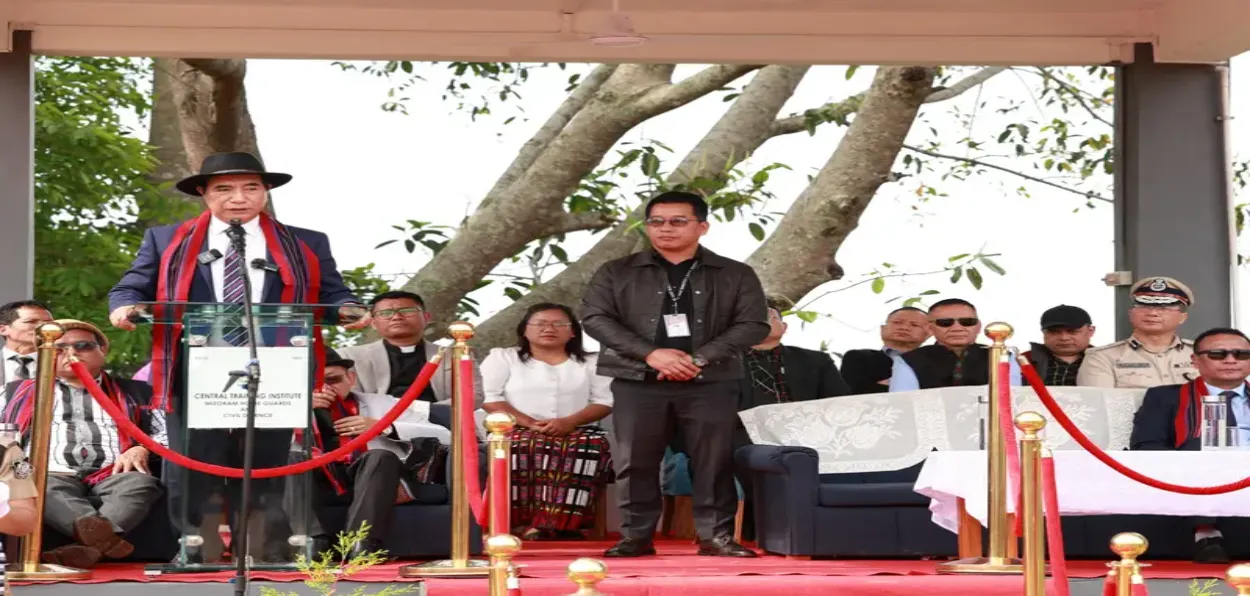
The surrender of the last remaining ethnic insurgent group on April 30, 2026, marked a moment of quiet triumph for Mizoram, as Chief Minister Lalduhoma declared the state “insurgency-free,” closing a turbulent chapter that once threatened to tear it away from the Indian Union.
That a region once synonymous with secessionist fervour has evolved into perhaps the most successful model of insurgent rehabilitation in India is not merely a story of administrative success, but of societal transformation—one that offers profound lessons for states like Assam and for regions grappling with Left Wing Extremism across the country.
The journey of Mizoram from insurgency to stability did not rest solely on the signing of the historic peace accord of
1986 with the Mizo National Front. Rather, it lay in the manner peace was nurtured thereafter—with dignity, inclusion, and a deep understanding that former insurgents must not merely surrender arms but must find a meaningful place in society. Rehabilitation in Mizoram was never treated as a transactional arrangement of surrender for subsistence; it was envisioned as a moral and social reintegration, supported equally by the state and society. Former militants were absorbed into security forces, offered livelihoods, and, most importantly, accepted back into their communities without stigma. This absence of alienation ensured that the cycle of violence did not regenerate itself in new forms.
🚨MAJOR UPDATE | Mizoram has been declared "INSURGENCY FREE" after the last militant group laid down arms pic.twitter.com/VtQt4uH8U9
— The Tatva (@thetatvaindia) May 1, 2026
Equally remarkable has been the role of Mizo society itself. Civil society organisations, particularly the Young Mizo Association, alongside the Church, became silent architects of peace. They did what governments alone cannot—shape attitudes, soften prejudices, and build a culture where discipline and collective responsibility become second nature. One sees this not only in grand narratives of reconciliation but in everyday life. The famously orderly traffic of Mizoram, often admired by visitors, is not enforced merely by law but by an internalised civic ethic. It reflects a society where rules are respected because they are collectively owned. Such discipline is not accidental; it is rooted in high literacy, strong community bonds, and an inherited resilience that has turned past suffering into present strength.
This layered approach—political settlement, economic support, and social acceptance—distinguishes Mizoram’s model from many other conflict resolution efforts. It is precisely here that valuable lessons emerge for Assam, which recently signed a Memorandum of Settlement with the United Liberation Front of Assam. The agreement declared Assam insurgency-free and laid out an ambitious roadmap for development and rehabilitation. Among its notable provisions is the emphasis on renewable energy, particularly the development of large-scale solar power projects, including a proposed 3,000 MW capacity and several solar parks across the state. This clause, though visionary, holds untapped transformative potential.
What Mizoram teaches is that such provisions must not remain abstract development goals; they must be directly linked to the lives of surrendered cadres. Had the ULFA settlement explicitly integrated former militants into the planning, installation, and maintenance of these solar projects, it could have created a powerful cycle of sustainable rehabilitation.
Engaging ex-cadres as stakeholders in green energy initiatives would not only provide them with livelihoods but also embed them in the very process of building the state’s future. Such an approach would elevate rehabilitation from mere economic assistance to participatory nation-building, making former insurgents agents of change rather than passive recipients of aid.
The same principle applies, perhaps even more urgently, to regions affected by Maoism. In these areas, insurgency is often rooted in deep-seated grievances related to land alienation, displacement, and exclusion from development. A purely security-centric response, or even a development model driven by large external capital without community involvement, risks perpetuating the cycle of discontent. Mizoram’s experience suggests an alternative path—one where development is inclusive, community-driven, and respectful of local identities and rights. Instead of pushing communities away from their land for large projects, policies must incorporate them as primary stakeholders, ensuring that the benefits of growth flow directly to those who have historically been marginalised.
Another critical element of Mizoram’s success is the dignity accorded to the surrender. The final laying down of arms by the last insurgent group was described not as defeat but as a “homecoming.” This language matters. It transforms the psychology of conflict resolution, allowing former militants to return without humiliation and enabling society to accept them without resentment. In contrast, approaches that emphasise victory over insurgents often deepen divisions and hinder reconciliation.
It would, however, be simplistic to assume that Mizoram’s model can be replicated wholesale. The state’s relatively small, cohesive population and strong cultural unity have played a role in its success. Yet, the principles underlying its transformation—dignity in negotiation, community participation, sustainable rehabilitation, and cultural cohesion—are universal and adaptable.
Today, Mizoram stands not just as a peaceful state but as a testament to positive outcomes of governance aligning with societal values. Its quiet roads, disciplined citizens, and absence of insurgency are not isolated phenomena; they are interconnected outcomes of a deeper social contract. In a world increasingly fractured by conflict and mistrust, and in an India grappling with multiple internal challenges, the Mizoram story offers a rare and hopeful narrative.
ALSO READ: Manipur imbroglio: Kuki-Meitei divide must be bridged at the earliest
The silence that followed the laying down of arms on that April day is not merely the absence of gunfire. It is the sound of a society that chose reconciliation over revenge, inclusion over isolation, and sustainability over short-term fixes. For Assam, for Maoist-affected regions, and indeed for any society seeking to move beyond conflict, the message is clear: peace endures not when wars end, but when people begin to rebuild together.
The author is the former Director General of Assam Police











_(1).webp)
