




New Delhi
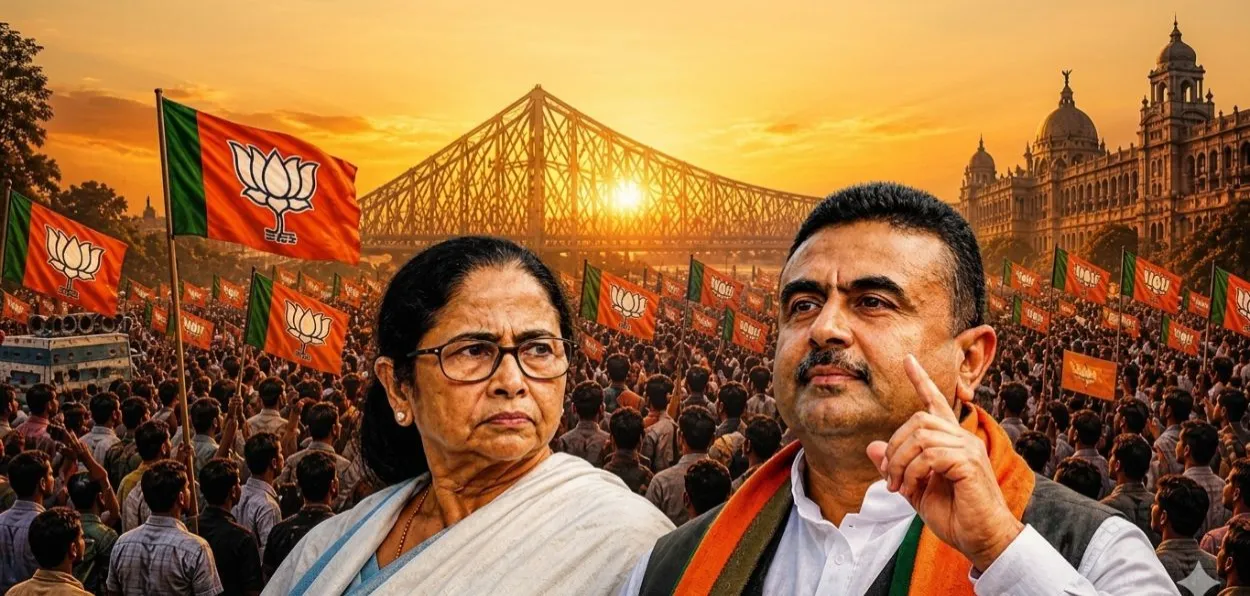
The election outcome has upended the established political calculations in West Bengal. The BJP’s resounding victory was not confined to its traditional strongholds; the party also made unexpected inroads into Muslim-majority districts.
For the first time in over a decade, the traditionally pro-TMC Muslim vote in these regions splintered, reflecting a subtle but significant shift in the political mindset of the community.
The Trinamool Congress (TMC) had long dominated districts such as Murshidabad, Malda and Uttar Dinajpur, relying heavily on a consolidated Muslim voter base. In many parts of this belt, Muslims constitute more than 50 per cent of the population. After the collapse of the Left Front in 2011, these voters largely shifted to the TMC. The highly polarised 2021 Assembly elections further cemented this alliance. This time, however, that bond weakened visibly, and the once-united voter base fragmented.
Election statistics underline the scale of the shift. Out of the 43 Assembly seats across these three districts, the BJP won 19 seats, compared to just eight in 2021. The TMC, which had earlier secured 35 seats, was reduced to 22.
The remaining seats went to smaller players such as the Congress, CPI(M) and Humayun Kabir’s Aam Janata Unnayan Party (AJUP). This fragmentation of minority votes proved costly for the ruling party.
The special revision of electoral rolls (SIR) carried out before the elections had resulted in the exclusion of a large number of voters. Politically, it was expected that the exercise would push Muslim voters to rally even more firmly behind the TMC. Instead, the opposite happened. Rather than voting strategically as a bloc, sections of minority voters chose different opposition parties.
Murshidabad shocker
The biggest setback for the TMC came in Murshidabad, a district with a Muslim population of around 66 per cent and long regarded as a TMC bastion. In the previous election, the party had won 20 of the district’s 22 seats. This time, it managed to secure only nine.
Significantly, the BJP too won nine seats here, up from just two earlier.
The SIR exercise, which reportedly led to the exclusion of nearly 7.8 lakh names from the district’s voter rolls, became a major political issue. The TMC claimed that the deletions disproportionately affected its support base.
“There was a huge division of votes between the Congress, CPI(M) and AJUP, and this became the TMC’s biggest loss,” said political analyst Vishwanath Chakraborty.
In Raninagar, the Congress defeated the TMC by a narrow margin, while the CPI(M) also secured a significant vote share. Together, the two parties cut deeply into the TMC’s minority support base. The CPI(M)’s victory in Domkal further signalled the Left’s revival in minority-dominated areas.
In Rejinagar and Nowda, Humayun Kabir’s AJUP converted its local influence into decisive victories, drawing substantial Muslim support that would otherwise have gone to the TMC.
Consolidation of Hindu votes
A contrasting trend emerged in constituencies with sizeable Hindu populations within these same districts. There, Hindu votes consolidated sharply in favour of the BJP.
In seats such as Kandi and Nabagram, the BJP capitalised fully on this consolidation. The fragmentation of opposition votes made the party’s victories considerably easier than they might otherwise have been.
A similar, though slower, trend was visible in Malda district, where the BJP increased its tally from four seats to six. The split in Muslim votes, combined with the Congress’s residual organisational strength, weakened the TMC’s hold over the district. Although the Congress achieved only limited electoral success, its presence was enough to reduce the TMC’s margins in several constituencies.
North Dinajpur reflected the same pattern. The BJP doubled its strength from two seats to four, while the TMC’s tally dropped from seven to five. In several constituencies, the combined vote share of Congress and Left candidates exceeded the TMC’s margin of defeat, underlining the decisive impact of opposition fragmentation.
Major warning for TMC
Beyond these three districts, similar trends were visible in parts of South 24 Parganas and Birbhum, where minority voters are influential though not numerically dominant. Here too, the BJP made significant gains by benefiting from divided minority votes alongside consolidated Hindu support.
The 2021 elections had been intensely polarised around issues such as the NRC and CAA. At the time, the TMC successfully positioned itself as the principal bulwark against the BJP, winning overwhelming minority support in the process.
That strategy now appears to have weakened. A section of Muslim voters has drifted back towards the Congress and the Left, while others have shifted to emerging regional formations such as the AJUP and the Indian Secular Front (ISF), as even senior TMC leaders privately acknowledge.
The politics of consolidation based on fear of a common adversary appears to have given way to more localised concerns — candidate credibility, grassroots dissatisfaction and the revival of older political networks. Political analysts say this election marks an important shift in Bengal’s political landscape.
The TMC’s electoral model depended heavily on a consolidated minority vote. Even a swing of 10 to 15 per cent in key constituencies was enough to dramatically alter outcomes. As one Kolkata-based election analyst pointed out, the BJP won many seats without a substantial increase in its own vote share. In several constituencies, it benefited directly from the fragmentation of the opposition vote.
The five districts of Murshidabad, Malda, North Dinajpur, South 24 Parganas and Birbhum account for 85 Assembly seats. The outcome of elections in these districts is critical for parties. The BJP’s strong performance in these areas has not only boosted its numbers but also altered perceptions about the party’s reach in regions once considered electorally inaccessible to it.
ALSO READ: Shah Taj Khan: The scribe who brought Science fiction to Urdu
For the TMC, the verdict carries a clear warning: its most loyal support base is no longer as unified as it once was. The erosion may not yet be uniform or irreversible, but it is deep enough to have reshaped the political contours of this election.










_(1).webp)
.webp)