 Aditi Bhaduri
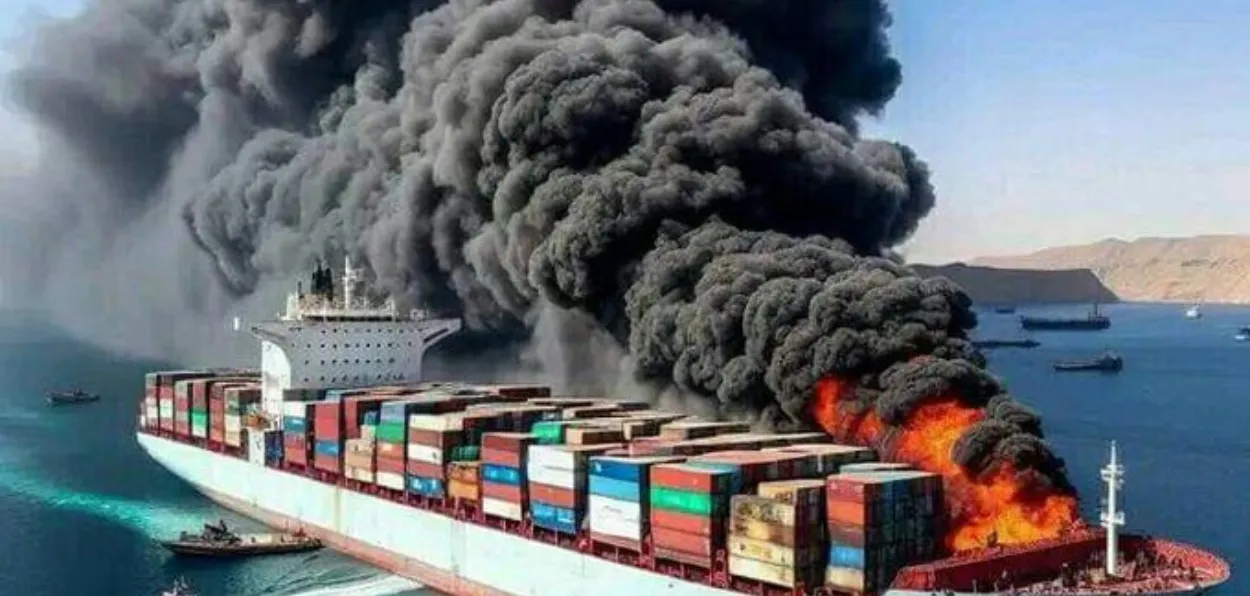
A drone strike caused a fire at a nuclear power plant in the United Arab Emirates, officials in Abu Dhabi said yesterday, Sunday, 17th May. This comes at a time when negotiations between Iran and the US on ending the war seem to be in limbo. The UAE did not apportion blame to anyone, nor has anyone claimed responsibility for it. However, media reports say the USA is urging the UAE to seize Iran's Lavan Island situated in the Persian Gulf.
A few days ago, according to a report by the Wall Street Journal, the United Arab Emirates had conducted covert military strikes against Iran in early April. One attack targeted an oil refinery on the same Lavan Island. The strike was never publicly acknowledged by Emirati authorities. If true, then this may mark a turning point in the conflict.
Throughout the conflict, the Gulf countries had exercised considerable restraint. As Israel and the US pounded Iran, Tehran turned to striking its Gulf neighbours. While most attacks targeted US military bases in these countries, Tehran also targeted civilian infrastructure, financial and energy hubs. Tehran says since it cannot strike the US, it is compelled to target US bases in the region as well as civilian infrastructure where it alleges US military personnel embed themselves. Yet almost all the Gulf countries desisted from retaliating. Instead, they have called for calm and even disallowed US personnel to use the bases in the Gulf for any strikes against Iran. And of all Gulf countries, it was the UAE that faced the maximum attacks - almost 3000 drone and missile attacks.
If the attacks were damaging to the Gulf security and economy, then the closure of the Strait of Hormuz has wrought a different kind of damage. It is one of the most critical arteries of the global economy, through which 20% of the world's oil and gas transit.
🚨#Bigbreaking news 🇮🇷🇦🇺
— Tehran Live News (@Tehran_lives) May 5, 2026
Attack on UAE Oil Port
Iran-linked drone and missile strikes hit the Fujairah oil facility, causing fires and multiple injuries, including Indian nationals. pic.twitter.com/Mw6lZNHkbW
The world has lost 1 billion barrels of oil due to Iran's closure of the Strait of Hormuz, according to Dr Sultan Al Jaber, the UAE's Minister of Industry and Advanced Technology. For the UAE, this is existential. Its economy is deeply tied to oil income. Now it finds that income is being throttled. This predicament, to a large extent, informed its decision to quit (OPEC) and OPEC+, with effect from May 1.
The UAE's decision was meant to help keep oil prices down, as, free of OPEC's constraints, it will be able to produce and export more crude. Another reason was to find buyers closer to it geographically. For India, this was good news, as not only is it a close strategic partner of the UAE, but it is also geographically closer.
That is why an attack on the Fujairah Petroleum Industry Zone on May 4 may prove to be a turning point if a resolution to the crisis around the Strait of Hormuz is not found soon.
The Fujairah Debacle
On May 4, a drone attack originating from Iran hit the Fujairah Petroleum Industry Zone in the UAE, causing a fire. Three Indian workers were also injured. India has strongly condemned the attack. Prime Minister Narendra Modi termed the strike unacceptable and expressed solidarity with the UAE, and he reiterated it during his recent visit to Abu Dhabi. In a statement, India's Ministry of External Affairs called for free and unimpeded navigation and commerce through the Strait of Hormuz in accordance with international law.
Apart from the harm caused to the Indian workers there, what is the significance of the Fujairah energy plant?
The Fujairah Oil Terminal FZC (FOT) is a premier 1.177 million cubic meter independent onshore storage facility in the UAE, specialising in crude oil and refined products. Its increased strategic significance stems from the fact that the Fujairah port is located outside the Strait of Hormuz on the Gulf of Oman. Now that the Strait of Hormuz is closed, the significance for global supply from it has increased manifold. The UAE is therefore accelerating the construction of its West-East oil pipeline, which will connect to the Fujairah port to double oil exports.
This is just as significant for India. Almost four million Indians live and work in the UAE, including in Fujairah. Moreover, through the port, the Fujairah oil terminal can still send supplies to India while also ramping up oil production. India has suffered much in the ongoing crisis in West Asia. It sources much of its energy supplies through the Strait of Hormuz, and disruption has hit its energy supplies immensely, as can be seen in the fuel price hike and the cascading effect on the economy.
Highlights from a productive UAE visit, which will deepen our bilateral friendship… pic.twitter.com/e8D8Wuuz0j
— Narendra Modi (@narendramodi) May 15, 2026
During Modi’s recent UAE visit, the two sides signed an agreement for India to participate in the UAE's Petroleum reserves in Fujairah.
Hitting Fujairah's energy facilities now shifts the narrative away from leveraging the Strait of Hormuz to intentionally hitting the UAE's economic lifeline.
This may explain why the UAE wants the war to continue and has promised to contribute troops to an international coalition to open the Strait of Hormuz. If the reports, therefore, that the UAE has covertly carried out secret air strikes on Iranian targets, is indeed true, then it would be after the UAE has been hammered by Iran for over a month. Iran alleges that it was the UAE that compelled such attacks because it allowed Americans and Israelis to use its territory to launch attacks on it.
The UAE hosts American troops at its Dhafra military base. Iran's allegations are bolstered by the recent disclosure by Israeli Prime Minister Benjamin Netanyahu's office that he had secretly visited the UAE and met with its President Sheikh Mohamed bin Zayed Al Nahyan. The UAE has denied the reports. But Israel has moved some of its famed Iron Dome batteries and interceptors onto UAE territory to protect it from Iranian attacks.
ALSO READ: Why, amid war and conflict, UAE asked Pakistan to repay its loan
Continuing the blockade of the Strait of Hormuz, as well as continuous targeting of strategic infrastructure, may turn out to be counterproductive for Iran. Much of the world has till now refused to participate in any military action against Iran, while many, especially in the Global South, see Iran as a victim. This has the potential to change, especially if attacks move beyond the Strait of Hormuz.



.webp "Union Home Minister Amit Shah")










_(1).webp)