Alfiya Shaikh
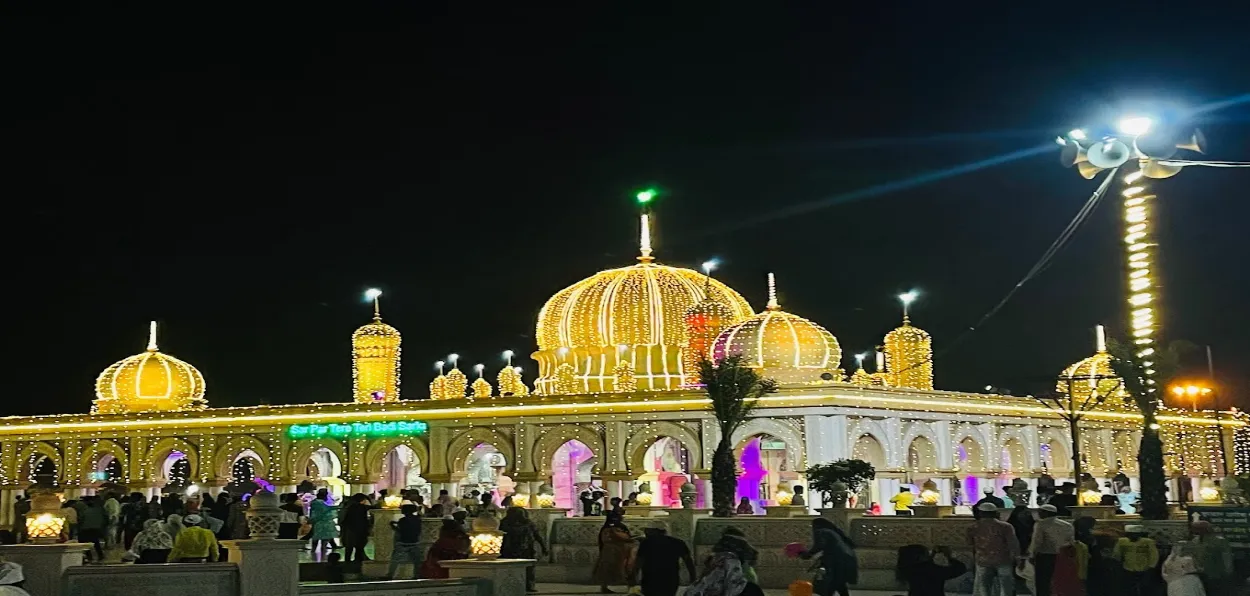
Nagpur's Tajbagh is resonating with qawwalis and prayers as devotees gather for the 12-day Urs of Sufi saint Hazrat Baba Tajuddin. Thousands have converged at the dargah to participate in Milad gatherings, qawwali evenings and daily prayers held in his memory.
As every year, the Urs began on July 9 with Parcham Kushai—the ceremonial hoisting of the dargah's green flag, the first and most significant ritual of the festival. In keeping with a century-old tradition, the flag was hoisted not by a cleric but by a descendant of Nagpur's Hindu Bhonsale royal family.
The celebrations will culminate with the Shahi Sandal procession on July 12, during which a ceremonial chadar scented with sandalwood paste is carried through the city before being placed on the saint's tomb.
#Nagpur: Over two lakh devotees participated in the annual Shahi Sandal procession of Hazrat Baba Tajuddin's Urs, with thousands gathering at Tajbagh for one of Central India's largest Sufi processions#Nagpur #ShahiSandal #HazratBabaTajuddin #BreakingNews pic.twitter.com/sIeKPkTvgr
— Lokmat Times Nagpur (@LokmatTimes_ngp) July 12, 2026
The Bhonsale Family's Bond with Baba Tajuddin
Hazrat Baba Tajuddin, born Syed Tajuddin Muhammad Badruddin on January 27, 1861, in Kamptee near Nagpur, belonged to a Sayyid family tracing its lineage to the Prophet Muhammad.
Orphaned in childhood, he was brought up by his uncle and educated in Urdu, Persian, Arabic and English. He briefly served in the 13th Nagpur Regiment of the British Indian Army before embracing an ascetic life in 1884.
During his early years of spiritual devotion, his unconventional behaviour led to his confinement in a mental asylum. Over time, however, people came to regard him as a God-realised saint, and he was recognised as one of the greatest Sufi masters of his era.
His association with the Bhonsale royal family brought him into public prominence.
According to accounts preserved by the family, the pregnant daughter-in-law of Raghoji Rao Bhonsale, the Hindu ruler of the Nagpur princely state, fell critically ill after doctors had given up hope. The family believes Baba's blessings saved both mother and child. In gratitude, the ruler invited him to reside in the royal palace, where he lived from 1908 until his death in 1925.
Baba Tajuddin became renowned for his compassion and miracles. Devotees continue to recount stories of the sick being healed and the distressed finding solace through his blessings. One of the most enduring tales is of a soldier's wife who prayed for her missing husband at Tajbagh. Baba is said to have assured her that he was on his way home, and within days, the soldier returned safely.
Such stories, passed down through generations, contributed to his recognition as a Qutb—a spiritual pole and one of the highest ranks in Sufi tradition.
A Tradition That Lives On
The bond between the Bhonsale family and the saint has endured for over a century.
104th Urs Mubarak – Hazrat Syed Baba Tajuddin Auliya, Nagpur ✨💫❤️#104thUrsMubarak #HazratBabaTajuddin #TajuddinAuliya #Nagpur #UrsShareef pic.twitter.com/ILlbrwbzxg
— Muftizubairraza (@muftizubairraza) July 12, 2026
Successive members of the royal family have continued the tradition of inaugurating the Urs by hoisting the ceremonial flag. Shrimant Raje Raghujirao Bhonsale performed the ritual during the 96th Urs in 2018, Mudhoji Raje Bhonsale at the 101st Urs in 2023, and Raje Raghuji Bhonsale at the 102nd Urs in 2024. This year, at the 104th Urs, the honour went to Shrimant Pancham Raje Raghuji Bhonsale, in the presence of Sajjada Nashin Sayyid Yusuf Iqbal Taji and Ameer-e-Shariat Mufti.
The Tajuddin Baba Trust, which manages the dargah, reflects the same spirit of inclusiveness. Alongside chairman Pyare Khan and secretary Taj Ahmad Raja, the trust includes vice-president Dr Surendra Jichkar and trustee Gajendrapal Singh Holia, underscoring the shrine's shared stewardship across communities.
The dargah is maintained by hereditary khuddams whose families have served there since Baba's lifetime, working alongside the Trust. In favourable years, the Urs has attracted more than 1.5 million devotees from across India and abroad.
The celebrations continue to embody the saint's message of harmony. The annual Shahi Sandal procession draws large numbers of both Hindu and Muslim residents, while the community langar serves all visitors without distinction. Pilgrims from Hindu, Muslim, Sikh, Christian and Parsi communities visit Tajbagh seeking the saint's blessings.
Baba Tajuddin is remembered for never asking anyone to change their faith. He is said to have advised Hindus to remain devoted to their own traditions and Muslims to continue offering namaz, emphasising that sincerity in worship mattered more than religious identity.
ALSO READ: Bablu Siddiqui performed kanyadaan of his sister Deepanshi
More than a century after his passing, that message remains alive at Tajbagh. Every July, a Hindu royal family raises the flag over a Muslim saint's shrine, and for the next twelve days, the celebrations belong to everyone.











_(2).webp)