




New Delhi
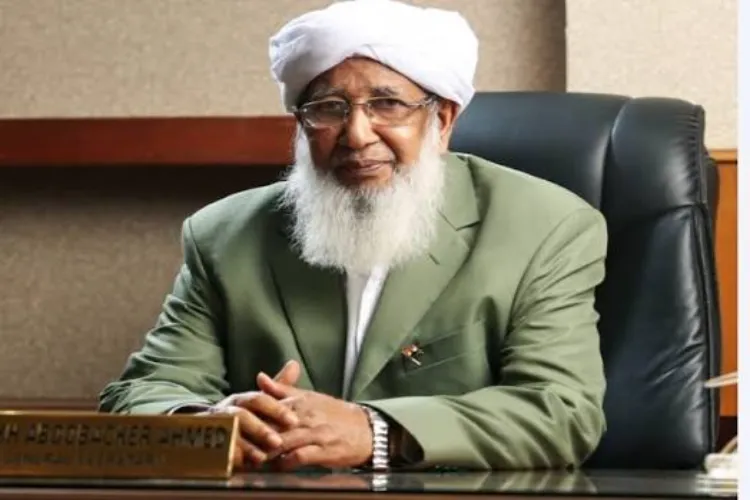
Shujaat Ali Quadri, Convener of the Muslim Youth Organisation (MYO), has condemned the reported remarks of Kanthapuram Aboobacker Musliyar comparing Muslim women to a gold necklace that should be kept locked safely inside a box, and his warning that women entering the public sphere could invite “great destruction.”
Quadri said that such a comparison reduces women to objects and is fundamentally inconsistent with the rich history of Muslim women, many of whom played important roles in commerce, scholarship, education, social service, public affairs and even on the battlefield.
“Muslim women are not pieces of jewellery whose value depends upon being hidden. They are human beings with dignity, intellect, rights and responsibilities. Their contribution to society cannot be measured by how effectively they are kept away from public life,” Dr Quadri said.
He pointed out that Islamic history itself provides powerful answers to such arguments. Prophet’s wife Hazrat Khadija was a successful businesswoman and trader. She managed commercial affairs and was a woman of extraordinary character, independence and influence.
His second wife Hazrat Ayesha became one of the most distinguished scholars of early Islam. She taught both men and women, disseminated thousands of Hadith and played a significant role in the intellectual and public life of the Muslim community.
Quadri further cited Hazrat Nusaybah bint Ka’ab, who participated in the defence of the Prophet Muhammad during the Battle of Uhud, as another example of a Muslim woman who shouldered public responsibility.
He also referred to Rufaidah al-Aslamiyyah, who is remembered for her work in caring for the wounded and providing medical assistance to Muslims.
Similarly, Fatima al-Fihri, traditionally credited with founding the Al-Qarawiyyin institution in Fez, Morocco, is remembered as an important figure in the history of Islamic education. Her legacy is associated with the development of one of the world's oldest centres of learning.
Dr Quadri said that the history of Muslim civilisation also produced women who exercised political authority. Shajar al-Durr became a ruler in Egypt, while Razia Sultan became the ruler of the Delhi Sultanate in India.
“If a woman appearing in public is inherently a source of ‘great destruction’, then what do we make of Khadija, Ayesha, Nusaybah, Rufaidah, Fatima al-Fihri, Shajar al-Durr and Razia Sultan?
“Are we going to erase these women from our history simply because their lives do not fit a particular patriarchal interpretation?” Dr Quadri asked.
He stressed that protecting women from exploitation, harassment and discrimination is an entirely legitimate concern, but protection cannot become a justification for denying women agency, education, employment or participation in society.
“The answer to the challenges faced by women is not to lock them inside a box. The answer is to build a society where women can live with dignity, safety, education and equal opportunity,” he said. Dr Quadri also urged religious scholars and community leaders to exercise greater responsibility when speaking about women.
ALSO READ: Grand Mufti gets backlash for 'confine women to home remarks
“Our young generation needs an Islam of knowledge, confidence, justice and dignity. We must teach our children the achievements of Muslim women rather than presenting women as objects whose ‘value’ depends upon remaining hidden. Islam's history is far more empowering and intellectually rich than such a narrow portrayal,” he said.






.webp "Dipika Pal shaping an idol")



_(1).jpg)
_(4).webp)