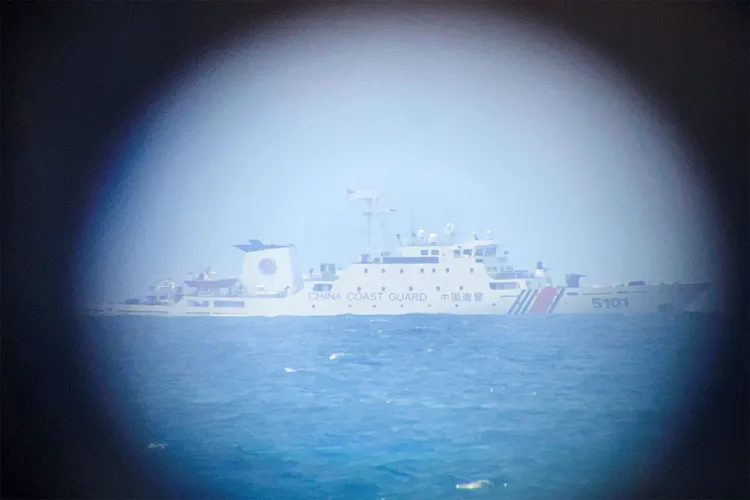
Beijing
After Japan and 13 other countries reaffirmed a 2016 arbitration ruling that China's expansive maritime claims in the South China Sea have no legal basis under international law, Beijing has reiterated that its governance of the disputed waters has never ceased.
Beijing also summoned the Japanese envoy in China, accusing Tokyo of undermining regional peace and stability and challenging the post-war international order.
Chinese state media Xinhua reported, "An official from the Department of Asian Affairs of the Chinese Ministry of Foreign Affairs summoned the chief minister of the Japanese Embassy in China on Sunday to lodge solemn representations and voice strong dissatisfaction and protest."
This comes after Japan and the other 13 countries in a joint statement reaffirmed an international arbitral ruling of 2016 that invalidated Beijing's sweeping claims in the South China Sea and described them as having "no legal basis."
The joint statement described the ruling by the Permanent Court of Arbitration in The Hague as "a significant milestone" and one that is "final, legally binding, and definitive between China and the Philippines with respect to the maritime entitlements and claims" addressed by the tribunal.
The 27-nation European Union also released a separate statement, reaffirming the ruling as a "landmark decision in the peaceful settlement of disputes."
In a statement issued separately on Sunday, Japanese Foreign Minister Toshimitsu Motegi said that for China not to accept the ruling goes "against the principle of peaceful settlement of disputes" and "undermines the rule of law in the international community."
The Chinese Foreign Ministry said it "strongly deplores and firmly opposes" Motegi's statement, maintaining that Japan is "not a party in the South China Sea" and is "in no position to pass judgment on China's territorial sovereignty" in the sea area.
"On July 12, Japan's Foreign Minister Toshimitsu Motegi made a statement ten years after the "2016 Arbitral Award on the South China Sea." The statement blatantly endorses the illegal "award," attacks China's lawful claims and mischaracterizes Japan as a "legitimate stakeholder who uses the South China Sea." China strongly deplores and firmly opposes it," the Global Times reported.
Japan has "no right to comment" on the South China Sea, Chinese FM spokesperson said on Sunday. Beijing also accused Tokyo of interfering in its regional affairs citing "innumerable crimes" commited by Japan during World War II. " Now decades later, Japan, in the name of a 'stakeholder,' is again attempting to meddle in the South China Sea. This reminds people of Japan's history of aggression and expansion, and heightens their vigilance against Japan's neo-militarism agenda," the Chinese spokesperson was cited as saying
On July 12, 2016, a tribunal established in The Hague under the United Nations Convention on the Law of the Sea ruled that China has no historic rights to resources in the South China Sea based on its so-called "nine-dash line" claim, upholding the Philippines' claim that Beijing's actions in the disputed waters violated the UN Convention on the Law of the Sea.
China has rejected the tribunal's decision and continues to defend its claims to the sea passage, which is a key global trade route.
The Chinese Foreign Ministry said in a statement Sunday that the ruling is "a piece of waste paper that is illegal, invalid and nonbinding," urging relevant countries to respect Beijing's territorial sovereignty in the South China Sea and stop "undermining peace and stability" there.
Chinese state media said, "The hype of so-called 'Arbitral Award on the South China Sea' 10 years after its issuance and Japan's joint statement issued in collusion with certain other countries, lodging stern representations and expressing strong dissatisfaction and protest, adding that China will resolutely and forcefully counter Japan's provocations and firmly safeguard its territorial sovereignty and maritime rights and interests.
In a video shared on its X platform, the Chinese Foreign Ministry said, "What the South China Sea Waves Tell Us", and invoked the old civilisational times, saying the water body is critical for China.
Governments of 14 nations affirmed in a joint statement their commitment to maintaining a free and open Indo-Pacific that is peaceful, stable, and rules-based, anchored in international law, and commemorate the 10th anniversary of the July 12, 2016, Arbitral Tribunal's landmark and unanimous decision on the South China Sea constituted under Annex VII of UNCLOS.
The US, Australia, Canada, Estonia, Germany, Italy, Japan, Latvia, Lithuania, New Zealand, the Republic of the Philippines, Romania, Slovenia, and the United Kingdom reaffirmed that maritime disputes must be resolved peacefully and in accordance with UNCLOS.
The governments reaffirmed the Arbitral Tribunal's decision that there is no legal basis for China's expansive maritime claims in the South China Sea, including those based on "historic rights". We underscore the importance of upholding freedom of navigation and overflight, as well as other internationally lawful uses of the sea, as reflected in UNCLOS.
The governments reiterated their strong opposition to any destabilizing or unilateral actions including by force or coercion that threaten peace and stability in the region. We reaffirm our strong opposition to the use of coast guard, military, and maritime militia forces to harass, obstruct, or intimidate lawful operations by other States at sea or in the air, and in so doing endanger the safety of personnel and fishermen and seriously degrade regional peace and security.
They urged the parties to abide by the 2016 Award and resolve disputes peacefully through dialogue and other lawful mechanisms in accordance with international law.
READ MORE: Assam: Badruddin Ajmal lends his support to anti-drug campaign
These nations said they were steadfast in their support for a free and open Indo-Pacific and reiterate our commitment to promoting our shared vision with ASEAN of the South China Sea as a sea of peace, stability, cooperation, and prosperity driven by vibrant lawful commerce, the statement said.











.webp "Ukrainian President Zelenskyy")



_(2).webp)