




Dhaka
Voting for Bangladesh’s 13th Parliamentary elections is set to begin shortly, marking a critical moment in the country’s political history as it enters a new phase. The election is taking place 18 months after an interim government took charge following the collapse of Prime Minister Sheikh Hasina's 15-year-old regime in massive nationwide protests.
The election comes at a time of significant change, following the death of former Prime Minister Khaleda Zia and the ongoing ban on her long-time rival, Sheikh Hasina’s Awami League party.
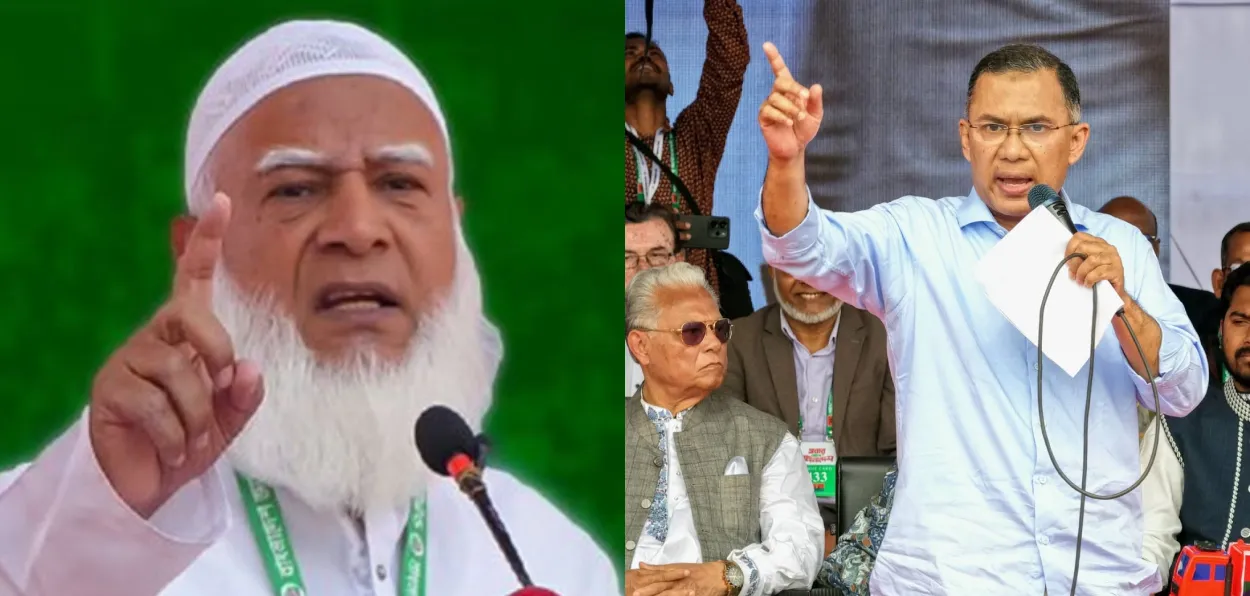
The contest is mainly between the Bangladesh Nationalist Party (BNP) and its once ally Jamaat-e-Islami, in the absence of Hasina's now disbanded Awami League. Chief Adviser Muhammad Yunus’ interim government last year disbanded the Awami League and barred it from contesting the polls.
This election is seen as a turning point, as the country looks to move beyond the decades-long ‘Battle of Begums’ era.
On the eve of the 13th national election, ballot papers and other materials were transported under tight security to polling centres across the country, The Daily Star reported.
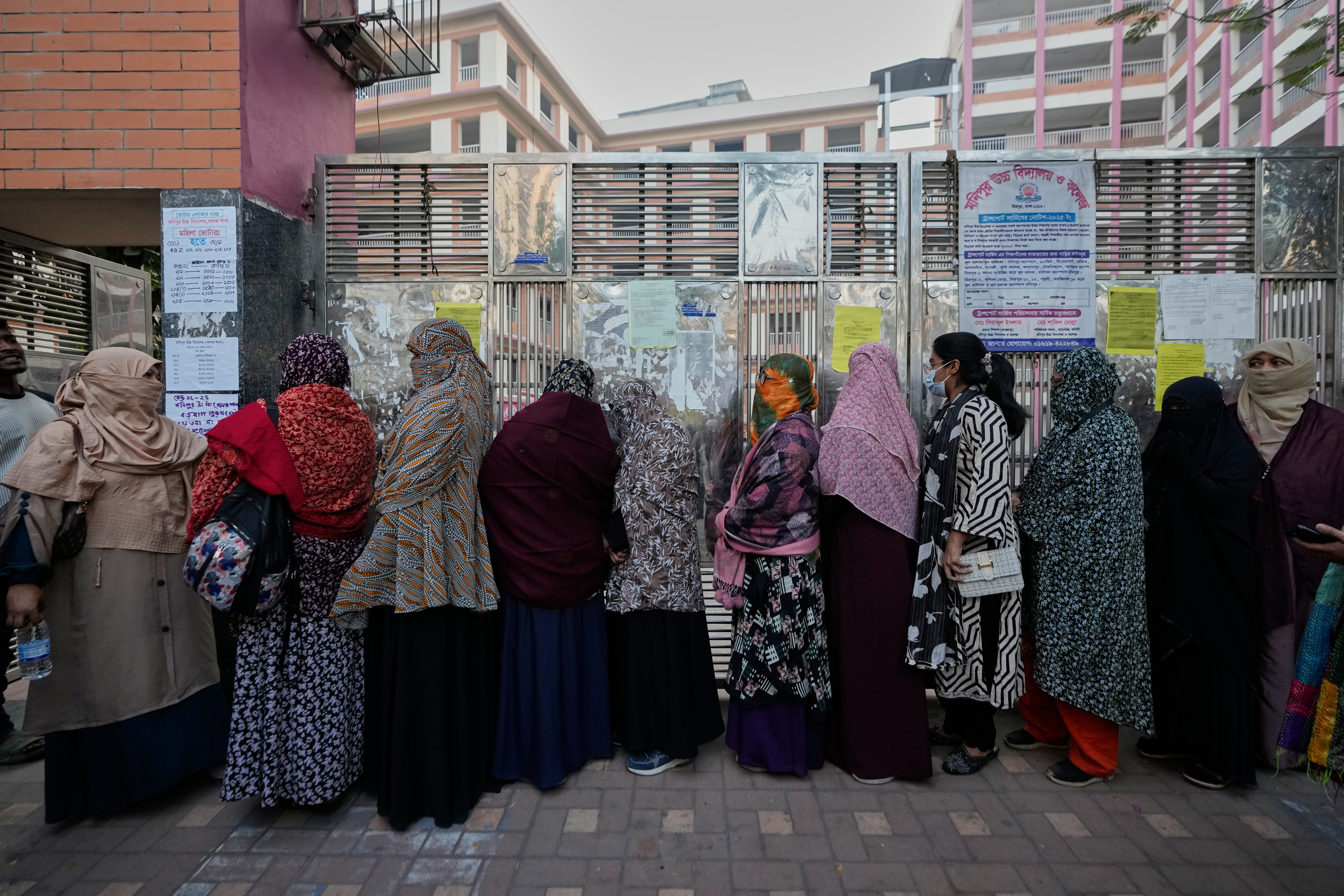
Women voters at a polling station in Dhaka
Polling takes place from 7.30 am to 4.30 pm (local time). The vote count will begin at 4 pm on February 12. The Election Commission will officially announce the results in the morning of February 13, as and when the counting is complete.
With nearly 127 million eligible voters, the eighth most populous nation in the world heads to the polls. Nearly half the voters are between the ages of 18-37, as per Al Jazeera, of which 4.57 million are first-time voters.
There are 59 registered political parties in Bangladesh, excluding Awami League, whose registration was suspended by the election commission last year, nullifying its ability to field candidates in the fray. Of these, 51 parties are participating in this year’s elections. In total, 1,981 candidates are contesting, including 249 independent ones.
The contesting parties are- Bangladesh Nationalist Party (BNP), Jamaat-e-Islami, National Citizen Party (NCP), Jatiya Party (JP-Quader), Jatiya Party (JP-Ershad), Left Democratic Alliance and Amar Bangladesh Party (AB Party), as per Al Jazeera.
Bangladesh is a parliamentary republic in which executive power is exercised by an elected government comprising the Prime Minister and Cabinet. The President is the ceremonial head of state and is indirectly elected by the parliament for a five-year term, Al Jazeera reported.
Corruption, inflation, employment and economic development are the main issues deciding the election.
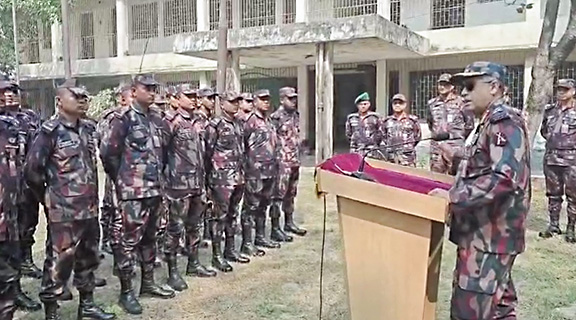
BGB Director General Major General Mohammad Ashrafuzzaman Siddiqui briefs brifing his men on election duties
Besides the parliamentary election, the country is holding a referendum on the National Charter 2025 – a document drafted by the interim government led by Muhammad Yunus, setting the foundation for future governance, as per Al Jazeera.
Earlier, Inspector General of Police Baharul Alam said they found 24,000 out of nearly 43,000 polling centres across the country were “high” or “moderate” risk-prone election stations.
Police said they provided a list of risk-prone polling centres to the EC, which showed that out of 2,131 polling centres in Dhaka, 1,614 were risk-prone. However, the army said they have identified two centres in Dhaka city to be "risky".
Doordarshan video posted on X showed the long queue of voters outside the polling booth in a rural area of Bangladesh:
▪️#Voting has begun for the 13th national parliamentary election and a simultaneous referendum in #Bangladesh amid tight security.
— All India Radio News (@airnewsalerts) February 12, 2026
▪️Long queues of voters are being witnessed at polling centres as they await their turn to cast their votes.#BangladeshElections2026 https://t.co/cMTiz2jLxl pic.twitter.com/mJb4B6KAwO
For the first time, drones and body-worn cameras are being used for election security, Sanaullah said.
Bangladesh Jamaat-e-Islami chief Shafiqur Rahman on Wednesday said that his party would work to build “strong, respectful and mutually beneficial” relations with India if voted to power.
ALSO READ: India must not react to Dhaka's proxy psychological warfare
"We seek positive relationships with our neighbouring countries and with friends around the world. India is our nearest neighbour, and it will remain a priority. Our goal is not to create conflict but to build partnerships for development and peace. Mutual respect and trust are essential," said the Jamaat leader, whose party is leading an 11-party alliance.







.webp)

.webp)

_(1).webp)