Washington DC (US)
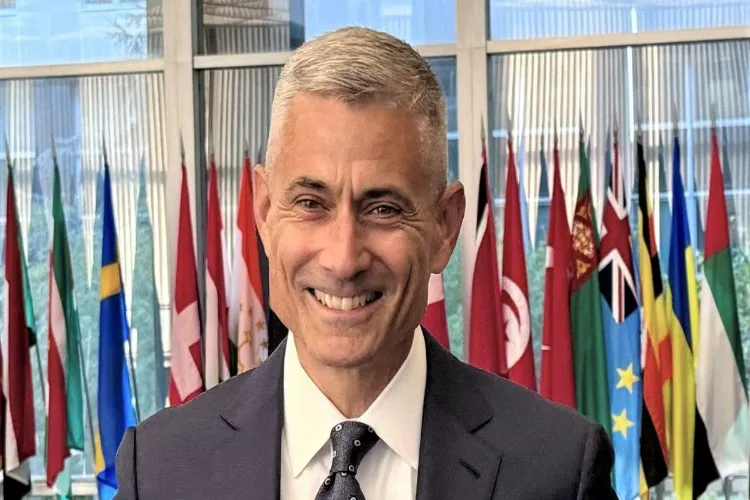
US Assistant Secretary for South and Central Asia, Paul Kapur, has called India an important ally in America's moves against China and underlined that a strong India not only keeps China out of the Indo-Pacific region but also prevents it or any single hegemon from taking over or imposing coercive leverage on the region.
He made the remarks on Wednesday while testifying to the subcommittee on South and Central Asia's hearing to examine America's foreign policy across South-Central Asia.
When asked his assessment of how India is going to support the American efforts across the Indo-Pacific region to counter an increasingly aggressive China, Kapur said that a strong India not only keeps China out but also prevents any single hegemon from taking over the region.
He said, "An India that can be independent and stand up for itself and preserve its freedom of action works to our strategic advantage and promotes our strategic interests because what we're trying to do fundamentally is not to keep China out of the region but to prevent China or any single hegemon from taking over or imposing coercive leverage on the region. So an India that is able to be independent, stand up for itself, and preserve its freedom of action takes a huge swath of the Indo-Pacific off of China's plate and almost by definition prevents it from becoming the dominant power in the region."
Kapur further emphasised the need for an independent India, especially in the spheres of economy and military, so as to prevent dependence on China.
He said, "I think at this point the goal is to ensure that India can stand up for itself, be independent, and of course it is, but the more wherewithal that it has economically, militarily in terms of its defence, in terms of its technology, the better it is able to maintain its independence from China."
He further noted, "An independent, strong, prosperous India takes a big swath of the Indo-Pacific away from China and that is actually a strategic win for us."
However, Ranking Member from California, Representative Kamlager-Dove, heavily criticised the diplomatic moves under Trump 2.0.
She said, "Trump has sabotaged U.S. regional interests and decimated our diplomatic toolbox, putting us on the back foot as major changes swept across South and Central Asia. In April, Trump announced tariffs on partners across South and Central Asia, an unexpected economic shock on countries already facing debt vulnerability to the PRC. 50% tariffs on India--one of the highest rates in the world--tore a needless rupture in bilateral ties that sacrificed decades of painstaking trust-building between our two countries. Dragging on negotiations for over a year cost us the timely convening of the annual Quad leaders' summit and weakened our posture in the Indo-Pacific."
Kapur noted that India and the United States continue to maintain consistent, robust cooperation, which has helped resolve issues such as trade relations.
He said, "India, with its size, location, and commitment to a free and open region, anchors South Asia and, more broadly, the western half of the Indo-Pacific. The United States and India maintain high-level diplomatic touchpoints such as the 2+2 Ministerial and cooperate closely in the defence technology and energy sectors, bilaterally and also through the Quad. Cooperation in these areas has remained robust, even as we resolved long-standing issues in our trade relationship, as evidenced by the renewed 10-year U.S-India defence framework agreement, the TRUST initiative, and Indian purchases of U.S. products ranging from drones to liquefied natural gas."
"Following the trade framework President Trump reached last week with Prime Minister Modi, we can now focus on other shared priorities: lowering barriers to trade with one of the largest economies in the world and opening the way to even more fulsome cooperation. This will enhance our mutual prosperity and help India to defend its sovereignty both on land and in its maritime near abroad," the US Assistant Secretary for South and Central Asia said.
The India-US Interim Agreement, announced last week, is intended as a framework for a reciprocal and mutually beneficial trade pact between the two countries. The agreement will involve the elimination or reduction of tariffs on US industrial goods and a wide range of food and agricultural products, including dried distillers' grains, red sorghum for animal feed, tree nuts, fresh and processed fruit, soybean oil, wine and spirits, and additional products.
READ MORE: When Zafar Sareshwallah offered namaz in RSS headquarters
In return, the United States will apply a reciprocal tariff of 18 per cent on selected Indian goods, including textiles, apparel, leather, footwear, plastics, rubber, organic chemicals, home decor, artisanal products, and certain machinery. Upon full implementation, US tariffs on items such as generic pharmaceuticals, gems and diamonds, and aircraft parts will be removed.






.webp "Prime Minister Narendra Modi")