New Delhi
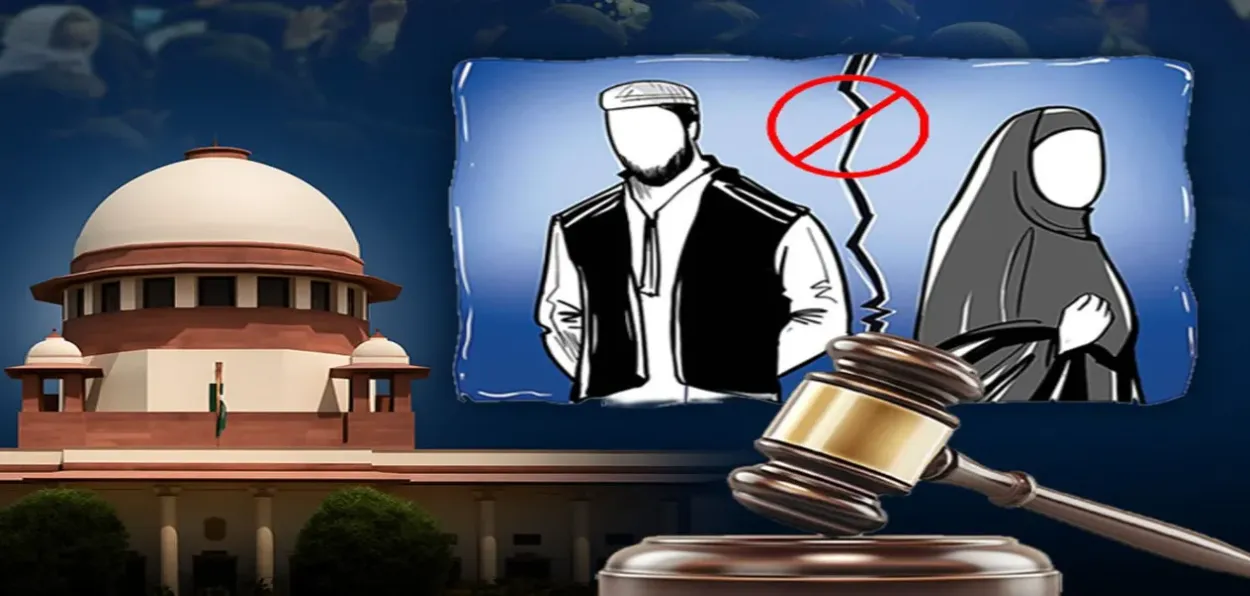
The Supreme has stayed the operation of a talaq-e-hasan divorce given by a Muslim husband to his illiterate wife, noting that there were allegations of his obtaining her signatures on blank paper and he that did not appear to defend them. The Chief Justice of India Surya Kant remarks that the matter was sensitive because it directly involved human emotions and family life.
A bench of CJI Surya Kant and Justice Joymalya Bagchi passed the order. When apprehensions were expressed by Senior Advocate MR Shamshad (appearing for respondents in a connected case), while pointing out that talaq-e-hasan is still a valid form of Muslim divorce, the CJI said that the Court was not rendering it invalid. The stay was necessitated in the case as the husband did not enter an appearance and the wife had levelled serious allegations, the CJI said.
The case stems from Belagavi, Karnataka, where Hena was married in 2021. Hena, a homemaker and unable to read or write, filed a lawsuit alleging that her husband attempted to divorce her through Talaq-e-Hasan. In her petition, she says that her husband used illegal means to obtain her consent for divorce, and it never happened in a court.
Before a bench comprising Chief Justice Surya Kant and Justice Joymalya Bagchi, senior lawyer M.R. Shamshad argued that Talaq-e-Hasan is a valid form of Muslim divorce.
Nevertheless, the Supreme Court clarified that the court was not invalidating Talaq-e-Hasan, but rather that the husband's absence and the serious allegations made by the wife necessitated the stay of the execution of the divorce.
The Supreme Court ruled that the parties would be considered legally married until the husband proves the divorce. The court directed the SHO concerned to ensure the husband's presence and locate him.
Senior advocate Jayna Kothari, representing Hena, told the court that her husband used digital means such as email, WhatsApp, and registered post to seek a divorce.
She urged the court to issue guidance to protect Muslim women from “illegal divorce, retaliatory criminal action, and police bias” until a permanent law was enacted by Parliament.
This case is also ongoing, challenging Talaq-e-Hasan as a violation of Articles 14, 15, and 21 of the Constitution. This demonstrates that Talaq-e-Hasan is not only a traditional practice but has also become a subject of serious debate in the context of modern Indian law and human rights.
The Supreme Court also noted that the process of Talaq-e-Hasan is often unilateral and extrajudicial. This is precisely what happened in Hena's case—the husband resorted to illegal means to obtain a divorce, while the woman's right to express her views was limited. The Court clarified that the need for justice in such cases is extremely sensitive.
The Supreme Court subsequently ordered mediation to resolve the dispute. Former Supreme Court judge Justice Kurian Joseph was assigned to mediate the dispute between the couple within four weeks.
This initiative sent a clear message that divorce matters require not only legal procedures, but also a family-oriented and humanitarian approach.
The Supreme Court also acknowledged that the matter was "somewhat sensitive."
The Chief Justice stated that justice in matters involving human emotions cannot be limited to the legal system, but must also take into account social and moral responsibilities. The court directed both parties to contact Justice Joseph and schedule a mediation date.
Advocate Dr. Rizwan Ahmed, representing Hena, told the court that despite the previous order, her husband had again attempted to divorce her illegally. Consequently, the court stayed all previously issued divorce orders to ensure that the mediation was conducted in a completely fair and effective manner.
While the Court did not order a temporary stay on divorce through digital means (WhatsApp, email, etc.) at this stage, the Chief Justice indicated that appropriate orders could be issued in the future. The Court clarified that this matter is not merely a matter of law, but rather a mix of emotions and sensitive human circumstances.
The Supreme Court's ruling also sent a message that women cannot be unilaterally harmed through talaq-e-hasan. The law not only affirms traditional practices but also ensures the rights and protection of women in modern society.
Senior advocate M.R. Shamshad represented the husband, while Jayna Kothari and Dr Rizwan Ahmed represented Hena, representing her rights and protections. The court ultimately chose mediation to resolve the dispute, allowing a just and fair settlement between the spouses.
This move by the Supreme Court is significant not only for Hena's case but also for protecting women's rights in Muslim divorce cases across the country. This case demonstrates the vital importance of maintaining a balance between law and humanity. The Court clarified that divorce should be handled not only from a legal perspective, but also from a social and emotional perspective.
Ultimately, the Supreme Court ensured that the process of talaq-e-hasan cannot be illegally or unjustly enforced against any woman. This ruling clearly underscores the importance of protecting women's rights, securing justice and constitutional safeguards.
ALSO READ: Muslim couple arrange wedding of their adopted Hindu son
The trial and mediation process in this case presents a landmark perspective on Muslim divorce law, women's rights, and human rights in the country. It will be considered significant not only from a legal perspective but also from the perspectives of social justice and constitutional safeguards.


.webp "Representational Image")








_(1).webp)