Ashhar Alam | New Delhi
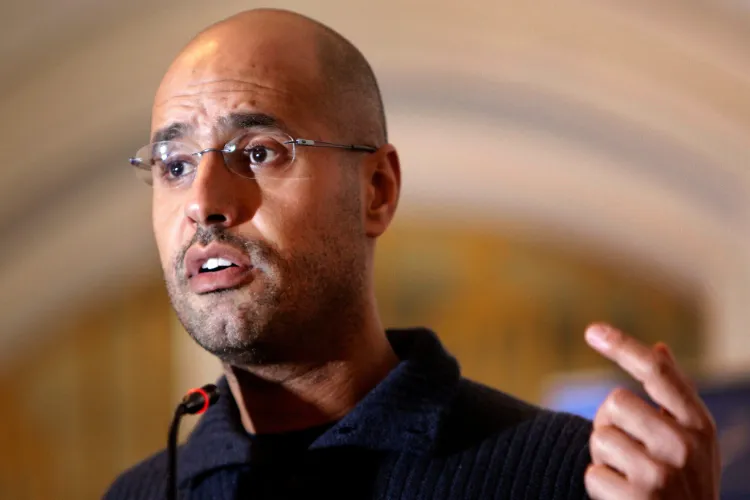
Seif al-Islam Gadhafi, the son and once-presumed successor of Libya’s former strongman Moammar Gadhafi, has been killed, Libyan authorities confirmed on Tuesday, marking a dramatic turn in the country’s long and turbulent political saga.
Libya’s chief prosecutor’s office said the 53-year-old was shot dead in the town of Zintan, around 136 kilometres southwest of the capital Tripoli. While officials confirmed the cause of death, they offered no further details on the circumstances surrounding the killing, saying initial investigations were still underway.
The news was later corroborated by Khaled al-Zaidi, Seif al-Islam’s lawyer, who announced the death in a social media post. Abdullah Othman Abdurrahim, who had represented Gadhafi during UN-sponsored political talks aimed at ending Libya’s prolonged conflict, also confirmed the development online.
In a statement released hours later, Seif al-Islam’s political team described the killing as a “cowardly and treacherous assassination,” alleging that four masked men stormed his residence in Zintan. According to the statement, the attackers disabled CCTV cameras before opening fire, and Seif al-Islam attempted to resist before being killed.
Born in Tripoli in June 1972, Seif al-Islam was the second son of Moammar Gadhafi and for years was seen as the reform-minded face of the regime. Educated in London, where he pursued doctoral studies at the London School of Economics, he was widely viewed as a potential bridge between Libya and the West during the later years of his father’s rule.
Moammar Gadhafi was overthrown in a NATO-backed uprising in 2011 after more than four decades in power and was killed later that year as the country descended into a brutal civil war. Libya has since remained fractured, with rival governments and armed factions vying for control.
Seif al-Islam was captured by Zintan-based fighters in late 2011 while attempting to flee to Niger. He was released in 2017 following an amnesty declared by one of Libya’s competing authorities and had since been living in Zintan.
Despite his release, his legal troubles persisted. A Libyan court sentenced him to death in absentia in 2015 on charges including inciting violence and the killing of protesters. He was also wanted by the International Criminal Court for alleged crimes against humanity linked to the 2011 uprising.
ALSO READ: Shab-e-Barāt: Mercy, memory, and moral reckoning in the Islamic realm
In a controversial move, Seif al-Islam re-entered public life in November 2021 by announcing his candidacy in Libya’s long-delayed presidential election. The decision triggered fierce backlash from anti-Gadhafi factions across the country. Although the election commission later disqualified him, the vote itself never took place due to deep political divisions and security concerns.
His killing now adds another layer of uncertainty to Libya’s fragile political landscape, underscoring the enduring instability that has plagued the country more than a decade after the fall of the Gadhafi regime.











.webp)