Basel
Record-breaking temperatures transformed Basel's public fountains into unconventional rehearsal venues as performers at Switzerland's annual national yodeling festival sought relief from the intense summer heat while preparing for their performances.
With temperatures climbing to around 39 degrees Celsius over the weekend, yodelers, folk musicians and festival participants gathered around city fountains to practise and cool down at the same time. In one popular spot, members of a traditional folk band sat with their feet in the water while rehearsing, drawing applause from passersby who also used the fountains to escape the heat.
The Eidgenössisches Jodlerfest, Switzerland's premier yodeling festival, was held in Basel from Friday to Sunday, bringing together around 12,000 performers and nearly 200,000 visitors. The northwestern Swiss city hosted the prestigious event for the first time in more than a century, having last organised it in 1924.
Throughout the city, spontaneous performances became a common sight. Yodeling echoed through restaurants and public squares, often surprising diners before encouraging them to join the celebrations.
While organisers had arranged for seamstresses to remain on standby at Petersplatz to repair damaged traditional costumes, it was the fountain rehearsals that emerged as one of the festival's most memorable scenes.
This year's gathering carried added significance as it was the first national yodeling festival since Swiss yodeling was inscribed on UNESCO's Representative List of the Intangible Cultural Heritage of Humanity in December 2025, a recognition widely celebrated across the country.
Swiss yodeling differs from the more widely recognised Austrian and Tyrolean styles. It is generally slower, more reflective and deeply rooted in regional dialects and local traditions.
Freddie Conquer, a member of the Jodlerclub Echo Basel, said music had helped him remain connected to his homeland after moving abroad.
"I have always loved music. When I returned to New Zealand as a child, I wanted to preserve my connection with Swiss culture, so I joined a New Zealand-Swiss-Kiwi yodeling club," he said.
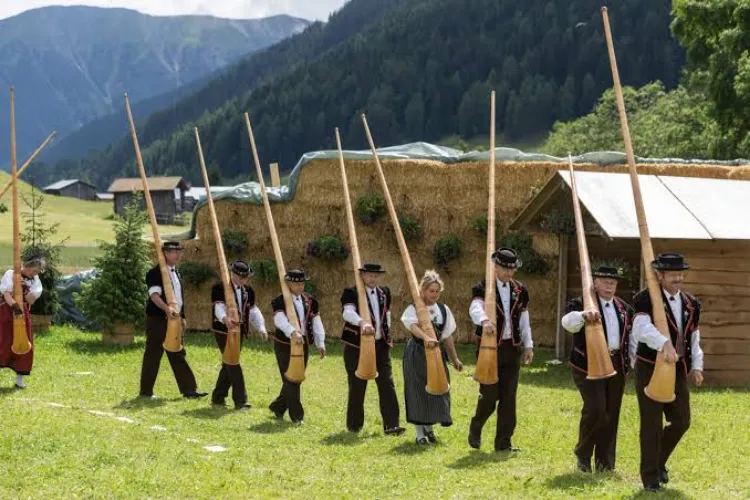
Festival participants competed in three traditional disciplines—yodeling, alphorn playing and flag throwing.
The alphorn, a long wooden wind instrument historically used by Alpine herdsmen, can exceed three metres in length and produces notes entirely through natural harmonics, without valves or keys.
Explaining the challenge of mastering the instrument, alphorn player Pierre-André Karlen said, "Everything depends on the mouthpiece, hearing the note in your mind and shaping it with your lips. The higher the note, the greater the effort required."
The festival concluded on Sunday with participants gathering outside Basel's town hall for the announcement of competition results. Members of Jodlerklub Balfrin from Visp in the canton of Valais celebrated enthusiastically after receiving a perfect score of one in the competition.
READ MORE: Bait-ul-Maal: A Muharram beacon of Hindu-Muslim harmony
The closing parade through Basel's historic streets featured traditional flags, decorated tractors carrying yodeling groups and alphorn players marching through the city. Despite the sweltering conditions, performers completed the celebrations in full traditional attire, bringing the festival to a colourful close.


_(1)_(1).webp "Khanqah Emadia Qalandaria, Patna, Bihar")






.webp "US President Donald Trump")


.webp)