Balasore/Bhubaneswar
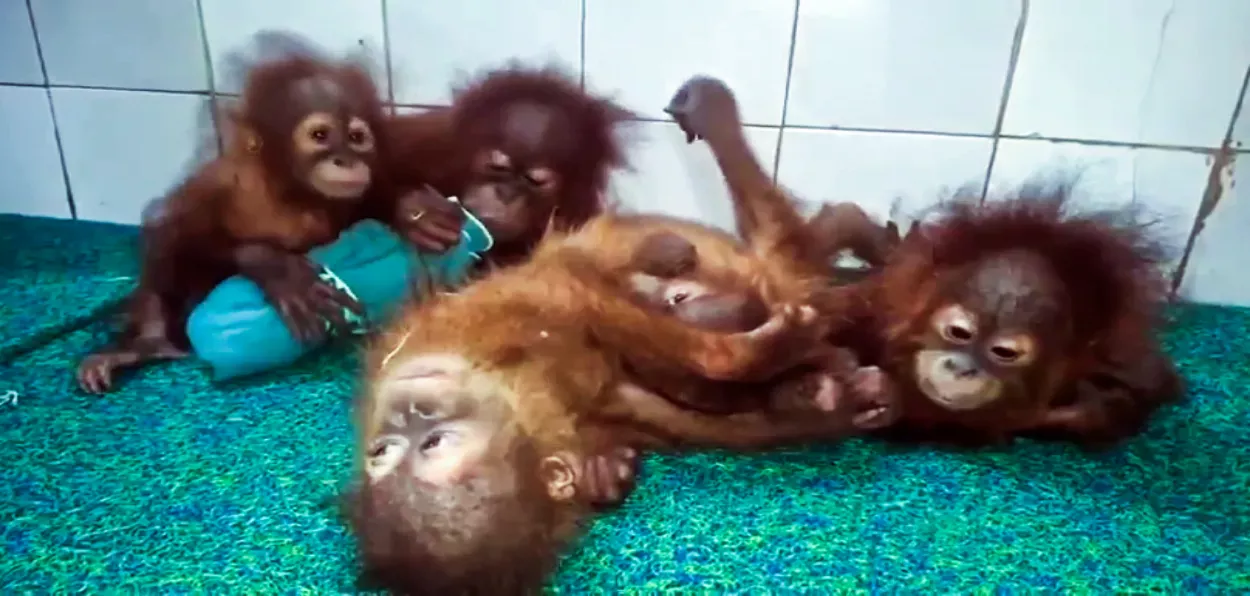
The sight must have seemed almost surreal: five baby orangutans sitting together on the forest floor, calmly eating bananas in a casuarina forest in Odisha. But there was one glaring problem. They were about 3,000 kilometres from the tropical rainforests they call home — and in a country where orangutans do not naturally exist.
The discovery of the five young apes, three males and two females, in Balasore district has now opened a disturbing wildlife-trafficking mystery, with investigators examining how the critically endangered animals reached Odisha and whether an international smuggling network was involved.
The orangutans were rescued on Tuesday from a forested area at Bichitrapur village under Bhograi block, close to the West Bengal border. After receiving first aid, they were taken to Nandankanan National Zoological Park near Bhubaneswar, where they have been placed in quarantine and are being closely monitored.
Photographs and videos of the animals soon circulated widely, showing the young orangutans huddled together and eating bananas. The images offered a striking glimpse of animals that should ordinarily be found in the rainforests of Indonesia and Malaysia.
#WATCH | Balasore, Odisha | Five baby orangutans, two females and three males, all under one year old, were found in the Ranakatha Protected Reserve Forest (PRF) near Badapai village, which is not their natural habitat.
— ANI (@ANI) September 9, 2026
According to Balasore DFO Indalkar Pratik Prakash, "While… pic.twitter.com/CcdHwug3FO
Orangutans are not native to India. They are critically endangered, with their survival threatened by deforestation, illegal hunting and the rapid expansion of palm oil plantations, which has destroyed large parts of their natural habitat.
The circumstances surrounding the animals' arrival in Odisha remain unclear.
Balasore District Forest Officer Pratik Prakash Indalkar told the BBC that the orangutans could not have reached Odisha naturally and were possibly transported by road.On Wednesday, Principal Chief Conservator of Forests (PCCF) and Chief Wildlife Warden Prem Kumar Jha sought the cooperation of the Odisha Police to determine the animals' source, ownership and transportation route, as well as possible inter-state or international trafficking links.
In a letter to the Director General of Police, Jha said the presence of the animals in Odisha "raises suspicion regarding their source and illegal transportation". He added that the possibility of an organised inter-state or international trafficking network could not be ruled out.
Jha also urged the police to coordinate with the Wildlife Crime Control Bureau (WCCB) and other enforcement agencies.
According to sources cited in reports on the investigation, the Odisha Police's Special Task Force (STF) has taken up the case and is trying to reconstruct the journey of the five animals.
One potentially important clue is a black SUV.
Sources said villagers had noticed the vehicle in the area on Monday night, shortly before the orangutans were discovered. CCTV cameras also reportedly captured the vehicle, giving investigators a possible starting point as they try to establish who brought the animals to the forest and where they were headed.
STF Inspector General Himansu Lal said the police intended to trace the entire network behind the incident.
"The case has been taken up. We will dismantle the entire network. Stringent action will be taken against all those involved in the crime," Lal said, according to reports.
The investigation, he added, would focus on how the orangutans reached Balasore and where they were being taken.
The Wildlife Crime Control Bureau has also reportedly begun examining the case, with particular attention being paid to gangs involved in international wildlife trafficking.
The zoo has also begun consulting experts and institutions with experience in orangutan care. These include Mysore Zoo and the Wildlife Institute of India, which are being consulted on the animals' specific requirements.
Orangutans are strictly native only to these Islands, which are 3000 kms away from India
— Royal Singh 🦁 (@Royalsinghz3) September 8, 2026
How the hell 5 baby Orangutans reached India without their mother ! https://t.co/2eAgjZZf43 pic.twitter.com/d4H27ZELsw
Their immediate needs are relatively simple but specialised: appropriate food, care, veterinary supervision and an environment suited to animals that have been abruptly removed from their natural habitat.
Their longer-term fate will depend partly on the outcome of the investigation and on determining where they came from.
ALSO READ: Mohsin is a volunteer at Ganeshotsav celebrations
For wildlife experts and law-enforcement agencies, the central questions are now straightforward but potentially difficult to answer: Where did the animals come from? Who transported them? How did they enter India? Were they destined for another location? And who was supposed to receive them?











.webp "Representational Image")