 Ruchita Beri
The visit of Prime Minister Narendra Modi to Ethiopia highlights the strategic importance of the African nation for India and the growing partnership between the two countries. Ethiopia has a highly strategic location in the Horn of Africa as it is the gateway to Africa, Asia and Europe. It has an immense economic potential, as one of the fastest-growing economies in Africa.
Its 8.5 percent growth is driven by large infrastructure projects. Ethiopia has transformed the domestic and regional energy landscape through the launch of the Grand Ethiopian Renaissance Dam (GERD). With this project, Ethiopia is on the way to becoming the largest hydroelectric power producer in Africa.
It will significantly enhance access to electricity within Ethiopia and across the Horn of Africa. Another noteworthy infrastructure project is the 750 km long electrified railway line connecting Ethiopia’s capital, Addis Ababa, with the Red Sea port of neighbouring Djibouti. This railroad is hailed as an “economic corridor to prosperity” as it has linked the landlocked country to the global maritime trade.
Demography is another appealing feature of Ethiopia. It is the second most populous country in Africa and has a largely young and vibrant population, which offers a huge potential as a labour force. Ethiopia hosts the headquarters of the African Union and plays an important role in continental diplomacy.
In recent years, despite internal conflict, Ethiopia has continued to foster regional security. It is one of the top ten troop contributors for the United Nations peacekeeping operations, which are heavily concentrated in the African region. Ethiopia also contributes a substantial number of troops to the African Union’s Support and Stabilisation Mission in Somalia (AUSSOM) in their ongoing fight against the Al Shabab terror group.
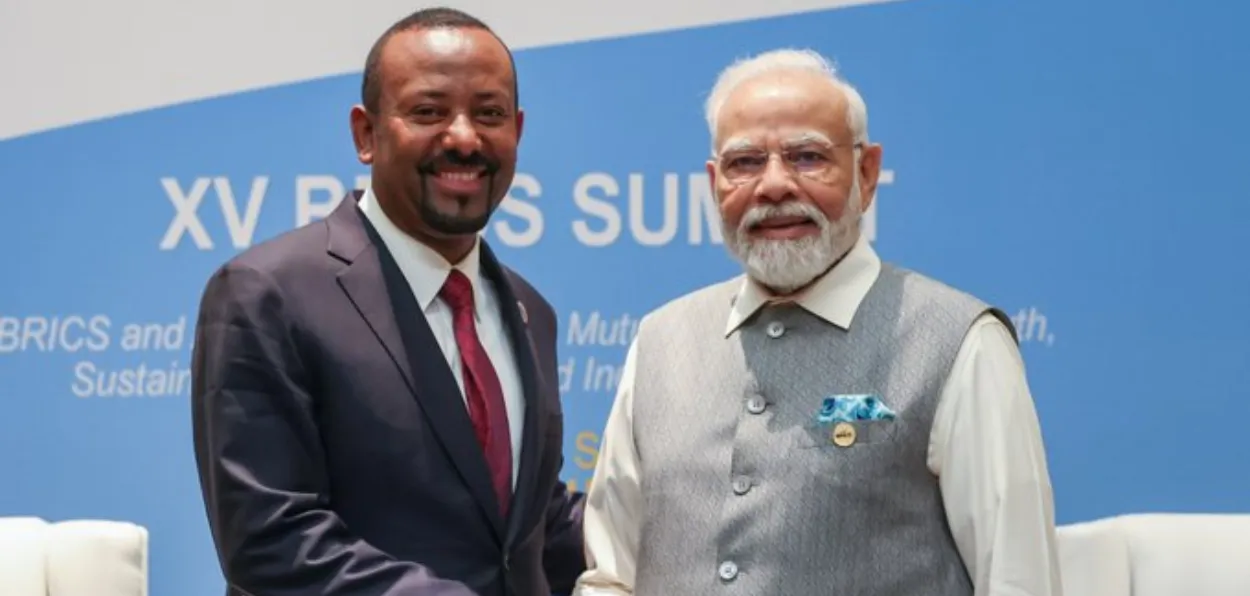
Prime Minister Modi’s visit will help in enhancing India’s relations with this vital country in Africa. This is Prime Minister Modi’s first visit to Ethiopia. During the visit, he is expected to have discussions on various aspects of bilateral cooperation with Ethiopian Prime Minister Abiy Ahmed Ali. Prime Minister Modi’s visit to Ethiopia comes less than a month after the meeting of the two leaders on the sidelines of the Johannesburg G20 Summit in South Africa.
Prime Minister @narendramodi's visit to Ethiopia
— PIB India (@PIB_India) December 15, 2025
💠PM’s first visit to the Federal Democratic Republic of Ethiopia
💠PM to hold detailed discussions with Dr. Abiy Ahmed Ali, Prime Minister of Ethiopia, in Addis Ababa and to also interact with the Indian diaspora living there… pic.twitter.com/twBSym2Rz5
However, India’s relations with Ethiopia are not new and can be traced back to the Axumite Empire (1st century CE). Extensive trade flourished between India and Ethiopia during this period. Indians mainly traded silk and spices for gold and ivory from the Ethiopians. After India’s independence, Ethiopia was the first African country to establish a diplomatic mission in 1948. Over the years, close cooperation has emerged in development cooperation, trade and investment, education, capacity building and defence.
Ethiopia is a major development partner of India in Africa; it has received over a billion dollars in Lines of Credit to build its infrastructure, in particular for rural power transmission and the development of sugar factories in the country. As in the rest of the African continent, India’s development cooperation with Ethiopia is based on the South-South Cooperation (SSC) framework.
The SSC framework is the main component of Prime Minister Modi’s “Ten guiding principles of India–Africa engagement.” The key message of these principles is that India’s development cooperation will be driven by African priorities.
India and Ethiopia have a long-standing partnership in the field of education and capacity building. Indian teachers have played a seminal role in shaping the mindsets of young school students in Ethiopia. In recent years, Indian teachers have contributed significantly to the higher education sector in Ethiopia. Over 2000 Indians continue to teach Ethiopian university students social sciences, engineering, management and medicine. Ethiopians have benefited from scholarships offered by the Government of India through the Indian Council of Cultural Relations (ICCR) to study at educational institutions within India. It's one of the largest beneficiaries of Indian Technical and Economic Cooperation (ITEC) training programmes.
India is Ethiopia’s second-largest trading partner and also an important source of foreign investment, with over 650 Indian companies present in the country. These companies have gained recognition as the largest private sector employers in the country. The India-Ethiopia trade stood at US $ 550 in 2024-25. India’s exports are mainly pharmaceuticals, and imports largely consist of pulses and seeds. It is hoped that the Prime Minister's visit will help in figuring out new avenues for economic cooperation and boosting bilateral trade between the two countries.
India was instrumental in setting up the Harar Military Academy in Ethiopia. This has trained military officers from Ethiopia and other African countries between 1957 and 1977, before it was abruptly shut down. However, the defence engagement has continued and expanded to a formal defence cooperation agreement in February 2025. Prime Minister Modi’s visit may enhance cooperation in cybersecurity, counter- terrorism and defence industry spheres.
In the multilateral area, India has always supported the aspirations of the Global South in various multilateral platforms. With India chairing the BRICS Forum next year, this visit provides an opportunity for the leaders of the two countries to align their views regarding intra-BRICS cooperation. The two sides may also discuss the possibility of India hosting the long-delayed 4th India-Africa Forum Summit soon.
ALSO READ: PM Modi to cement ties with Jordan, Oman and woo Ethiopia in his maiden visit
In conclusion, in the backdrop of global tumult, weaponisation of tariffs by the United States, debt trap diplomacy by China, India’s continuing engagement of partners like Ethiopia validates its “Africa First” policy, hinged on sharing knowledge, experiences and technology for mutual benefit.
The author is a senior Fellow, Vivekananda International Foundation, New Delhi


.webp "Justice Poonam A. Bamba with Captain Amarinder Singh")







.webp "US President Donald Trump")

.webp)
.webp)