 Shankar Kumar
Prime Minister Narendra Modi's four-day visit to Jordan, Ethiopia, and Oman from December 15 signals India’s interest in deepening its engagement with these countries of the Middle East and Africa. His visits to Jordan and Oman -- New Delhi’s oldest diplomatic friends in the Middle East region -- will script a new chapter in their relationship with India.
The visit is taking place amid a fast-churning geopolitical situation in West Asia and the world. Even as it signals India’s sincere effort to solidify its engagement with the region - important for its energy security, trade and diaspora - both Jordan and Oman share a reciprocal intent of expanding the contours of their relationship with New Delhi.
When Pakistan-based terrorists killed 26 people in Pahalgam in Jammu and Kashmir on April 22, Jordan and Oman strongly condemned the ghastly terror attack. Jordanian King Abdullah II called Prime Minister Modi and conveyed his sincere condolences on the loss of innocent lives. While strongly condemning the Pahalgam terror attack, he said terrorism should be rejected in all its forms and manifestations, and there can be no justification.
Prime Minister Modi will be visiting Jordan and Oman for the second time since 2018. His trips are taking place at a time when Amman is commemorating 75 years of its diplomatic relations with New Delhi, while Muscat is celebrating 70 years of diplomatic ties with India. However, it will be the first time Prime Minister Modi will undertake a trip to Ethiopia, commemorating 75 years of diplomatic relations with India.
Strategic importance of Jordan
A relatively small country which is bordered by Syria to the north, Iraq to the east, Saudi Arabia to the south and Israel, along with the occupied West Bank to the west, Jordan is strategically situated in the West Asian region.
In fact, its balancing acts in the region make it a strategically important nation for India’s foreign policy. According to experts, India’s defence agreement with Jordan has led to a strategic imprint in the region of the Red Sea and the East Mediterranean through the Levant.
This defence agreement was signed during the Jordanian King’s visit in 2018. It envisaged military training, defence industry, military studies, military medical services, cyber security, peace-keeping and counter terrorism.
Jordan is currently the eighth country in West Asia with which India has signed a comprehensive defence agreement. The other countries are Oman, UAE, Saudi Arabia, Qatar, Kuwait, Egypt, and Israel.
Jordan is known to have one of the most capable security apparatuses in the region. This is proven by the fact that when West Asia is facing the worst security and stability crisis, Jordan continues to stand as a bastion of political stability. This has been possible because Jordan has an advanced intelligence and gathering system.
In 2023-24, the two-way trade between India and Jordan was $2.875 billion, with New Delhi’s exports to Amman standing at $1,4465 million.
Main items which are exported by India to Jordan include mineral fuels, mineral oil and products of their distillation, cereals, meat and edible meat offal, organic chemicals, pharmaceutical products, coffee, tea, spices, vehicles, cotton, electrical machinery, and equipment.
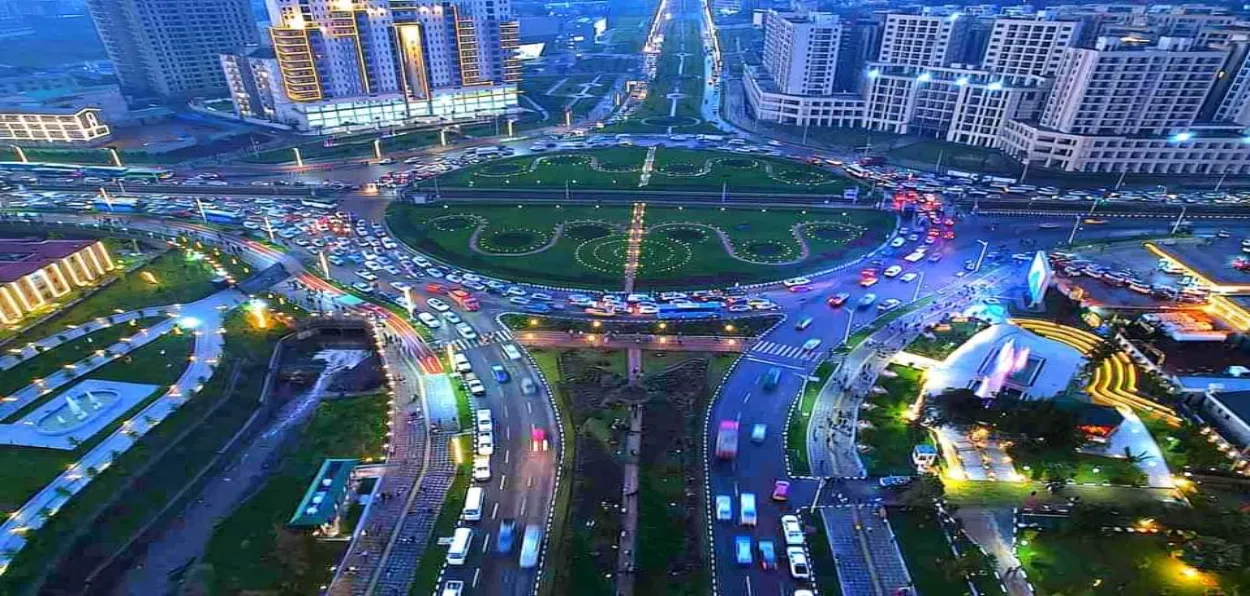 Addis Ababa, capital of Ethiopia
Both India and Jordan are keen to increase the basket of their trade. During India-Jordan Foreign Office Consultations (FoCs) in Amman on April 29, 2025, both sides agreed on the need to further diversify economic cooperation and promote mutual investments. Indian investments in Jordan are primarily in fertiliser and textiles. To the tune of $1.5 billion, Indian companies are in the phosphate and textile sectors of Jordan.
Education forms an important link to connect Indians with Jordanians. Annually, around 500 Jordanian students pursue studies in India. About 2500 Jordanian alumni of Indian universities are in Jordan. Following the Foreign Office Consultations, slots offered to Jordan, under the Indian Technical and Economic Cooperation (ITEC) Programme, have been increased from 37 to 50.
Indian art and culture, especially Bollywood films and actors, are very popular in Jordanian households. A few Bollywood films have also been shot in the picturesque and historical locations of Jordan. For instance, ‘Bade Miyan Chote Miyan’ film, with stars like Akshay Kumar, Tiger Shroff, and Prithviraj Sukumaran in lead roles and released in 2024, was shot in Jordan.
Besides Bollywood films, Yoga is also very popular in Jordan. Farah Qudsi’s Namaste Zone has played a significant role in popularising this exercise, which emphasises bringing harmony between mind and body. Jordanian Princess Basma bint Ali attended the Yoga Day this year.
Importance of Ethiopia
Ethiopia, where Prime Minister Modi will land in the second leg of the visit—from December 16 to 17, is one of the key partners of India in the Global South. The seat of the African Union and a major player in the Horn of Africa, Ethiopia has enjoyed warm and cordial relations with India since full time diplomatic ties were established between the two countries in 1950.
 Prime Minister Narendra Modi with Sultan Haitham bin Tariq Al Said of Oman in New Delhi
The first-ever prime ministerial visit from India to Ethiopia since 2011 is taking place at a time when the US, China, the European Union, the Gulf countries, and Türkiye are increasing their influence in Africa. India’s outreach indicates its keenness to consolidate its relationship with the region. Prime Minister Modi has redefined India’s engagement in Africa by outlining its 10 guiding principles.
These include, commitment to liberate Africa’s potential by building local capacity and creating local opportunities; keeping India’s markets open; sharing India’s experience with the digital revolution to support Africa’s development; improving delivery of public services; extending education and spreading digital literacy in Africa; improving Africa’s agriculture; addressing the challenges of climate change; and working with African nations to keep the oceans open and free for the benefit of all nations among others.
Trusted partnership with Oman
Oman, which is sitting at the mouth of the Strait of Hormuz, a strategic waterway through which India imports a significant portion of crude oil every year, will be the last destination of Prime Minister Modi’s three-nation trip.
Visiting Oman from December 17 to 18 at the invitation of Sultan Haitham bin Tarik, Prime Minister Modi is expected to impart a new dimension to New Delhi’s partnership with Muscat. Oman is the only Gulf country with which India’s Army, Navy and Air Force regularly conduct joint exercises.
Both countries cooperate closely on maritime security in the Indian Ocean. Over the years, the two countries have expanded their collaboration to counter-terrorism, combating organised crime and anti-piracy operations.
During the G20 summit in September 2023, India as a mark of its special friendship with Oman, had extended an invitation to the Gulf nation to participate in the meet as a guest country.
The economic and commercial relations between India and Oman are robust. Bilateral trade during 2023-24 reached $8.947 billion, and for 2024-25 reached $10.613 billion. During the Prime Minister’s visit, the two countries are likely to sign a free trade agreement.
Notably, Oman ranked as India’s 29th largest export market and 25th largest source of imports for 2024-25. Overall, Oman was India’s 28th largest trading partner in 2024-25. India was the 3rd largest market for Oman’s non-oil exports for 2024-25.
Main items of India’s exports to Oman during 2024-25 included light oils and preparations, aluminum oxide (other than artificial corundum), and rice, along with boilers, machinery and mechanical appliances and their parts.
India also exported airplanes and other aircraft and spacecraft, electrical machinery and equipment and their components, as well as beauty and make-up preparations, plastics and articles thereof, iron and steel and ceramic products.
Main items of India’s imports from Oman during 2024-25 included energy and industrial inputs. The principal import items included crude petroleum oil and liquefied natural gas (LNG), which together accounted for a significant portion of the bilateral trade value.
ALSO READ: Pakistan bursting at the seams, internally and externally
Other major imports comprised urea (including fertiliser grade), organic chemicals, anhydrous ammonia, and sulphur. India also imported earth and stone, plastering materials, lime, plastics in primary forms, airplanes and other aircraft, and iron ores and concentrates.

.jpg "Gujarat’s women entrepreneurs bring their craftsmanship to life during Navratri")