Mumbai (Maharashtra)
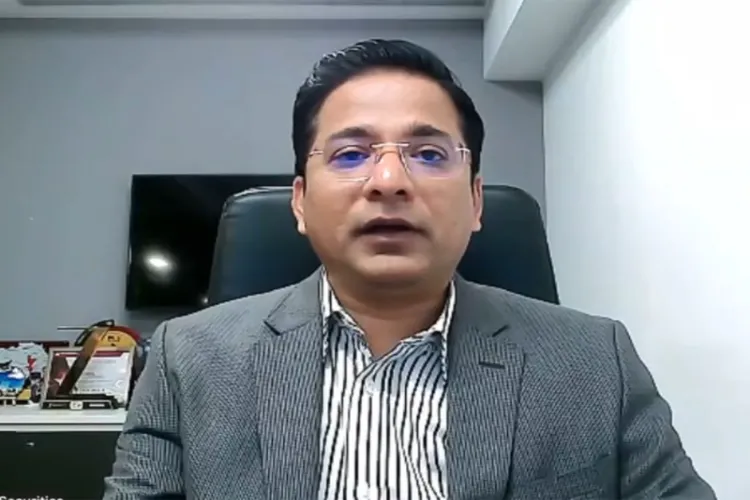
The share markets in the country are likely to remain under pressure for the next couple of quarters due to rising crude oil prices, geopolitical tensions, foreign institutional investor (FII) outflows and concerns around currency weakness, according to Rajesh Palviya, Head of Research at Axis Direct.
In an exclusive conversation with ANI on Wednesday, Palviya said Indian markets may not quickly return to their previous all-time high trajectory as multiple global headwinds continue to weigh on investor sentiment.
"I think it will remain for next couple of quarter we will not be able to move very fast to again all time high trajectory," he said.
According to him, supply disruptions in crude oil due to geopolitical tensions have already started impacting the economy and could add inflationary pressure in the coming quarters.
"This crude oil supply disruption is already taking place and I think it will take time to settle down and this is going to give inflationary pressure to our economy also in coming quarter," he said.
Palviya noted that Indian markets have already been witnessing a prolonged correction phase for nearly 18 to 20 months, which he described as one of the longest correction periods seen after the COVID-19 pandemic.
"We are already seeing almost 18-20 month of correction phase. This is the highest time period post COVID," he stated.
He attributed the weakness in markets to multiple factors including US tariffs, geopolitical tensions and concerns around the global economy.
While acknowledging that the government has introduced several proactive reforms and measures to support the domestic economy, he said global developments continue to dominate market sentiment.
"Global factors are always supreme because we are linked economy to the global market and until and unless we don't have stability in the global triggers I think our market may remain under pressure," he said.
Palviya also pointed to continuous FII selling over the past few years as a major reason behind the underperformance of Indian equities compared to global peers.
"The major concern is from the FII flows also and since last couple of years we are seeing negative flows from the FII continuously withdrawing the money from our market," he said.
He further said the rupee has also struggled to stabilise despite measures taken by the Reserve Bank of India.
However, he noted that certain sectors such as metals and quality mid-cap stocks have continued to perform well due to better earnings visibility.
Discussing factors that could trigger a market recovery, Palviya said de-escalation of geopolitical tensions would be the biggest positive trigger for equities.
"Once we see de-escalation at any given point of time of this war, then our market will start recovering," he said.
At the same time, he highlighted concerns regarding the impact of artificial intelligence on the IT sector.
READ MORE: Abeda Inamdar left a cushy job to change lives through education, social reform
"How IT companies are going to cope up with all this AI disruption which is taking place, that's another concern," he stated, adding that investors are closely watching how quickly Indian IT companies adapt their business models to AI-led changes.
On the government's recent decision to raise import duty on gold, Palviya said the move is aimed at containing gold imports and protecting India's foreign exchange reserves amid rising crude prices and rupee weakness.














.webp)
.webp)