New Delhi
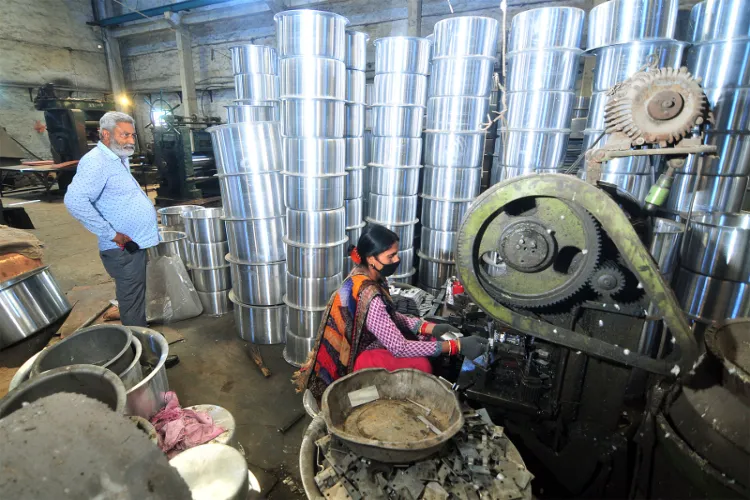
The Micro, Small, and Medium Enterprises (MSME) sector in India has emerged as a primary driver of national economic output, with its share in the country's Gross Value Added (GVA) rising consistently to reach 30.1 per cent in the 2022-2023 fiscal year, said Soumya Kanti Ghosh, the Group Chief Economic Advisor at the State Bank of India (SBI) and member of the Prime Minister's Economic Advisory Council (EAC-PM).
Speaking at the India SME Finance and Summit, he said this growth highlights the sector's increasing significance, with its share rising to 27.3 per cent in 2021, reflecting remarkable resilience in the domestic economy.
The sector's integration into global trade has also deepened, as MSME-related products accounted for 45.73 per cent of India's total exports in 2024-2025. Ghosh stated that these figures reinforce the role of smaller players in positioning the country as a global manufacturing hub. The value of exports from MSMEs witnessed a significant surge, climbing from 3.95 lakh crore in 2021 to 12.4 trillion in 2024-2025.
The number of exporting MSMEs has increased almost threefold over a four-year period. According to data shared by Ghosh, the count of these units grew from 52,849 in 2021 to 1,76,315 in 2024-2025. This trend underscores the sector's potential to drive India's position as an export powerhouse. Ghosh noted that the contribution to Indian exports grew from 43.5 per cent in 2022-2023 to 45.79 per cent in 2024-2025.
Addressing the regulatory landscape, Ghosh emphasised the shift toward more transparent and rational implementation steps.
"In India, in fact, interestingly, MSMEs have been traditionally defined based on investing in plant and machinery and equipment, which has since then largely given way to the wide system of factoring turnover-based criteria, which is a rational, transparent, easier-to-implement step with the introduction and operation tradition of the GST," he said.
He added that including retail and wholesale trade under the MSME umbrella is expected to create synergies across the ecosystem.
Ghosh highlighted that the formalisation of the sector has been accelerated through increased registrations on digital platforms. Total registrations on the Udyam and Udyam Assist portals have reached approximately 7.7 crore, a substantial rise from the 6.6 crore recorded during the 2016 survey.
This total includes 4.6 crore registrations on Udyam and 3.1 crore on the Udyam Assist Portal. Micro-enterprises continue to dominate the landscape, representing 99 per cent of the total share.
READ MORE: Khan Sir’s affordable hospital in Patna becomes lifeline for poor
Ghosh further noted that the sector has generated 34 crore jobs across various categories. Trading accounts for 3.32 crore employees, followed by services at 2.38 crore and manufacturing at 1.6 crore.
Ghosh highlighted the sector's inclusivity, noting that "Around 40%, which is 3.33 crore, of the firms are owned by women". He compared the Indian landscape to global trends, noting that in the USA, small and medium-sized enterprises account for 99.9 per cent of all businesses and employ six in ten workers.













.webp)