




New Delhi
Satyajit Ray bent over his hard-bound ledger, or “kheror khata”, eyes fixed and lips pursed, is one of the most intimate moments captured by photographer Nemai Ghosh, whom Henri Cartier-Bresson once described as the great filmmaker's “photo-biographer”.
Colour photographs that show Ray composing music on his synthesiser, designing costumes in his sketchbook, or deeply engrossed in his study at home extend the filmmaker’s life beyond his sets and are now part of “Faces and Facets: Satyajit Ray in Colour”, an exhibition by DAG devoted exclusively to the colour photographs of Ray by Ghosh.
Ghosh, who was Ray’s photographer from 1968 until his death in 1992, went beyond shooting the filmmaker at his filmsets and ventured into his personal spaces, unannounced and at odd hours.
In a book accompanying the exhibition, originally published in 2019 and written by Andrew Robinson, Ghosh recalls “dropping in on him”, whenever he felt low.
“I visited his house as often as I liked, at any hour. If I did not turn up for a day or two, there would be a phone call asking why I was absent… I caught him at his drawing-board, at his piano, immersed in his sketchbook, in conversation with friends and family, in contemplation, at public functions and at private ones.
"Yet, unobtrusive as I was and candid as the photographs are, I cannot say that I ever caught him unawares. Manikda was always aware of my presence, although he never commented on it,” the photographer wrote in the book's preface.
Ghosh’s quiet observation of moments when Ray was alone with his thoughts and preoccupations would make him say, “Nemai is like a bug on my windowsill”.
The exhibition offers a vivid portrait of one of India’s most celebrated filmmakers, opening a window into the life and art of “The Jewel of Bengal”, through Ghosh’s decades-long documentation of the quintessential Satyajit Ray.
If one image shows Ray at home in Calcutta, 1982, in a large room surrounded by books and papers, another features him contemplatively smoking a cigar with his foot dangling over the other.
“Nemai Ghosh’s lens extended beyond Satyajit Ray’s film sets into his intimate personal world. A frequent visitor to Ray’s home, Ghosh often captured Ray at the piano, at his drawing board, or in quiet conversation with friends and family. He photographed Ray in moments of profound introspection – whether at home, in his studio, or on location – likening him to a meditative yogi,” Ashish Anand, CEO and MD, DAG said in a statement.
Before becoming Ray's photographer, Ghosh was an actor in Utpal Dutt's theatre company. He was introduced to Ray through the filmmaker's art director, Bansi Chandragupta. Ray liked the pictures Ghosh clicked and asked him to join his production in 1968 during the shooting of "Goopy Gyne Bagha Byne".
From solitary walks through his house and lighter moments during shoots, or silent contemplation in open fields, Ghosh preserved a deeply human and nuanced portrait of the filmmaker, he added.
Apart from looking at Ray, the multi-hyphenate man at home, the exhibition focuses on Ray, the filmmaker, and his cinematic practice in vivid detail with rare images of actors, scenes, sets and locations, taken over a twenty-five-year period.
“Ray’s dedication to his craft led Ghosh to follow him like a shadow and conditioned him to the exacting demands of the maestro. Over the course of a twenty-five-year association that began on the sets of ‘Goopy Gyne Bagha Byne’, Ghosh remained steadfast in upholding the values that defined Ray’s artistic vision. In Ray, Ghosh found not just a filmmaker but a mentor and friend; no other director’s set quite measured up,” Anand said.
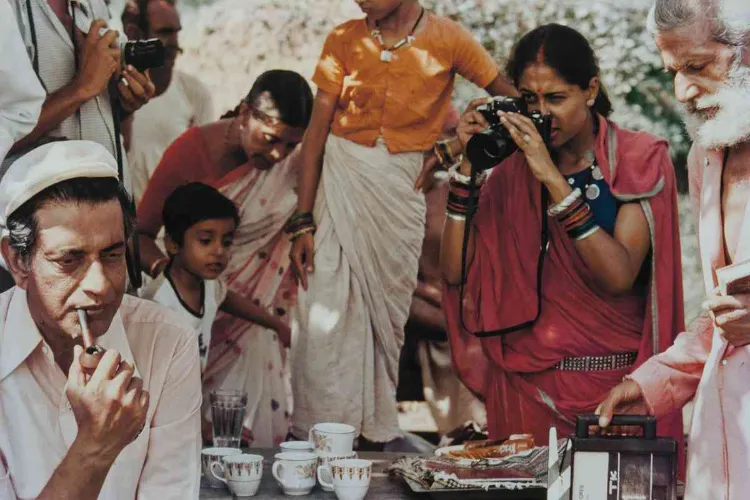
If on the set of “Shatranj ke Khiladi” (1977), Ghosh captured Ray, who did not speak Urdu, rehearsing the Urdu-speaking Sanjeev Kumar and Saeed Jafrey in English, a moment from the set of “Sadgati” (1981) caught Smita Patil photographing Ray, surrounded by other crew members.
Ghosh also followed Ray when he was working on “The Inner Eye” (1972), a documentary on renowned artist Benode Bihari Mukherjee.
Mukherjee was Ray's favourite teacher when he was an art student at Tagore’s university in Santiniketan in 1940-42, and remained an inspiration to him thirty years later in his documentary about Mukherjee.
READ MORE: Abeda Inamdar left a cushy job to change lives through education, social reform
The photographer caught Ray in action on the sets of most of films, including “Ashani Sanket” (1973), “Sonar Kella” (1974), “Joi Baba Felunath” (1979), “Hirak Rajar Deshe” (1980), “Pikoo” (1980), “Ghare Baire” (1984), “Ganasatru” (1989), “Sakha Prasakha” (1990), and “Agantuk” (1991).
The exhibition will remain on view till July 14.






.jpg "Anil Kapoor with Satish Kaushik")
.jpg "Veteran actor Tom Skerritt")
.jpg "Actor Manoj Bajpayee")
_(1).jpg)
_(4).webp)