New Delhi
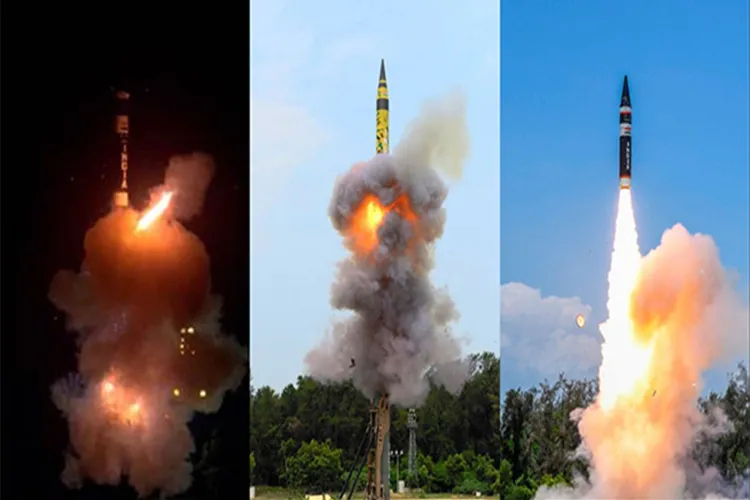
At the ANI National Security Summit 2.0 in New Delhi, DRDO Chairman Samir V Kamat said that progress on the proposed Agni-VI ballistic missile programme hinges on a formal decision by the government, while emphasising that the agency is fully prepared to move ahead once approval is granted.
“The decision rests with the government. We are ready to proceed whenever we receive the go-ahead,” he stated.
The Agni-VI is expected to be a next-generation intercontinental ballistic missile with greater range and enhanced capabilities compared to earlier systems in India’s Agni series.
Kamat also shared updates on India’s hypersonic weapons efforts, noting that the long-range anti-ship missile (LR-AShM) hypersonic glide programme has reached an advanced phase, with initial trials likely in the near future. He explained that India is currently pursuing two parallel hypersonic projects — a hypersonic glide missile and a hypersonic cruise missile — with the glide system ahead in development.
Clarifying the distinction between the two, he said hypersonic cruise missiles are powered throughout their flight using a scramjet engine, while hypersonic glide missiles rely on an initial boost before gliding unpowered at high speeds. According to him, the glide variant is closer to testing and may see its first trials soon.
Discussing the concept of a conventional missile force, which remains under consideration, Kamat outlined the need for a balanced mix of systems across varying ranges and operational roles. He said such a force would likely include short-, medium-, and longer-range ballistic missiles, potentially extending up to around 2,000 kilometres, along with cruise and hypersonic missiles.
He stressed that a diverse arsenal would provide the flexibility required for different tactical scenarios, enabling precision strikes at multiple distances.
On current preparedness, Kamat pointed out that short-range systems are nearing induction, highlighting the Pralay missile as being in the final stages of testing. He added that some existing strategic missile platforms could also be adapted for tactical roles in medium and higher ranges.
READ MORE: RJ Saima's Purani Jeans revived love of golden era music among youth
Earlier at the same event, Defence Secretary Rajesh Kumar Singh had indicated that India is working towards building a multi-layered conventional missile capability covering short, medium, and long-range requirements.










_(1).webp "Senior Congress leader Ashok Gehlot")

.webp)