Bratislava
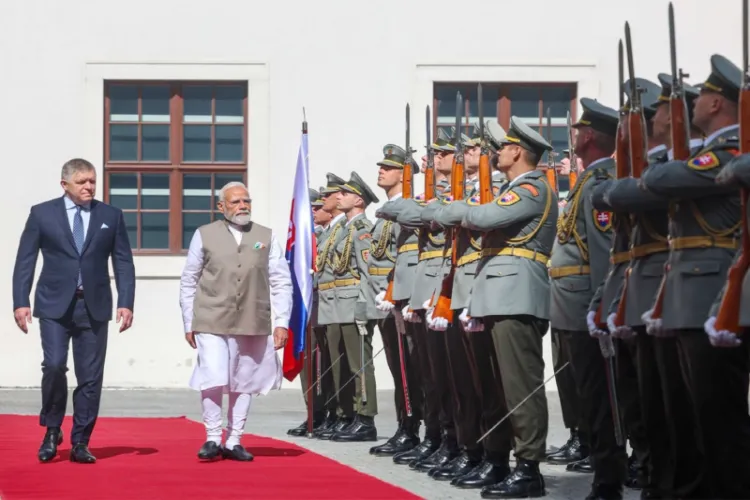
India and Slovakia on Monday agreed to strengthen cooperation in the fight against terrorism by establishing a Joint Working Group on Counter-Terrorism, while jointly condemning terrorism in all its forms, including cross-border terrorism, during Prime Minister Narendra Modi's visit to Slovakia.
In a joint statement issued after talks between Prime Minister Modi and Slovak Prime Minister Robert Fico, both leaders strongly denounced the April 22, 2025 terrorist attack in Pahalgam, Jammu and Kashmir, and reaffirmed their commitment to closer collaboration in addressing global terror threats.
The two sides stressed that terrorism remains one of the most serious challenges facing the international community and called for coordinated and sustained global efforts to combat the menace. They also pledged to enhance cooperation at both bilateral and multilateral levels, including within the United Nations framework.
The statement underscored the need for firm action against terrorists, terrorist organisations and those who provide them with support, funding, shelter or logistical assistance. It also highlighted the importance of bringing to justice the planners, perpetrators and sponsors of terrorist activities.
India and Slovakia further agreed to work together towards the early conclusion and adoption of the Comprehensive Convention on International Terrorism (CCIT) at the United Nations.
The reference to the Pahalgam attack recalled the deadly assault carried out in Jammu and Kashmir on April 22, 2025, in which 26 civilians lost their lives. The attack targeted tourists and residents in the popular hill destination, triggering widespread condemnation across India and abroad.
According to official accounts, the attackers allegedly identified victims on the basis of their religious identity before carrying out the killings, making the incident one of the deadliest civilian-targeted terror attacks in recent years.
Following the attack, India launched Operation Sindoor on May 7, 2025, targeting terrorist infrastructure located across Pakistan and Pakistan-occupied Jammu and Kashmir (PoJK). Indian authorities stated that the operation struck multiple terror launchpads associated with groups such as Lashkar-e-Taiba, Jaish-e-Mohammed and Hizbul Mujahideen, resulting in significant damage to militant infrastructure.
The operation was followed by a period of heightened military tensions between India and Pakistan, including drone attacks and cross-border shelling. Indian forces subsequently carried out retaliatory strikes against military installations, including radar facilities in Pakistan.
The hostilities lasted several days before a ceasefire understanding was reached on May 10 following communication between the Directors General of Military Operations (DGMOs) of the two countries.
Security forces later conducted Operation Mahadev, a coordinated counter-terrorism mission that resulted in the elimination of three militants allegedly linked to the Pahalgam attack.
READ MORE: Zeenat Pannah's enduring work to preserve India's textile heritage
In the diplomatic and economic sphere, India also announced a series of measures against Pakistan following the attack, including the suspension of bilateral trade and the termination of the Indus Waters Treaty.


.webp "Rocks bearing inscription in ancient Arabic excavated in Saudi Arabia's Madina region")