New Delhi
India on Friday reaffirmed its position that terrorism, particularly cross-border terrorism, poses a serious global challenge and stressed that nations supporting or enabling such activities must be identified and held accountable.
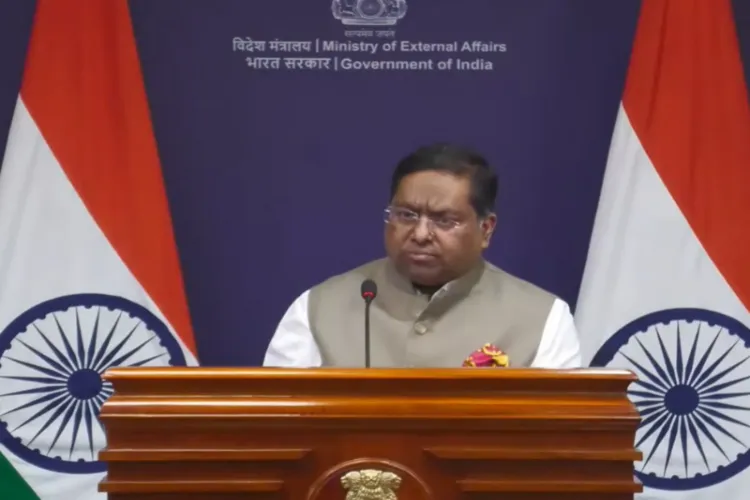
Speaking during the weekly media briefing in New Delhi, Ministry of External Affairs spokesperson Randhir Jaiswal said the international community must work collectively to combat terrorism in all forms.
“Cross-border terrorism is a global threat, and the world must unite to fight it. Countries that support or facilitate terrorism from their territories should be clearly identified and called out,” Jaiswal said.
His remarks came in response to questions regarding statements made by National Security Advisor Ajit Doval during his recent visit to Moscow.
Addressing the 1st International Security Forum and the XIV International Meeting of High-Ranking Officials Responsible for Security Matters in Moscow on Thursday, Doval stressed that there should be no double standards in the global fight against terrorism.
He said every nation has a responsibility to act against terror groups and those who finance or shelter them, describing terrorism as one of the gravest threats to international peace and security.
“There cannot be selective approaches in dealing with terrorism. Responsible countries must decide whether they stand with the sponsors of terrorism or against them and take firm action accordingly,” Doval stated.
Referring to the April 22, 2025 terror attack in Pahalgam in Jammu and Kashmir, the NSA said India had long suffered from state-sponsored terrorism and pointed towards terror groups operating from Pakistan.
Doval recalled that 26 civilians were killed in the attack after reportedly being targeted on the basis of their religion.
The Resistance Front (TRF), believed to be linked to the Pakistan-based terror group Lashkar-e-Taiba (LeT), had claimed responsibility for the attack.
The NSA said India’s response following the attack was in line with the approach outlined by the United Nations Security Council, which had called for bringing perpetrators, organisers, financiers and sponsors of terrorism to justice.
Following the Pahalgam attack, India launched Operation Sindoor on May 7, 2025, targeting terror infrastructure located in Pakistan and Pakistan-occupied Jammu and Kashmir (PoJK).
According to official information, Indian armed forces destroyed nine terror launchpads associated with Lashkar-e-Taiba, Jaish-e-Mohammed and Hizbul Mujahideen during the operation, and more than 100 terrorists were reportedly eliminated.
The strikes were followed by drone attacks and shelling from Pakistan in border areas, leading to a four-day military confrontation between the two countries.
India subsequently carried out retaliatory operations targeting radar systems and military infrastructure across the border.
READ MORE: Bashir Badr: people's poet whose words echoed from college canteens to political corridors
The hostilities eventually ended after Pakistan’s Director General of Military Operations contacted his Indian counterpart, following which a ceasefire understanding was reached on May 10.