Calicut (Keralam)
For nearly two decades, Abdul Rahim existed in the memories and prayers of his family in a small Kerala village — a son trapped in a Saudi prison, a man staring at the shadow of death in a foreign land. On Thursday morning, as he finally returned home ahead of Eid, the narrow lanes of Kodampozha in Kozhikode turned into scenes of tears, prayers and celebration.
His homecoming was not just the return of one man. For many in Kerala, it felt like the triumph of collective humanity, especially the unity of the Kerala people, the Malayalis.
Abdul Rahim, who spent almost 20 years in a Saudi Arabian jail after being convicted in the death of his employer’s disabled son, reached his hometown to an emotional welcome from hundreds of villagers, relatives and well-wishers. His release became possible after Malayalees from across the world — irrespective of religion or social status — raised more than Rs 34 crore as blood money to secure his freedom.
People in Kodampozha had been waiting since dawn. By the time an SUV carrying Abdul Rahim entered the village around 9:15 a.m., the narrow road leading to his ancestral house, Zeenat Manzil, was overflowing with people. Children stood on compound walls, elderly men leaned on walking sticks near the gate, and women watched silently from verandahs, many wiping tears even before catching a glimpse of him.
20 വർഷത്തിന് ശേഷം സൗദി ജയിലിൽ നിന്ന് മോചിതനായ കോഴിക്കോട് സ്വദേശി അബ്ദുൽ റഹിം നാട്ടിലെത്തി#AbdulRahim #SaudiArabia #Kozhikode #Kerala #BreakingNews pic.twitter.com/UAOykRb5Fd
— DD News Malayalam (@DDNewsMalayalam) May 28, 2026
As the vehicle slowly moved through the crowd, people surged forward, some raising prayers, others simply wanting to see the man whose story had moved an entire state. Abdul Rahim lowered the car window and waved weakly. His face carried exhaustion, disbelief and gratitude all at once.
For a moment after stepping out of the vehicle, he appeared overwhelmed by the sea of faces surrounding him. Many in the crowd had never met him personally, yet they spoke of him as though he were a member of their own family.
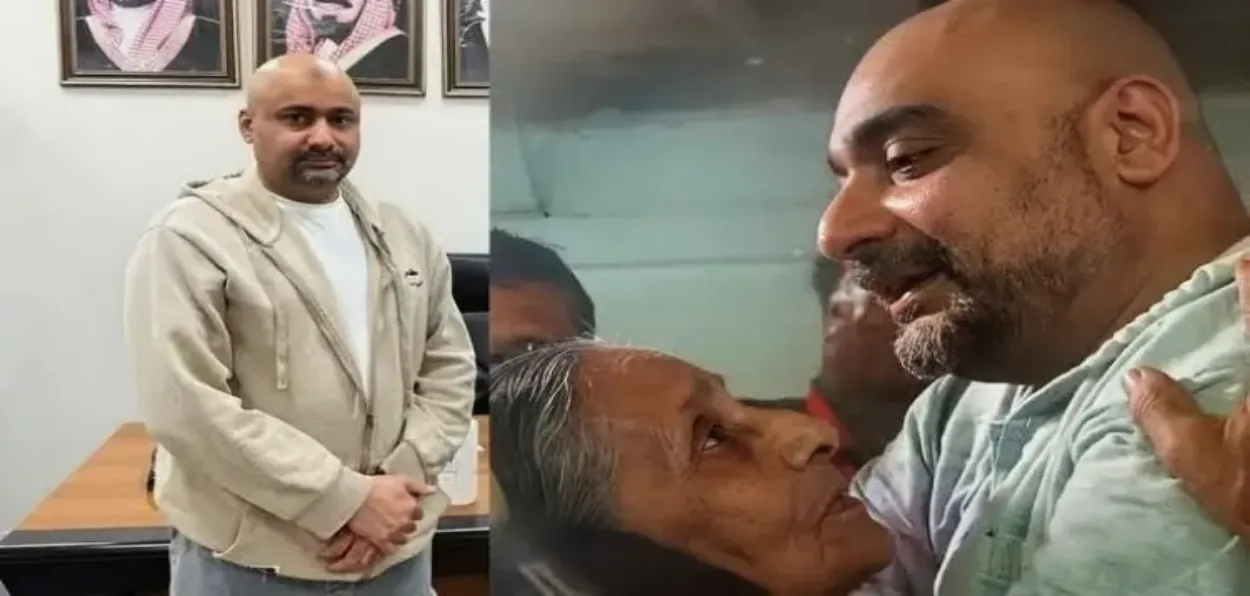
Standing in the verandah was his ageing mother, Fatima.
Time had carved deep lines across her face during the years her son spent in prison, but on Thursday morning, her eyes were fixed only on him. The moment Abdul Rahim looked towards her, Fatima broke down. Covering her face with a towel, she wept openly as relatives tried to console her. Abdul Rahim, too, struggled to hold back tears while moving towards her through the crowd.
Inside the house, the first meal waiting for him had been prepared by the mother who had spent almost two decades praying for this moment.
“I have no words to describe my happiness,” Abdul Rahim said later, his voice trembling with emotion. “I am alive today because of the prayers and selfless help of thousands of kind-hearted people. I will remain grateful to them forever.”
Abdul Rahim had travelled to Saudi Arabia nearly 20 years ago in search of a better livelihood. He was only 26 then. Within weeks of reaching the Gulf country, tragedy struck.
After 20 years in a Saudi jail, Kozhikode native Abdul Rahim returned home to Kerala. Malayalis worldwide united through the “Save Abdul Rahim” campaign and raised Rs 34 crore in blood money, securing his release. pic.twitter.com/uQyZ4k37Dj
— TheNewsMinute (@thenewsminute) May 28, 2026
He had been working as a driver for a Saudi family and was accompanying his employer’s disabled son during a journey when a medical feeding tube attached to the boy’s neck reportedly became dislodged after a sudden jerk inside the vehicle. According to Abdul Rahim’s account before the Saudi court, his hand accidentally struck the medical device connected to the child. The boy later lost consciousness and died.
Though the incident was described as unintentional, Abdul Rahim was arrested on December 24, 2006. After years of legal proceedings, he was sentenced to death in 2012.
Back home in Kerala, the case slowly transformed from a private tragedy into a public cause.
When news spread that the victim’s family had agreed to pardon Abdul Rahim in exchange for 15 million Saudi riyals — approximately Rs 34 crore — ordinary Malayalees began mobilising in extraordinary ways. A “Save Abdul Rahim” campaign gathered momentum across Kerala and among expatriate communities in the Gulf.
The fundraising effort soon became one of the largest public humanitarian campaigns witnessed in the state. Contributions poured in from mosque committees, churches, temples, expatriate workers, students, shopkeepers, auto-rickshaw drivers and Kudumbashree workers.
Fund Committee Convener KK Ali Kutti recalled how people donated whatever they could afford.
“Some sent Rs 100, others Rs 1,000. Many poor people gave from what little they had,” he said.
The campaign witnessed astonishing moments. Around Rs 10 million was reportedly collected within just nine minutes during one phase of fundraising. By the fifth day of Ramzan, collections had crossed Rs 5 crore. But the real surge came during the final days of the holy month.
On the 27th night of Ramadan — regarded by Muslims as Shab-e-Qadr, the Night of Power — emotions and prayers translated into massive public support. Nearly Rs 9 crore was raised in a single day. When the target amount was finally reached on April 12, another Rs 1 crore reportedly came in within minutes.
For many in Kerala, the campaign represented something larger than fundraising. It became a rare moment of unity cutting across religion, class and politics.
On July 2, 2024, a Saudi court overturned Abdul Rahim’s death sentence after the blood money agreement was completed. However, under Saudi public law, he remained in prison to complete a 20-year sentence.
The Indian Embassy in Saudi Arabia later confirmed his release, stating that officials had maintained continuous contact with Saudi authorities and monitored Abdul Rahim’s well-being throughout the legal process. The embassy also acknowledged the extraordinary support extended by the Indian community through the fundraising campaign.
After two decades away from home, Shri Abdul Raheem is finally returning to his family in Kozhikode, Kerala. His flight to India left moments ago.
— India in Saudi Arabia (@IndianEmbRiyadh) May 27, 2026
Shri Abdul Raheem, who was facing a death sentence, has been pardoned and released after spending 20 years in prison. Throughout… pic.twitter.com/BvwqyiqzVY
On Thursday morning, as Abdul Rahim finally sat inside his modest home in Kodampozha eating food served by his mother, the scenes outside still resembled a festival. People continued arriving in groups, some carrying flowers, others simply wanting to offer prayers and shake his hand.
In the village that had spent years speaking his name in whispered prayers, Abdul Rahim was no longer a distant prisoner in Saudi Arabia.
ALSO READ: Hebron, a town where Jews and Muslims claim Prophet Ibrahim's legacy
He was finally home for Eid.