.webp "Prime Minister Narendra Modi")
New Delhi
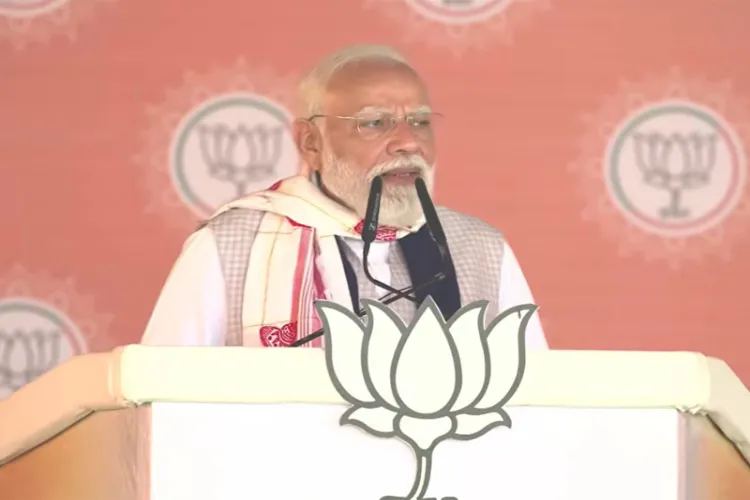
Prime Minister Narendra Modi on Monday underlined the Bharatiya Janata Party’s efforts to transform India’s political landscape, pointing to key reforms and upcoming initiatives as part of what he described as a service-driven approach to governance.
Addressing party workers via video conferencing on the BJP’s 47th foundation day, Modi listed several measures undertaken by his government, including the scrapping of outdated colonial-era laws, the construction of a new Parliament building, the introduction of 10 per cent reservation for economically weaker sections, the law banning triple talaq, implementation of the Citizenship Amendment Act, and the Ram temple project in Ayodhya.
He said these steps reflected the party’s commitment to nation-building and added that its reform agenda remains ongoing. The Prime Minister also referred to emerging policy discussions around the Uniform Civil Code and the concept of One Nation One Election, describing them as efforts aimed at strengthening national unity and improving governance efficiency.
Looking ahead, Modi noted that the party would soon complete 50 years, calling it a significant milestone that should inspire workers to set new goals while adapting to technological changes. He extended greetings to party members across the country on the occasion.
Emphasising the BJP’s ideological foundation, Modi said the party operates on the principle of “Nation First”, contrasting it with what he described as power-centric politics of earlier regimes. Referring to the post-1984 period, he claimed that public trust in the BJP grew gradually as people became disillusioned with the Congress.
He also drew a distinction between the BJP and the Indian National Congress, alleging that the latter prioritised a single family, whereas his party gives importance to all citizens.
On foreign policy, Modi said India’s global engagement has expanded significantly, moving from a phase of limited outreach to building relationships with a wide range of countries.
Tracing the party’s origins, he recalled that the BJP was formed in 1980 following the exit of former Jana Sangh members from the Janata Party amid ideological differences, particularly over links with the RSS.
READ MORE: Delhi Advocate Ekta Pareek fights for clean environment, animal rights
Since its inception, the BJP has led the country under two prime ministers — Atal Bihari Vajpayee and Narendra Modi.

.webp "S. Irfan Habib with Saquib Salim in Deen Aur Duniya")






.webp)
.webp)