Shahjahanpur
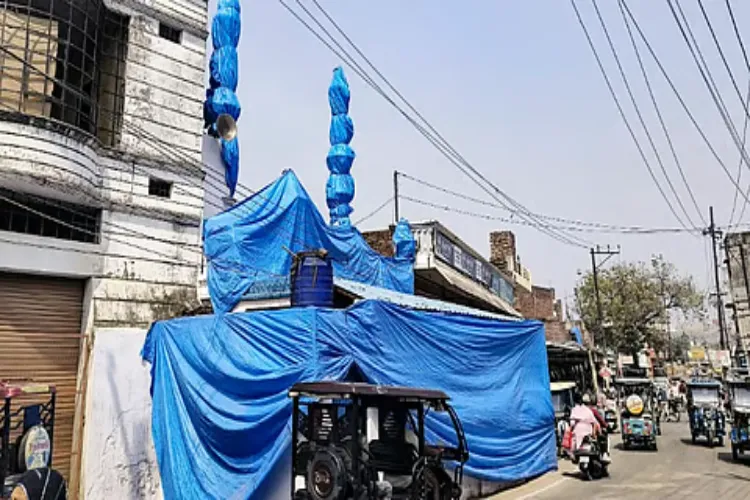
Authorities have covered mosques and mazars along the routes of the traditional ‘Juta Maar Holi’ procession in Shahjahanpur with tarpaulin sheets and announced heightened security arrangements for the annual event, officials said on Monday.
‘Juta Maar Holi’ is a centuries-old tradition celebrated in Shahjahanpur on the day of Holi, during which participants throw shoes and sandals at a person dressed as a British-era ‘Laat Sahab’, who rides a buffalo cart through the city, amid colours and festivities.
Superintendent of Police Rajesh Dwivedi said that more than 200 magistrates will be deployed, while security personnel strength will be about one-and-a-half times higher than last year.
Four Additional Superintendents of Police, 13 Circle Officers, 310 sub-inspectors, 1,200 constables and 500 home guards will be deployed during the procession, he said.
In addition, four companies each of the Provincial Armed Constabulary (PAC) and the Rapid Action Force (RAF), along with a team of the National Disaster Response Force (NDRF), will be stationed along the route, the SP added.
Over 100 solar-powered CCTV cameras have been installed along the eight-kilometre routes of the ‘Bade Lat Sahab’ and ‘Chhote Lat Sahab’ processions to ensure uninterrupted surveillance even during power outages.
Dwivedi said that since minor incidents were reported during last year’s procession, an additional security zone has been created this year. He added that peace committee meetings involving members of all communities have been held over the past month at police stations and outposts.
Appealing to people to celebrate Holi peacefully, the SP warned that strict action would be taken against anyone attempting to disrupt the procession.
Additional District Magistrate (Administration) Rajneesh Kumar Mishra said that 48 mosques and mazars located along the procession route have been fully covered with thick plastic sheets.
He said 148 lanes opening onto the procession route will be barricaded to prevent sudden crowd surges. The procession has been divided into seven zones with sector and sub-sector arrangements.
A total of 136 zonal, sector and static magistrates will supervise the procession in their respective areas, while 103 magistrates will be deployed at Holika Dahan sites to oversee rituals from lighting of the pyre to the conclusion of ceremonies, Mishra added.
Preventive measures, including externment of identified individuals and opening of history sheets, have also been undertaken in view of the event, he said.
According to historian Vikas Khurana of Swami Sukdevanand College, the procession dates back to the 18th century when Nawab Abdullaha Khan returned to Shahjahanpur in 1728, coinciding with Holi celebrations, which were jointly observed by Hindus and Muslims through a city-wide procession.
He said the British administration later formalised the event after regaining control of Shahjahanpur in 1859. The procession continued peacefully after Independence and was renamed from “Nawab Sahab” to “Lat Sahab” in 1988 by then district magistrate Kapil Dev.
READ MORE: We want to ensure that no Hajj pilgrim dies: Kiren Rijiju
The procession begins with prayers at the Phoolmati Devi temple and passes through various parts of the city. A petition filed in the High Court in 1990 seeking a ban on the procession was dismissed, with the court recognising it as a long-standing tradition.









.webp "Representational Image")