

New Delhi
Stressing the expanding scope of global maritime vulnerabilities, Defence Minister Rajnath Singh on Wednesday emphasised that national security strategies can no longer focus solely on defending traditional sea lanes.
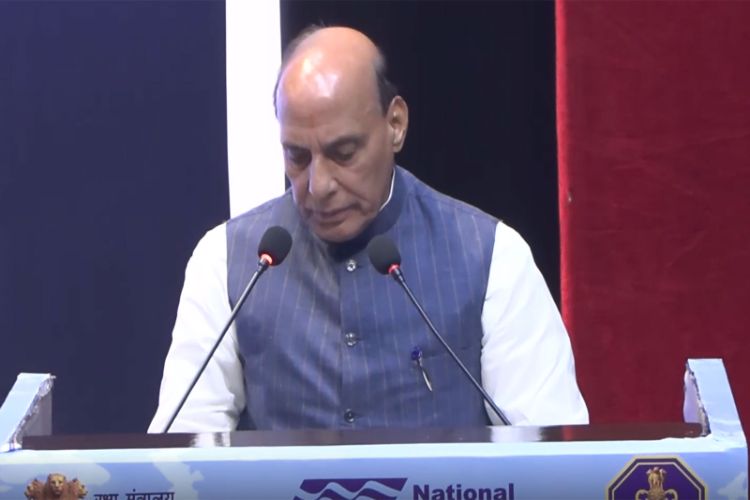
Addressing the Indian Indo-Pacific Regional Dialogue (IPRD) in New Delhi, the Defence Minister called for an upgraded, holistic surveillance architecture designed to protect critical assets, including offshore energy reserves, commercial ports, and vital undersea data cables, against both conventional naval threats and hybrid non-traditional challenges.
"The security of shipping lanes remains essential, but so does the security of ports, undersea cables, offshore energy infrastructure, and other critical maritime assets. The ability to understand what is happening across our maritime spaces has become equally important. The threats may emerge from conventional military activities. They may also arise from non-traditional challenges, including piracy, trafficking, illegal fishing, cyber attacks, and natural disasters. Our understanding of maritime security must therefore evolve with the changing nature of the maritime domain," said Rajnath Singh.
The Defence Minister’s remarks underscore a strategic shift in India’s maritime domain awareness (MDA), moving beyond basic sea lane patrol to safeguarding multi-dimensional maritime infrastructure.
With over 95% of global internet traffic and financial transactions passing through submerged fibre-optic cables, securing subsea communication networks has emerged as a top national security mandate.
Protecting offshore oil wells, natural gas terminals, and deep-water commercial ports is essential for safeguarding economic sovereignty and ensuring continuous supply lines.
The Defence Minister highlighted that non-state disruptions—such as maritime cyber-attacks, illegal, unreported, and unregulated (IUU) fishing, smuggling routes, and climate-induced natural disasters—require continuous, multi-agency domain tracking and agile naval response.
Rajnath Singh’s address aligns with India's ongoing efforts to enhance its blue-water naval posture and regional security footprint in the Indian Ocean Region (IOR) and the broader Indo-Pacific.
The Indian Navy has been steadily expanding its surveillance network through automated coastal radar chains, satellite-based tracking, acoustic sensors, and unmanned aerial vehicles (UAVs).
READ MORE: Burn survivor Parveen Khan turns her ordeal into a mission to help others
By advocating for a dynamic framework, India aims to ensure rules-based freedom of navigation while safeguarding critical economic nodes from evolving asymmetric threats.