New Delhi
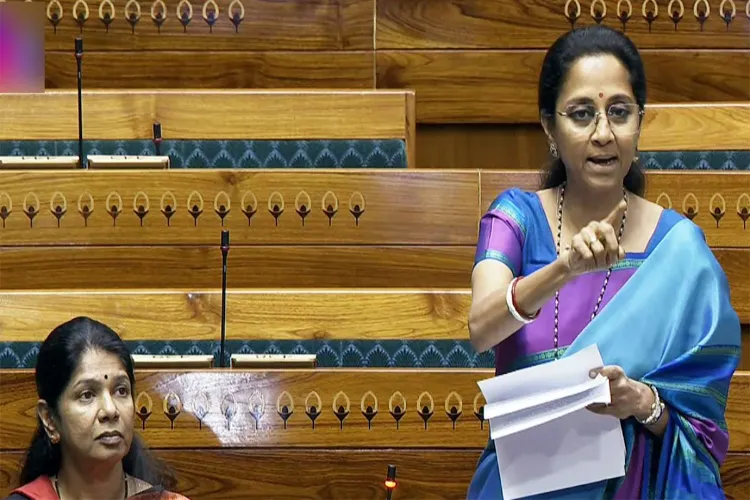
Lok Sabha member Supriya Sule has introduced a private member's Bill in the Lower House to promote work-life balance for workers and employees in India.
The Bill, "The Right to Disconnect Bill, 2025", seeks to impose sanctions at a rate of 1 per cent of the total remuneration of its employees on entities (companies or societies) for any non-compliance with the provisions of the Bill.
The Bill, as introduced in the Lok Sabha on Friday, provides every employee the right to disconnect from work-related electronic communications.
"It aims to foster a better quality of life and a healthier work-life balance by reducing the "burnout caused by today's digital culture," she wrote on X.
Introduced three forward-looking Private Member Bills in the Parliament:
— Supriya Sule (@supriya_sule) December 5, 2025
The Paternity and Paternal Benefits Bill, 2025, introduces paid paternal leave to ensure fathers have the legal right to take part in their child's early development. It breaks the traditional model,… pic.twitter.com/YjrWw4LFwf
While digital and communication technology offer benefits in terms of work flexibility, it also carries a significant risk of eroding the boundaries between professional and personal life, she argued in the private member's Bill.
"Studies have found that if an employee is expected to be available round the clock, they tend to exhibit risks of over-work like sleep deprivation, developing stress and being emotionally exhausted. This persistent urge to respond to calls and emails (termed as 'telepressure'), constant checking of emails throughout the day, and even on weekends and holidays, is reported to have destroyed the work-life balance of employees," the statement of objects and reasons of the Bill read. "According to a study, the constant monitoring of work related messages and emails, may overtax employees' brains leading to a condition called 'info-obesity'."
The Bill argued that there is a need to respect the personal space of the employees by recognising their right to disconnect and not respond to their employer's calls, emails etc., during out-of-work hours.
"The need is also to recognise the rights of the employees, it also takes into consideration the competitive needs of the companies and their diverse work cultures. Flexibility in the right to disconnect rules and leaves it to the individual companies to negotiate terms of service with their employees is need of the hour," the Bill further read.
The digital transformation has direct impact on conditions in the employment contract, like the time and the place of work.
Hence if an employee agrees to works during out-of-work hours, overtime pay at the same rate as his wage rate is also necessary to check the surge in unpaid overtime work, brought about by digital transformation, she argued in the Bill.
The Bill also provides for counselling services to increase awareness among employees and citizens, on reasonable use of digital and communication tools, for professional and personal use.
To free an employee from digital distractions and enable him to truly connect with the people around him, the Bill provides for digital detox centres.
"The Bill thus champions for the rights and welfare of employees, by mandating individual entities to negotiate out-of-hour service conditions with their employees, and upholding the right of employee to disconnect. The Bill seeks to recognise right to disconnect as a way to reduce stress and ease tension between an employees' personal and professional life," the Bill concluded.
She introduced all together what she termed forward-looking Private Member Bills in the Parliament - the other two were The Paternity and Paternal Benefits Bill, 2025. It introduces paid paternal leave to ensure fathers have the legal right to take part in their child's early development. It breaks the traditional model, supports the new mother's well-being, and promotes flexible parenting.
The other one is the Code on Social Security (Amendment) Bill, 2025, that recognises platform-based gig workers as a distinct category, ensuring minimum wages, regulated hours, social security, fair conditions, and equitable contracts to ensure a fairer, more sustainable environment and economy for them.
Several other members of the Lok Sabha also introduced their Private Member Bills in the House.


.png)





.webp "Rekha Gupta (CM, Delhi)")


.webp)