.webp "Guru Vishwmitra and Allama Iqbal (AI-generated image for representational purposes)and")
Ghaus Sivani
Allama Iqbal did not confine his writings to Islam or Muslim figures. Transcending religious boundaries, he paid tribute to many great personalities from different traditions. Vishvamitra was one such figure. Although Vishvamitra is primarily known through Hindu religious texts and the Puranas, Iqbal portrayed him as a revered and inspiring embodiment of wisdom, determination and the spirit of struggle.
In his celebrated Persian work Javid Nama, Iqbal uses the voice of Vishvamitra to convey powerful messages about humanity, self-confidence, freedom and the need for continuous struggle.
Who is Vishvamitra?
Vishvamitra was a great sage (Rishi). He is mentioned in the Rigveda, the Ramayana, the Mahabharata, and various Puranas.
According to tradition, Vishvamitra was originally a powerful king named Kaushik, a Kshatriya (Warrior community). He once confronted the sage Vashistha and was defeated. Instead of accepting defeat, he embarked on rigorous penance and spiritual discipline. Through his perseverance, he eventually attained the exalted status of Brahmarshi.
In the Ramayana, Vishvamitra is closely associated with Lord Rama. He imparted knowledge of divine weapons to Rama and Lakshmana and sought their assistance when demons repeatedly disrupted his yagnas (sacred ritual fire). King Dasharatha eventually sent his two sons with him in his Ashram.
Vishvamitra later took Rama and Lakshmana to Mithila, where, in King Janaka’s court, Rama broke Shiva’s bow and married Sita.
Hindus regard Vishvamitra as a symbol of wisdom, penance, determination and inner strength. He is also traditionally associated with the revelation of the Gayatri Mantra. (a sacred chant that demonstrates the unity that underlines manifolfness in creation).
Why did Iqbal admire Vishvamitra?
Vishvamitra was among the great figures whom Iqbal chose to bring into his poetic universe. Why did the poet, known for his Islamic thought and philosophy, find inspiration in an ancient Indian sage?
The answer lies in the striking similarity between Vishvamitra’s life and one of the central pillars of Iqbal’s philosophy: Khudi, or selfhood.
For Iqbal, Khudi was not merely an awareness of the self. It represented self-realisation, confidence, courage, purposeful action and the determination to overcome obstacles. Vishvamitra’s life exemplified this spirit precisely. He refused to regard defeat as his destiny. Through relentless effort and penance, he transformed himself and ultimately attained a spiritual stature at which even Vashistha acknowledged him as a Brahmarshi.
This journey from worldly power to spiritual greatness, achieved through determination and struggle, resonated deeply with Iqbal’s philosophy.
His famous couplet expresses the idea:Khudi ko kar buland itna ki har taqdeer se pehle; Khuda bande se khud pooche bata teri raza kya hai (Elevate your selfhood to such heights that, before decreeing your destiny, God Himself asks you: “Tell me, what is your will?”)
Vishvamitra in Javid Nama
Among Iqbal’s many celebrated works, Javid Nama, published in 1932, occupies a special place. It is much more than a collection of poems; it is a spiritual, intellectual and cultural journey through which Iqbal explores some of the deepest questions concerning humanity, civilisation and the destiny of nations.
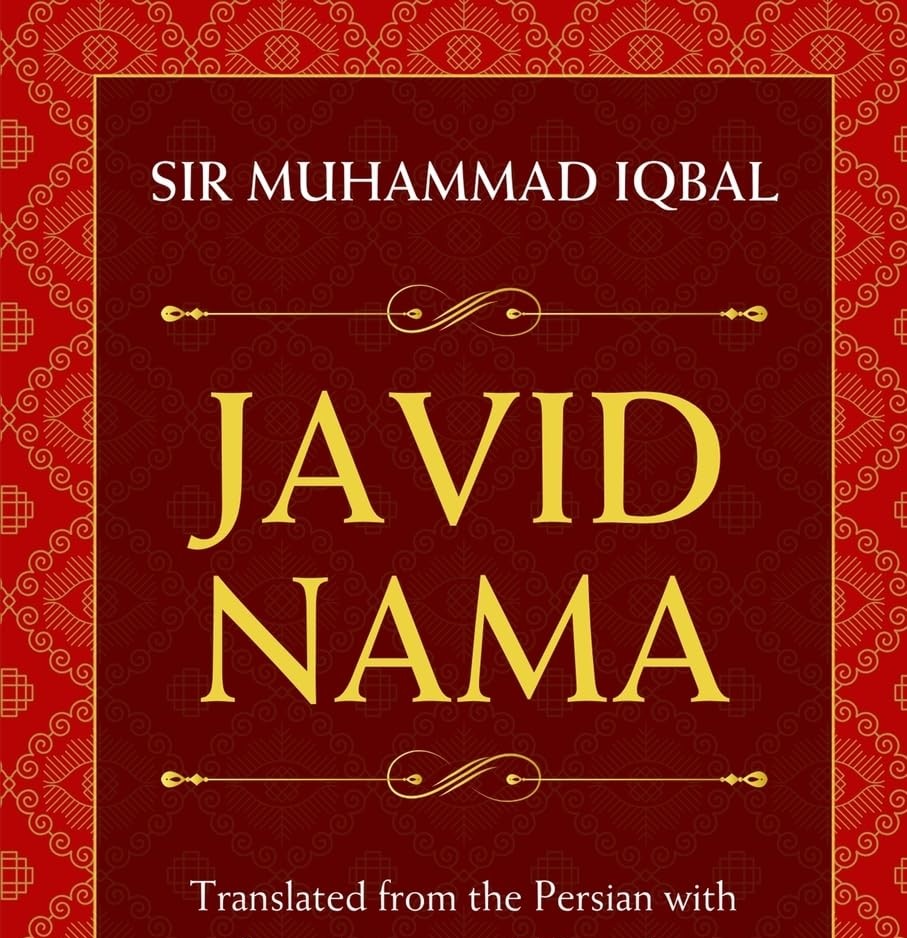
Guided by his spiritual mentor, the great Persian Sufi poet Maulana Jalaluddin Rumi, Iqbal travels through various celestial spheres and encounters a remarkable range of personalities. These include prophets, Sufis, Muslim thinkers, Western philosophers and figures associated with India’s ancient intellectual tradition. He also encounters controversial historical personalities such as Mir Jafar and Mir Sadiq.
It is during this extraordinary spiritual journey that Iqbal meets Vishvamitra.
He addresses the sage with honorific titles such as Arif-e-Hindi (Indian Sage) and Jahan-Dost (Friend of Humanity). His portrayal reflects not only his familiarity with India’s ancient culture, philosophy and literature but also his respect for those aspects of its intellectual heritage that he considered elevating and constructive.
The meeting with Vishvamitra
In Javid Nama, Iqbal describes an Indian sage living in seclusion in a cave on the Moon. The people of India, he says, call him Jahan-Dost—“Friend of the World”. Iqbal too arrives at this mysterious cave.
He then paints a striking, almost dreamlike picture of the surroundings. The valley is bathed in light, while every stone appears to be adorned with the sacred thread (Janeu). The towering date palms resemble enormous deities. The surreal landscape leaves Iqbal wondering whether he is witnessing reality or experiencing a dream.
He then sees Vishvamitra seated beneath a date palm. The sage’s eyes are lined with kohl, his hair is long, and a white serpent is coiled around his body.Vishvamitra turns to Rumi and asks about the person accompanying him, saying that he can see an intense yearning for life in his eyes.
Rumi responds by sharing his thoughts about Iqbal. Vishvamitra then reflects on the deepest questions of existence:
Alam az rang ast va be-rangi ast Haq; Chist alam? Chist adam? Chist Haq? (The world is filled with colours and forms, whereas the Ultimate Truth—God—is beyond colour and form. What, then, is the world? What is man? And what is the true nature of Truth?)
Through these questions, Iqbal invites the reader to reflect on the relationship between humanity, creation and the Creator. Everything in the visible world possesses a particular form and identity, yet its Creator transcends all such distinctions. The search for answers to these fundamental questions is one of the defining features of Javid Nama.
The conversation then moves towards broader philosophical questions, including the nature of God and the differences between Eastern and Western thought.
Vishvamitra observes: Mashriq-e-asrar ra kam dida ast (The truth remains concealed in the mystery of existence and non-existence, and the East has only partially understood this mystery.
He further says:Kar-e ma aflakiyaan juz did neest (The task of the celestial beings is merely to observe and bear witness).
Yet this observation does not imply despair. Rather, it reinforces the idea that human beings possess the capacity to act, struggle and shape their own destiny. The angels may remain spectators, but humanity has been given the power to transform its circumstances.
Through Vishvamitra, therefore, Iqbal explores the mysteries of life and creation while simultaneously delivering a message of hope. However difficult the circumstances may be, humanity's future need not be bleak. Man's capacity for action and struggle gives him the power to change his destiny.
A nation's awakening
At another point in the poem, an angel descends from the heavens and reflects on the destiny of nations. One of his observations is that the most fortunate nation is one that strives to recognise its true essence.
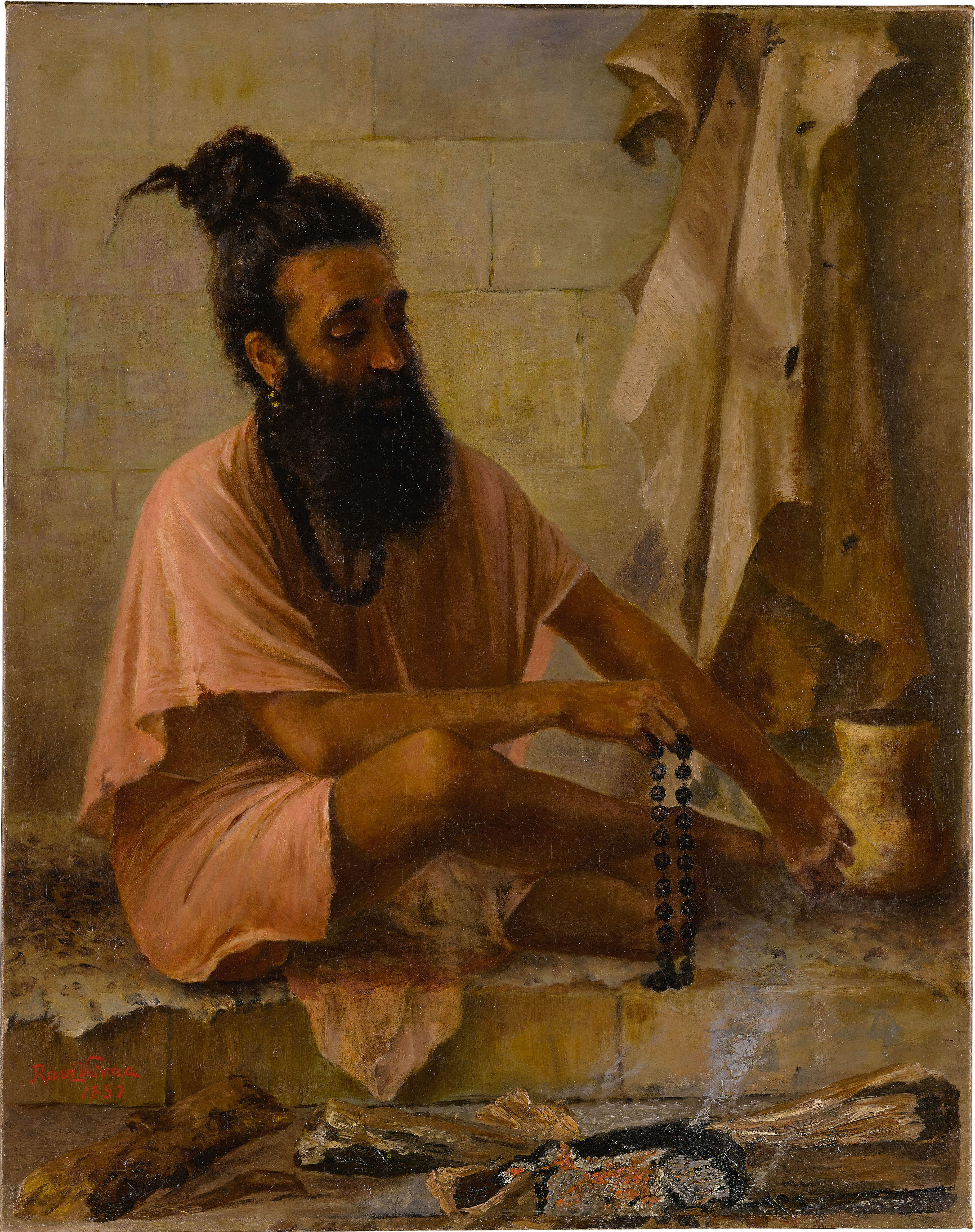 Raja Ravi Verma's painting of Vishvamitra in meditation (Wikepedia)
He says: Arshiyan ra subh-e-Eid aan sa'at-e; Chun shavad bedar chashm-e-millat-e (The moment a nation’s eyes open and its consciousness awakens is like the morning of Eid for the inhabitants of heaven.)
For Iqbal, the intellectual, spiritual and political awakening of a nation is not merely a source of happiness for that society; it is an event of significance for humanity as a whole. When a people emerge from ignorance and move towards awareness, freedom and purposeful action, their awakening becomes a cause for celebration even in the heavens.
A message to India through Vishvamitra
At first glance, Iqbal’s meeting and dialogue with Vishvamitra may appear to be a poetic fantasy. But beneath the imaginative setting lies a serious message aimed at humanity—and particularly at the people of India.
The India of Iqbal’s time was under British colonial rule. Openly challenging the regime could be dangerous. Many freedom fighters faced imprisonment, exile and even the gallows. At the same time, intellectuals and writers such as Iqbal sought to awaken people through ideas, poetry and literature.
Although the British government had conferred an honorary title upon him, Iqbal continued to use his poetry to encourage self-respect, confidence and a spirit of resistance among Indians.
His dialogue with Vishvamitra should therefore be understood in this wider context. It is not simply a conversation with a figure from Hindu mythology. It is a meditation on India’s cultural consciousness, spiritual condition, national awakening and future.
For Iqbal, Vishvamitra represented an ancient Indian tradition of knowledge and intellectual achievement. At the same time, the sage embodied qualities that were central to Iqbal’s own thought: determination, struggle, action and self-realisation.
By placing these ideas in Vishvamitra’s voice, Iqbal was able to communicate with Indian readers through a figure deeply rooted in their cultural heritage. The message was one of awakening, self-confidence, knowledge and action.
A dialogue between civilisations
One of the defining characteristics of Iqbal’s poetry is that he did not approach other cultures and civilisations merely through confrontation. Instead, he engaged them in dialogue.
 His encounter with Vishvamitra is a striking example of this approach. Rather than reducing the interaction to a religious debate, Iqbal uses it to explore the exchange of ideas between two great intellectual and cultural traditions.
He regarded India as an ancient civilisation that had contributed enormously to humanity—not only through moral and spiritual values but also through knowledge, philosophy and culture. In his vision, the awakening of India would have significance far beyond its geographical boundaries. It could contribute to a wider renaissance of the human spirit, intellect, morality and knowledge.
Vishvamitra with Ram and Laxman (Calendar Art)
At the same time, Iqbal’s dialogue contains a subtle critique of the West. He admired the West’s achievements in science, technology and material progress, but believed that these achievements needed to be balanced by spiritual and moral values.
This is why Javid Nama places Indian and Western thinkers within the same intellectual landscape. Iqbal could engage respectfully with a Hindu sage such as Vishvamitra while also entering into dialogue with Western philosophers.
His approach was neither an uncritical rejection of the West nor a romantic glorification of the East. Instead, he sought a synthesis in which modern scientific and intellectual achievements could coexist with the moral and spiritual insights of older civilisations.
ALSO READ:Why did Allama Iqbal call Lord Ram Imam-e-Hind?
In Vishvamitra, Iqbal found a figure who symbolised the power of self-transformation and the triumph of determination over defeat. Through him, he articulated one of his enduring messages: nations and individuals must awaken to their inner strength, cultivate self-confidence, acquire knowledge and act with courage if they are to shape their own destiny.










_(2)_(1).webp "Representational Image")