Amir Suhail Wani
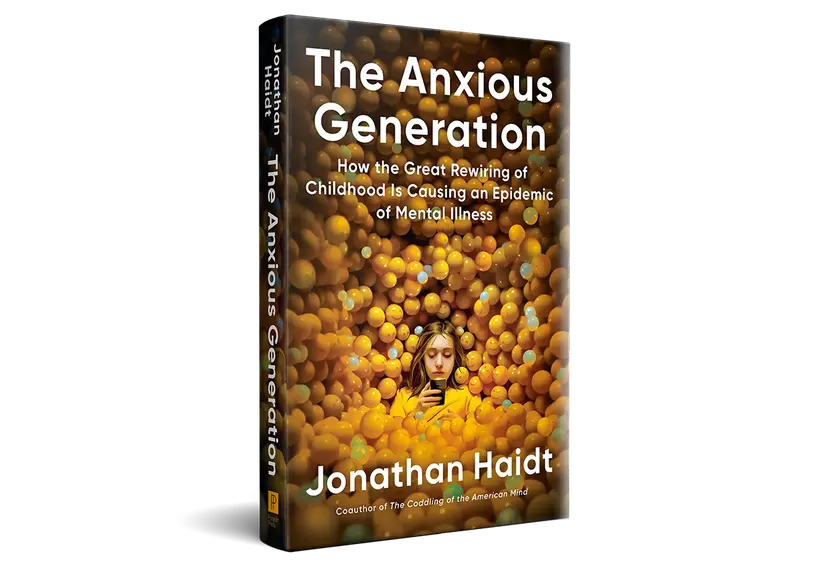
Jonathan Haidt’s The Anxious Generation: How the Great Rewiring of Childhood Is Causing an Epidemic of Mental Illness is one of the most important and disturbing books written about childhood in the digital age. Its central argument is simple: over the last 15 years, childhood has undergone a profound transformation. Children who once spent much of their time playing outdoors, interacting face-to-face, exploring their surroundings, and gradually gaining independence are increasingly growing up through smartphones and social media.
According to Haidt, this transformation has come at a serious psychological cost.
The book revolves around what Haidt calls the “Great Rewiring of Childhood.” Around the early 2010s, smartphones became widely available, social media platforms became deeply integrated into everyday life, and childhood gradually moved from the physical world to the virtual one. Haidt argues that this shift coincided with a significant increase in anxiety, depression, self-harm, loneliness, and other mental-health problems among young people, particularly adolescents.
His argument is: children have become overprotected in the real world and under-protected in the virtual world.
In the past, children were often allowed to walk to school, play outside without constant adult supervision, visit friends, ride bicycles, climb trees, settle arguments among themselves, and occasionally make mistakes. Such experiences were essential parts of growing up. Through free play and small risks, children developed confidence, resilience, independence, social skills, and the ability to deal with uncertainty.
Today, however, many parents are understandably afraid to give their children the same freedom. Childhood has become increasingly supervised, scheduled, and controlled. At the same time, the same children are often given unrestricted access to a far more dangerous and psychologically complex environment: the internet.
A child may not be allowed to go alone to the nearby market, but may spend several hours alone on social media. A teenager may be constantly monitored in the physical world while simultaneously being exposed online to strangers, bullying, pornography, unrealistic beauty standards, ideological conflicts, addictive content, and endless social comparison.
This, according to Haidt, is one of the great paradoxes of modern parenting.
The book identifies four major ways in which phone-based childhood can harm young people: social deprivation, sleep deprivation, attention fragmentation, and addiction.
Human beings, especially children and adolescents, are deeply social creatures. Friendship is not simply about exchanging messages or reacting to photographs. It involves body language, facial expressions, shared experiences, silence, laughter, disagreement, and emotional presence. Digital communication can connect people across distances, but it cannot entirely replace the richness of physical human interaction.
In India, this problem is becoming increasingly visible. The smartphone has entered almost every aspect of family life. The transformation has happened quickly. In a single generation, childhood has moved from “Go outside and play” to “Where is your phone?”
Haidt also emphasises the importance of sleep. Adolescents need adequate and regular sleep for emotional stability and healthy development. Yet smartphones accompany young people into their bedrooms. Notifications, conversations, videos, and the endless temptation to continue scrolling can push sleep later into the night. The result is often a combination of exhaustion, irritability, poor concentration, and emotional vulnerability.
This is particularly relevant in societies where academic competition is already intense. In the Indian context, many students experience significant pressure related to examinations, careers, competitive tests, and family expectations. When long hours of study, coaching, and academic anxiety are combined with late-night digital consumption, the result can be an unhealthy cycle. The phone becomes both a source of escape and another source of stress.
Another major concern is the fragmentation of attention. Social media platforms are designed to keep users engaged. Short videos, notifications, likes, comments, recommendations, and constantly changing content make sustained concentration increasingly difficult. Haidt worries that young people are losing the ability to remain mentally present for long periods.
This concern extends beyond mental health. A generation accustomed to constant stimulation may find it difficult to read a long book, reflect deeply, engage patiently with an argument, or remain focused on a difficult task.
For a country such as India, where education has traditionally placed great emphasis on books, disciplined study, and intellectual achievement, this raises an important question: What happens when the tools designed to connect and entertain us begin to reshape our capacity for attention itself?
Perhaps the most important aspect of Haidt’s book is his defence of free play and independence. He argues that children do not become strong merely by being protected from every difficulty. They become stronger by gradually encountering manageable difficulties and learning to overcome them.
A child who resolves a disagreement with friends learns something about conflict. A child who explores a neighbourhood learns independence. A child who occasionally falls and gets up again learns resilience. Excessive protection, even when motivated by love, can sometimes prevent children from developing confidence in their own abilities.
This argument has a particular resonance in contemporary Indian society. Parents naturally want the best for their children, especially in an increasingly competitive world. Childhood is often organised around school, tuition, coaching, extracurricular activities, and preparation for the future. But in the process, there is a danger that childhood itself becomes something to be managed rather than lived.
The book's greatest strength is that it forces parents, teachers, policymakers, and young people themselves to reconsider assumptions that have become normal. Why should a 12-year-old have unrestricted access to social media? Why should phones be present throughout the school day? Why have we become so afraid of allowing children ordinary independence while becoming relatively comfortable with handing them devices connected to the entire world?
Haidt proposes four broad solutions: delaying smartphone ownership, delaying access to social media, making schools phone-free, and allowing children greater freedom for independent play and responsibility.
ALSO READ: With 15K rakhis on wrist, Khan Sir says he would set up an orphanage
Jonathan Haidt’s book is therefore an important warning for parents, educators, and policymakers. It reminds us that children do not merely need to be safe; they also need to become strong. And perhaps the challenge of our age is to protect childhood not only from the dangers of the physical world, but also from the far less visible dangers that now enter quietly through the screen in a child’s hand.









_(2)_(1).webp "Representational Image")