Ashhar Alam/New Delhi
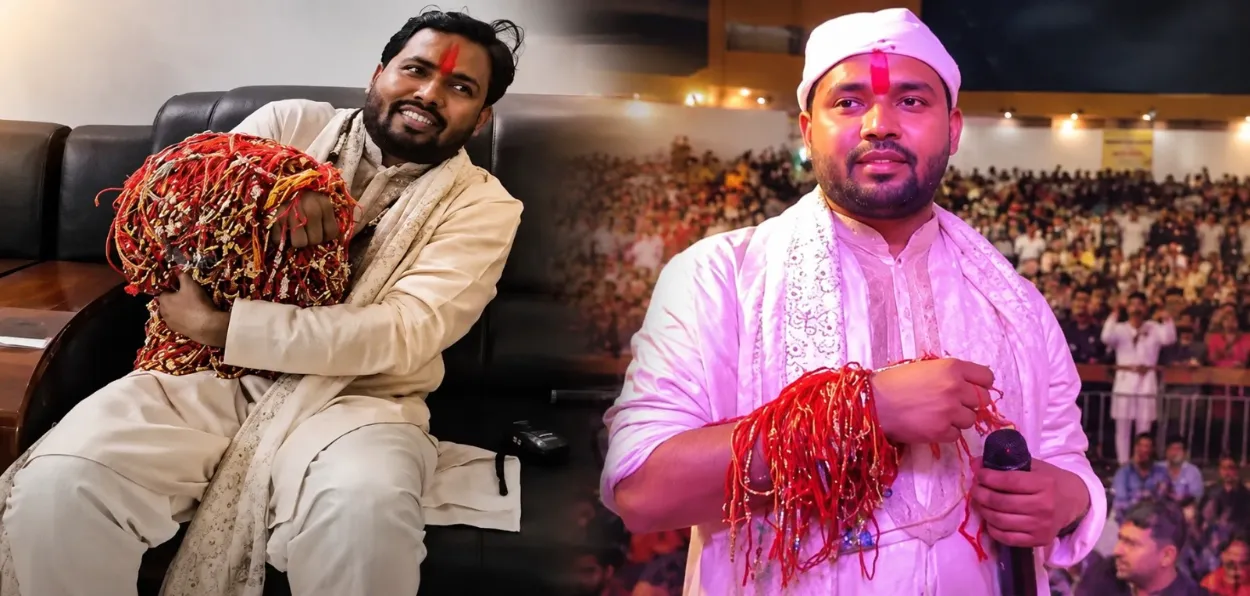
Popular coaching expert and philanthropist Khan Sir, who built a hospital for the poor in Patna, announced that he will build an orphanage. He made the announcement on the occasion of Raksha Bandhan, during which he received 15,000 rakhis that weighed so heavily on his right hand.
Speaking to the media, he said the thought about an orphanage clicked in his mind after he realised how much he missed not having a sister and empathised with those women who grow without brothers or family. “It was in the middle of the night that I decided that I would build an orphanage.”
He said the orphanage will provide children with opportunities to study and grow
He told the media that the cancer hospital he had announced last year is expected to be completed within the next two to three months.
Khan Sir whose real name is Faizal Khan was at the centre of an extraordinary celebration. Around 15,000 women and girls tied rakhis to him, celebrating their love and gratitude for a man who had changed millions of lives through his inexpensive coaching for competitive jobs and entrance to top-ranking professional colleges.
The celebration wherein Khan Sir hosted all the 15,000 women with sumptuous food ended up as a record-breaking event. Yet, behind the impressive number was a deeply personal story, that of a man who had once wished for a sister.
For Khan Sir, therefore, the rakhi on his wrist was not simply a ceremonial thread. It carried the affection of thousands and, in an unusual way, spoke to a childhood absence.
Raksha Bandhan is usually associated with memories of home: a sister preparing a rakhi, a brother offering a gift, families gathering together and promises being renewed. But Khan Sir grew up without the sister he had longed for. That simple wish remained with him even as his life took him from an ordinary childhood to becoming one of India's most recognisable educators.
Khan Sir said that while he has achieved so much through his hard work and struggle, he misses not have grown up with a sister. “This is the reason I enjoy the festival. The rakhis my sisters tied on my wrist make me think of way of protecting them from illiteracy, poverty and their unfavourable circumstances.”
This year, thousands of women and girls symbolically stepped into that space.
Khan Sir has become a familiar name among students preparing for competitive examinations. Known for explaining complicated subjects through simple language, humour and everyday examples, he has developed a teaching style that has made him particularly popular among young aspirants.
His educational journey has extended beyond the traditional classroom. Through the Khan GS Research Centre and digital platforms, his lessons have reached students across different parts of the country.
For many young people, especially those from smaller towns and families with limited resources, access to good coaching can be a major challenge. Competitive examinations often demand not only academic preparation but also considerable financial investment.
Khan Sir's approach has attempted to make learning more accessible and less intimidating.
His popularity is consequently not based only on his ability to teach. It also comes from the relationship he has developed with students. For many of them, he represents encouragement at a stage when a few words of confidence can make the difference between giving up and trying once again.
It is this student community that has gradually become part of his larger social identity.
The Raksha Bandhan celebration demonstrated just how far that relationship has travelled.
The women and girls who tied rakhis were not necessarily connected to Khan Sir through family or blood. Their connection came through the world of education and the affection that students often develop for teachers who influence their lives.
Khan Sir could have allowed the celebration to remain focused on the record. Instead, his announcement of an orphanage moved the conversation towards children who themselves may be growing up without the support of a conventional family.
He said the proposed orphanage would provide children with opportunities to study and grow.
That emphasis on education is particularly relevant to his own journey.
An orphanage, in its most meaningful form, cannot simply be a building offering food and shelter. Children need a safe environment, education, emotional support, healthcare and the confidence to believe that their circumstances do not determine their future.
Khan Sir's proposed initiative seeks to bring education into that equation.
A child who has lost parental support should not also have to lose the opportunity to dream. Giving such children access to learning can help them acquire the independence and confidence required to shape their own lives.
In this sense, the announcement gave a wider social meaning to Raksha Bandhan.
The cancer hospital announced by Khan Sir last year is another part of this larger effort. He said the project is expected to be completed within the next two to three months.
Cancer affects not only patients but entire families. Treatment can bring emotional distress, financial pressure and prolonged uncertainty. Healthcare infrastructure that can provide timely and affordable care can therefore become a lifeline for families facing one of life's most difficult battles.
The proposed orphanage and cancer hospital address very different needs, but both are connected by the idea of service.
One seeks to give children a future.
READ MORE:1947 Kabali Raid: Sikhs, the forgotten martyrs of Kashmir
The other seeks to give patients hope and medical support.
Fifteen thousand rakhis may have broken a record, but their deeper significance lies in the human story behind them, a childhood longing transformed into a vast circle of affection, and a celebration that ended with a promise to give others the chance to build better lives.