Ghaus Sivani
Through his poetry and prose, Allama Iqbal conveyed a powerful message of national unity and patriotism. He wrote appreciatively about Hindu and Sikh saints, Christian philosophers, Gautama Buddha, Zoroaster and Mani. He even chose the founder of the Bahá’í Faith, Bahá’u’lláh, as the subject of his PhD thesis.
Iqbal’s writings reveal a deep engagement with different religious and philosophical traditions. In one of his poems, he writes:
Let the sacred thread (Zunnar) hang around the neck, and the rosary be held in hand,
Thus revealing the sanctity of the Haram (Sanctuary) within the idol-temple.
Let us tear open the heart to make His vision accessible to all,
Igniting a fire of divine love within every soul.
Taking water from the ‘Ganga’ that flows in our eyes,
Let us create a stream of devotion before that Deity.
Let us inscribe “Hindustan” upon the forehead of that Beloved Idol,
And sing those forgotten anthems to the world once more.
When the time comes to summon priests to the temple,
Let the call to prayer (Azan) blend with the sound of the temple conch.
That formless fire—known as Peet (the Divine Light)—awaits;
Let us cast all these sectarian disputes into that sacred flame. (Translated from Urdu)
For Iqbal, national unity and religious harmony had to be rooted in justice, morality, spirituality and mutual respect. Geographical nationalism alone, he believed, could not make a country strong. A truly united nation required shared values and high ethical ideals.
Iqbal’s Perspective on Hindus
Iqbal regarded Hindus not merely as one of the world’s oldest peoples, but as members of a civilisation that had produced a vast body of knowledge and art at a time when many other parts of the world were still immersed in ignorance. He wrote:
“There is a remarkable blend of thought and action in the heart and mind of the Hindu people. The profound philosophers of this community have deeply contemplated the nature of the power of action.”
His interest in Hindu philosophy was particularly evident in his study of Vedanta. He studied Sanskrit, as well as translations of Sanskrit texts and their commentaries. He also explored Vedantic thought through the works of Western scholars, and references to its principles appear frequently in his philosophical writings. Vedanta is often described as the “philosophy of the Upanishads”.
According to Iqbal, during India’s freedom movement, Hindu society was passing through a phase in which political independence had become its overriding objective. He regarded the idea of freedom as a relatively new experience for Hindu society and observed that it had captured its intellectual, emotional and practical energies.
.png) The cover of one of Allama Iqbal's books
The cover of one of Allama Iqbal's books
Iqbal saw this as a natural but powerful psychological process through which a society’s established priorities and ideas begin to move in a new direction. His larger point was that when a community embraces a new ideal, the resulting transformation extends beyond politics and can also affect its moral and spiritual outlook.
He believed that the struggle for political independence would give Hindu society a new collective identity, while potentially distancing it from some of the moral and spiritual values associated with its past. He was neither condemning nor praising the community; rather, he was examining the consequences of historical change as a thinker and observer.
He wrote in his diary: “It is a fascinating phenomenon to witness the birth and evolution of a new ideal within a community. The new ideal kindles fresh enthusiasm and zeal, rallying all its energies toward a shared objective. The modern Hindu exemplifies this very situation. To me, his conduct holds greater psychological significance than political import. It appears that the goal of political freedom—an entirely novel experience for him—has completely captivated his soul. Consequently, the various currents of his spirit are abandoning their traditional courses and surging rapidly toward a new sphere of action. Having traversed this experience, he will also come to realise what he has lost. He will undergo a complete transformation, emerging as a ‘new’ community—new in the sense that the moral concepts held by his ancestors, whose lofty ideals long offered solace to many a restless mind, will no longer exert the same influence upon him. Communities give birth to ideas, yet with the passage of time, ideas give birth to new communities.” (Muntashir Khayalat-e-Iqbal, pp. 55–56; compiled by Javed Iqbal)
In this diary entry, Iqbal interprets the political awakening of Hindu society as more than a political development. He sees it as a psychological and cultural transformation. At a time when the freedom movement was gathering momentum across India, the demand for independence was reshaping the aspirations of society.
Iqbal, however, focused particularly on the country’s majority community. In his view, when a society embraces a new ideal, its scattered energies begin to converge around a common objective, profoundly altering its collective identity. His analysis therefore reads almost like that of a psychologist examining the changing mindset of a society.
Iqbal and Vedanta Philosophy
Vedantic thought is based principally on three major philosophical and religious texts: the Upanishads, the Bhagavad Gita and the Brahma Sutras. The Upanishads explore profound questions concerning the cosmos, the self (Atman), God and liberation (Moksha). The Bhagavad Gita connects these philosophical ideas with practical and ethical life, while the Brahma Sutras provide a systematic framework for interpreting them.
Vedanta is a major school of Hindu philosophy. At its core is the concept of Brahman as the ultimate reality, with the individual self, or Atman, understood in relation to that ultimate reality.
Over time, different interpretations of Vedanta gave rise to several schools. Advaita Vedanta, systematised by Adi Shankaracharya, holds that Brahman alone is the ultimate reality, while the material world is Maya, or an illusory manifestation. Ramanuja developed Vishishtadvaita, or Qualified Non-dualism, which emphasises a profound relationship between God and the individual soul while maintaining that they are not completely identical. Madhvacharya later established Dvaita, or Dualism, which regards God and the soul as eternally distinct.
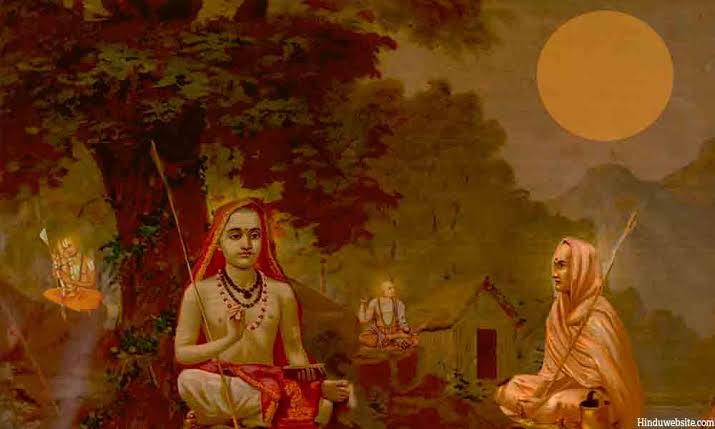 A Sage with his disciples (painting)
Shaivism was also influential in medieval India, with Kashmir emerging as one of its major centres. Shaiva philosophy similarly emphasises the worship of Shiva, conceived as formless (Nirakar).
Iqbal studied Vedanta seriously and engaged with its ideas through a critical and analytical approach. Although he considered the Islamic doctrine of Tauhid, or Divine Oneness, superior to the Vedantic understanding, he did not dismiss Vedanta as insignificant. He referred to it when relevant in both his poetry and prose.
For Iqbal, Vedanta contained important ideas concerning spirituality, self-realisation and the search for truth—ideas that encouraged human beings to reflect deeply on existence. His own discussions of unity (Wahdat) also show points of engagement with Vedantic thought, even where he disagreed with its conclusions.
He writes: “However, it must be remembered that some later Sufi orders (such as the Naqshbandiyya) developed other methods to attain this spiritual experience—or, one might say, adopted them from Hindu Vedantists. Emulating the Hindu doctrine of Kundalini, they taught that the human body contains six centres of light, each associated with a different colour. The Sufis’ objective is to activate these centres through specific meditative techniques and to experience the primordial light lying behind this diversity of colours—a light that is itself colourless, that renders all things visible, yet remains invisible itself.” (Falsafa-e-Ajam, p. 107)
The passage illustrates the breadth of Iqbal’s comparative scholarship. He draws attention to conceptual parallels between Sufism and Hindu philosophy, particularly Vedanta, and suggests that certain later Sufi traditions adopted methods of spiritual development resembling the Hindu doctrine of Kundalini.
The extent of his engagement with Indian philosophy becomes even clearer in another passage:
“It is possible that the evolution of this concept was influenced by Hindu travellers who passed through Iran on their way to the Buddhist temples that existed in Baku at the time. Husain Mansur fully transformed this ideology into the doctrine of ‘Wahdat-ul-Wujud’ (Unity of Being) and, much like a true Hindu Vedantist, proclaimed ‘Ana-al-Haq’ (‘I am the Truth’)—an utterance akin to ‘Aham Brahmasmi’ (‘I am Brahman’).” (Falsafa-e-Ajam, p. 111)
Here, Iqbal explores possible connections between Iranian Sufi thought and Hindu and Buddhist philosophical traditions. He suggests that ideas travelled across civilisations through religious and intellectual exchanges, influencing philosophical traditions in different regions.
He further compares the famous declaration of Hussain bin Mansoor Hallaj, “Ana-al-Haq” (“I am the Truth”), with the Vedantic expression “Aham Brahmasmi” (“I am Brahman”). Through such comparisons, Iqbal highlights the movement of ideas across civilisations and the similarities that can emerge between apparently distinct philosophical traditions.
Hindu Philosophy in Iqbal’s Writings
Iqbal presented aspects of Hindu philosophy at several points in his writings, sometimes explicitly identifying his sources and, at other times, incorporating ideas without extensive explanation. His engagement with Indian thought demonstrates the breadth of his intellectual interests.
Few people are aware that Iqbal also wrote textbooks for children. One such work was Tarikh-e-Hind (History of India), which included an account of Sanskrit literature. The following passages illustrate the extent of his knowledge of Hindu philosophy and history.
He wrote: “Hindu religious literature is divided into two categories: Shruti—scriptures received from the Divine—and Smriti—tradition or religious pronouncements. The first category comprises the Vedic Samhitas and the Brahmana texts. The second category includes various works considered to be extensions of the Vedas; collectively, these are known as Dharmashastras.”
Explaining, he wrote: “There are four Vedas – Rigveda, Yajurveda, Samaveda and Atharvaveda. These four Vedas have two parts each. The first part is the hymn or mantra, called Samhita. In these, the wishes and desires of their creators are written, which reveal the life and society of the people of that time. The second part is called Brahman, in which most of the religious rituals are described. Rig Veda is the oldest Veda among these texts. Its mantras are considered the highest.
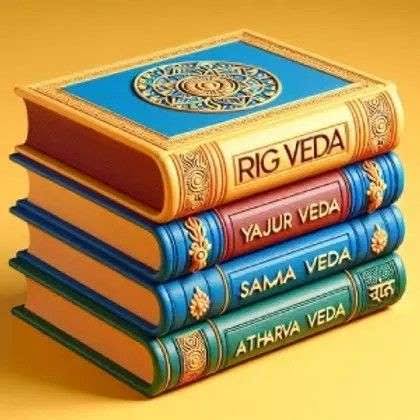
The Vedas
"Of all the books available in Aryan languages, Rigveda is the oldest. It is believed to be composed about fourteen hundred years before Christ. In its mantras, the great forces of nature have been praised as deities. The names of these gods are – Indra, i.e. the god of the sky, who is often described as having god-like qualities; Agni means god of fire; Varuna means god of sky and rain; Savitri, Surya and Mitra – these three are the names of Surya; Vayu means god of wind; Marut means god of storm; Usha means goddess of dawn. Apart from these Ashwins, there are many other gods.” (Tarikh-e-Hind, by Allama Iqbal and Lala Ram Prasad, pp. 441–442)
The passage outlines the classification and antiquity of Hindu religious literature, providing readers with an overview of the foundations of the tradition. It distinguishes between Shruti, regarded as divinely revealed scripture, and Smriti, which encompasses traditions, interpretations and religious codes.
Iqbal also discussed the Vedangas and ancient Indian scientific traditions. He wrote: “Finally, the Vedangas also include Jyotish, or the science of astronomy. The oldest extant text on this subject is attributed to Parashara. However, Aryabhata, who lived around 500 CE, is regarded as a preeminent scholar of astronomy. He posited that the Earth rotates on its axis daily and made several other discoveries that were far ahead of his time. Another scholar of this discipline was Bhaskaracharya, born around 1100 CE in the Bidar region of the Deccan. It is said that he discovered a mathematical principle bearing a striking resemblance to the calculus developed by modern European mathematicians.” (p. 443)
This passage reflects Iqbal’s interest in the scientific and mathematical achievements of ancient India. He highlights Aryabhata’s astronomical contributions and draws attention to Bhaskaracharya’s mathematical work, noting its resemblance to ideas later associated with European calculus.
These references demonstrate that Iqbal’s engagement with Indian civilisation extended well beyond religion and philosophy. He explored its literature, intellectual traditions, astronomy and mathematics, treating them as important sources of knowledge.
A Broad Intellectual Vision
Iqbal’s writings show that his intellectual world was not confined to a single civilisation or philosophical tradition. He studied ideas from across India, Iran and the wider world, engaging with them critically while also recognising their intellectual and spiritual value.
His interest in Hindu philosophy was therefore not incidental. Ancient Indian thought and scripture formed an important part of the intellectual material with which he engaged, and their influence can be seen in both his poetry and prose.
His treatment of Hindu philosophy, Vedanta and Indian intellectual history also reflects his broader belief in the exchange of ideas between civilisations. For Iqbal, such encounters did not necessarily erase differences; rather, they demonstrated how philosophical traditions develop through dialogue, interaction and intellectual exploration.
ALSO READ: Allama Iqbal believed in respecting all religions
This broad comparative outlook is an important part of understanding Iqbal’s message of national unity. His writings acknowledge the diversity of India’s religious and philosophical traditions while emphasising the values of morality, spirituality, mutual respect and a shared cultural heritage.














.jpeg)