




Amir Suhail Wani
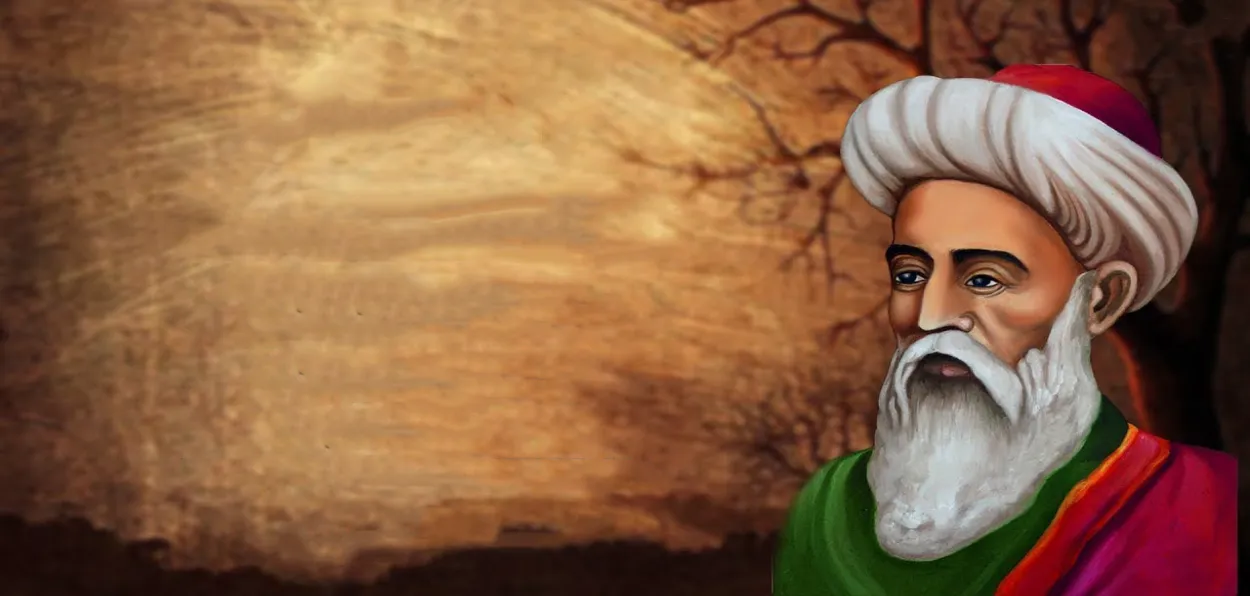
The life of Amir Khusrau unfolds as one of the most luminous chapters in the cultural and spiritual history of India. Born in 1253 CE in Patiyali (present-day Uttar Pradesh), Khusrau was the son of a Turkic father and an Indian mother.
His early exposure to diverse linguistic, cultural, and spiritual traditions shaped his extraordinary thoughts. A prodigious talent, he entered royal courts at a young age and served several Delhi Sultans, yet his inclination was to spirituality. He found its anchor in the great Chishti Sufi master Nizamuddin Auliya, under whose guidance Khusrau’s poetic genius reached its zenith. While he lived amidst courts and chronicles, his soul belonged to the khanqah, where love, devotion, and the dissolution of the self in the Divine were the highest pursuits.
Khusrau’s mystical tendencies cannot be understood merely as abstract spirituality; they were lived, sung, and woven into the fabric of everyday experience.
Rooted in the Chishti Sufi tradition, his mysticism emphasised ishq (divine love), fana (annihilation of the ego), and the intimate union between the lover and the Beloved. Unlike more austere philosophical traditions, Khusrau’s spirituality was sensuous, musical, and deeply human. His poetry often blurs the line between earthly and divine love, allowing the reader to traverse seamlessly between longing for a beloved and yearning for God.
This ambiguity is not confusion but a deliberate mystical strategy: to reveal that all love, in its purest form, is a reflection of the Divine. His verses in Hindavi and Persian carry a remarkable emotional immediacy, making profound metaphysical truths accessible to common people.
In his famous riddles, songs, and couplets, the voice of a mystic speaks through the idiom of the masses, dissolving the distance between elite and popular culture.
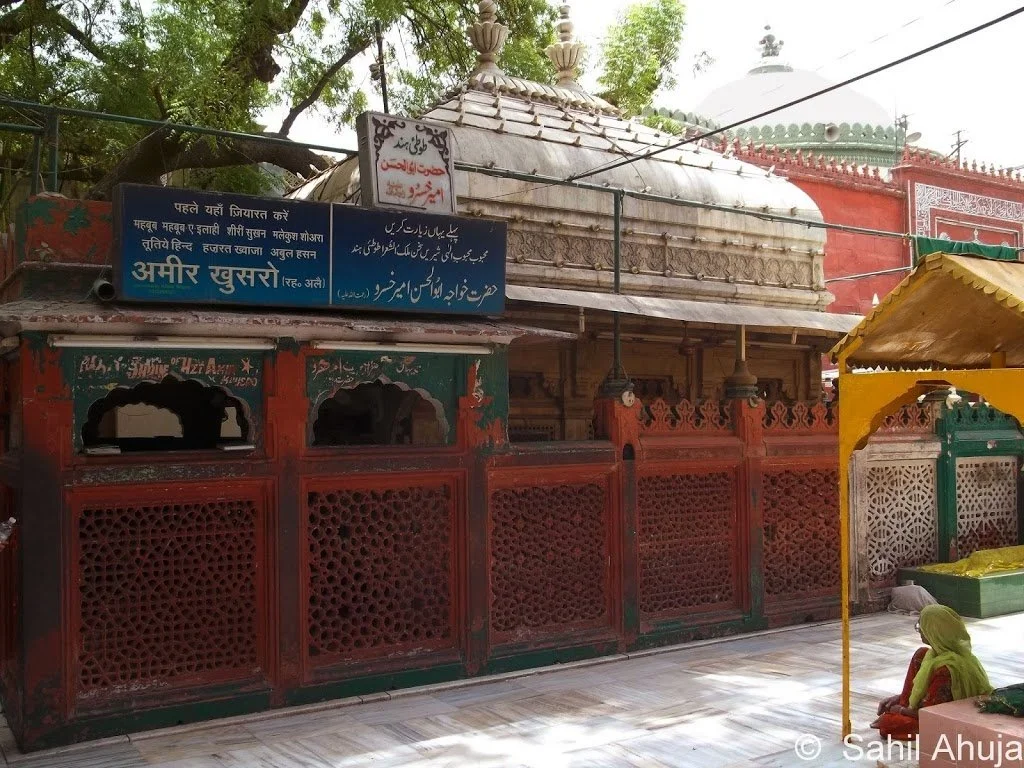 Shrine of Amir Khusrou
In the domain of literature, Khusrau stands as a pioneering figure who bridged linguistic worlds. Writing extensively in Persian—the court language of his time—he also composed in Hindavi, thereby legitimising and enriching a vernacular tradition that would later evolve into modern Hindi and Urdu. His literary corpus includes masnavis, ghazals, riddles, and historical chronicles, each reflecting his versatility and creative depth.
He infused Persian literary forms with Indian imagery, metaphors, and sensibilities, creating a hybrid aesthetic that mirrored the cultural synthesis of the subcontinent. His playful compositions, such as pahelis (riddles) and mukris, reveal a mind that delighted in linguistic experimentation and popular engagement. Through this synthesis, Khusrau not only expanded the expressive possibilities of language but also laid the groundwork for a shared literary heritage that transcended religious and cultural boundaries.
Khusrau’s contribution to music is perhaps even more transformative, marking him as one of the foundational figures in the evolution of Indian classical music. He is creditedf for innovations such as the development of qawwali as a structured form of Sufi devotional music, the introduction or refinement of musical instruments like the sitar and tabla (though historically debated), and the creation of new ragas and rhythmic patterns.
Whether or not all these attributions can be historically verified, there is no doubt that his influence on Hindustani music is profound. By integrating Persian melodic sensibilities with Indian ragas, he created a musical language that was both devotional and aesthetic, capable of expressing the deepest spiritual emotions. In the sama (Sufi musical gathering), music became a means of spiritual elevation, a way to transcend the ego and experience divine presence. Khusrau’s compositions, still sung in shrines and concert halls alike, continue to evoke a sense of unity, devotion, and transcendence.
Beyond literature and music, Khusrau’s life and work exemplify India’s pluralistic and composite culture—what is often described asGanga-Jamuni tehzeeb. He lived at a time of political upheaval and cultural encounters, yet he responded not with exclusion but with synthesis. His identity was not fragmented but enriched by multiple affiliations: Turk and Indian, courtier and mystic, Persian poet and Hindavi singer. In his writings, one finds an affectionate engagement with Indian seasons, festivals, and landscapes, as well as a deep respect for local customs and traditions.
His famous celebration of Basant at the shrine of his master is a striking example of how he embraced and transformed cultural practices into expressions of spiritual joy. In Khusrau, one sees not a clash of civilisations but their creative confluence, where differences are not erased but harmonised.
This capacity for synthesis is precisely what makes Khusrau so relevant in modern times. In an age marked by increasing polarisation, identity conflicts, and cultural anxieties, his life offers a powerful alternative vision—one rooted in dialogue, creativity, and shared humanity. To revive Khusrau is not merely to celebrate a historical figure but to reclaim a way of being that values connection over division. His emphasis on love as the central principle of existence challenges the rigidities of dogma and invites a more inclusive understanding of faith and culture.
His use of vernacular language to express profound truths reminds us of the importance of accessibility and empathy in communication. His music, which dissolves boundaries between performer and listener, sacred and secular, offers a model for cultural expression that is both rooted and open.
Reviving Khusrau in contemporary times would mean re-engaging with his works in educational curricula, promoting his musical traditions, and fostering spaces where cultural synthesis can flourish. It would also mean internalising his ethos: to see diversity not as a threat but as a source of enrichment, to approach differences with curiosity rather than fear, and to recognise the underlying unity of human experience. In Khusrau’s world, the beloved could be both human and divine, language could be both elite and popular, and identity could be both particular and universal. This fluidity is not a weakness but a profound strength, one that allowed him to create a legacy that continues to resonate across centuries.
READ MORE: Delhi Advocate Ekta Pareek fights for clean environment, animal rights
Ultimately, Amir Khusrau stands as a timeless symbol of India’s composite culture—a culture that thrives on interaction, adaptation, and mutual respect. His life reminds us that the richest civilisations are those that embrace plurality, that allow different voices to coexist and enrich one another. In remembering and reviving Khusrau, we are not looking back in nostalgia but forward with hope, drawing from a past that offers enduring lessons for building a more harmonious and inclusive future.

_(1)_(1).webp "Khanqah Emadia Qalandaria, Patna, Bihar")









.webp)


.webp)