 Pallab Bhattacharyya
In the annals of rural development in India, few initiatives have attempted to challenge gender stereotypes as boldly as Assam’s Lakhimi Mistri programme. Conceived and driven by IAS officer Keerthi Jalli, Commissioner of Panchayat and Rural Development, Assam, this pioneering initiative seeks to transform rural women from passive beneficiaries of development into active builders of development itself.
At a time when governments across the country speak of women’s empowerment, Assam has chosen to place a trowel, measuring tape and masonry tools in the hands of rural women and invite them to become creators of homes, livelihoods and prosperity.
Launched on 17 May 2025 in Guwahati, the programme was introduced as a women mason initiative under the Pradhan Mantri Awaas Yojana-Gramin (PMAY-G). Simultaneously, the Centre sanctioned 3.76 lakh additional PMAY-G houses for Assam, creating a massive demand for trained construction workers and making the timing of the initiative particularly significant.
The idea behind Lakhimi Mistri is deceptively simple but revolutionary in its implications. Across rural India, women have long worked on construction sites as helpers, carrying bricks, mixing mortar and transporting materials. Yet the skilled jobs, recognition and higher wages have remained almost exclusively in male hands.

The Lakhimi Mistri programme seeks to bridge this divide by providing structured training, certification and employment opportunities to women in masonry and allied construction trades.
The name itself carries a powerful message. “Lakhimi,” the Assamese form of Goddess Lakshmi, symbolises prosperity and abundance, while “Mistri” refers to a skilled craftsperson or mason. Together, the name conveys the vision of a woman who is both skilled and economically empowered. It represents a conscious attempt to redefine the image of a mason in rural society, replacing a traditionally male identity with one that is inclusive and aspirational.
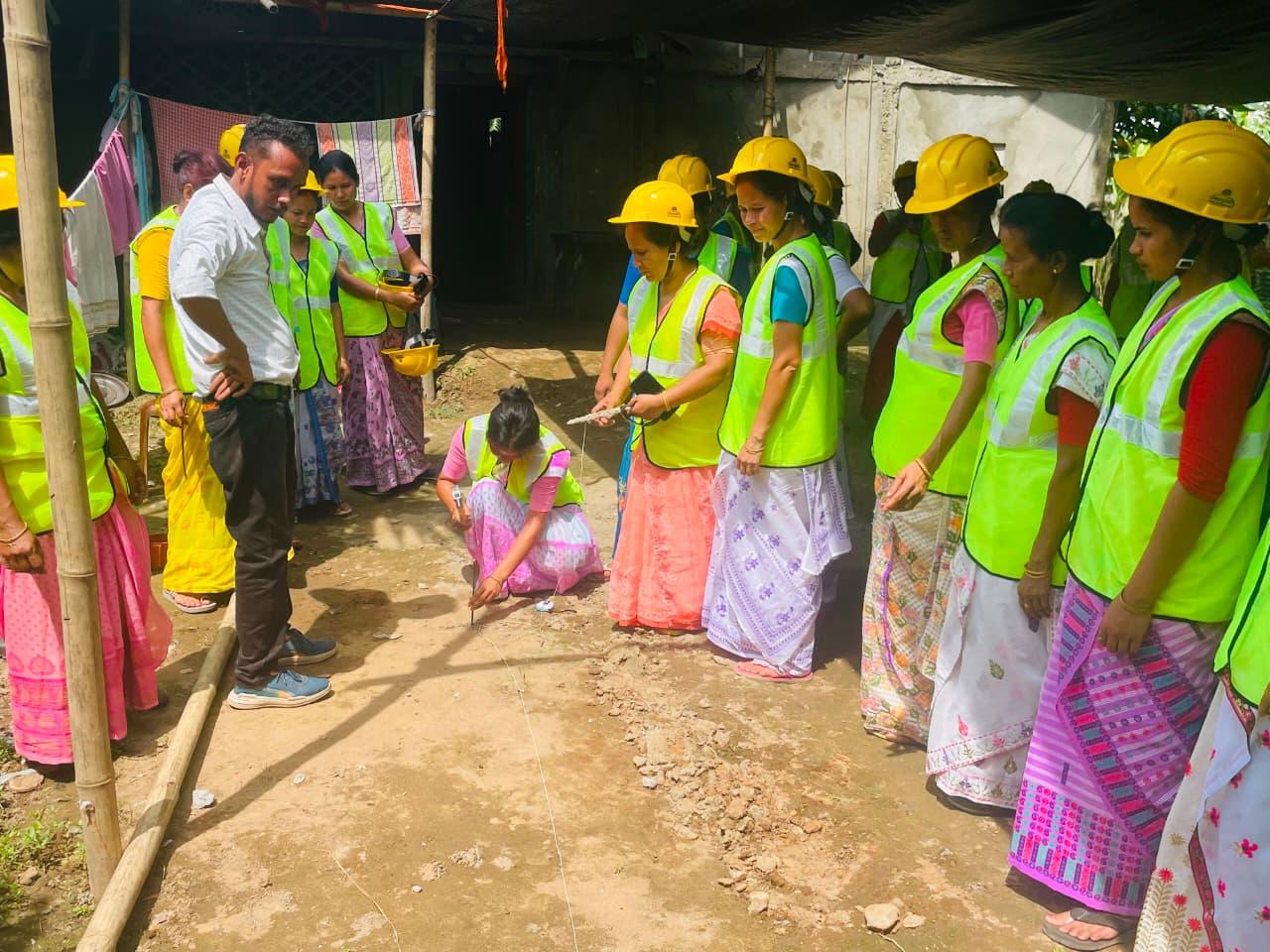
According to the Panchayat and Rural Development Department’s July 2025 newsletter, the programme is designed as a comprehensive 53-day training course aligned with national skill standards. Trainees receive a daily stipend, practical field exposure, certification under nationally recognised frameworks, professional toolkits and opportunities for further upskilling in trades such as tiling and electrical work.
Importantly, the training is conducted on active PMAY-G construction sites rather than in classrooms alone, ensuring that learning remains practical and employment-oriented. The programme also includes childcare facilities, a feature rarely seen in skill-development programmes but essential for enabling participation by mothers.
What makes Lakhimi Mistri truly unique is that it appears to be the first state-led programme in India specifically designed to create a dedicated cadre of women rural masons linked directly to a major housing programme. While various skill-development missions have trained women in non-traditional trades, no state has attempted such a systematic integration of women masons into a large-scale rural housing ecosystem. Much of the credit for this innovation goes to Kiriti Jhalli,
whose administration not only conceptualised the programme but also established the institutional architecture required for its implementation
The programme has already moved beyond the conceptual stage. Pilot implementation has commenced in selected Gram Panchayats, including Moradhol Gram Panchayat in Dhemaji district. Across districts, Panchayats, District Rural Development Agencies, Self-Help Groups and training providers have been mobilised to identify eligible women and facilitate training. This decentralised approach ensures that implementation remains rooted in local realities rather than being driven solely from state headquarters.
The economic implications are substantial. Women who previously worked as unskilled labourers earning modest wages can potentially double or even triple their incomes after certification. More importantly, they gain access to a growing market created by PMAY-G, Swachh Bharat Mission and Jal Jeevan Mission projects. Assam’s rural housing programme alone generates thousands of opportunities for skilled masonry work every year. By creating a pool of certified women masons, the state is simultaneously addressing a labour shortage and expanding livelihood opportunities for women.
The social impact could be even more transformative. Rural societies often assign construction work exclusively to men. When women begin building houses, supervising construction quality and earning skilled-worker wages, traditional perceptions of gender roles inevitably change. Young girls witness new possibilities. Families start viewing daughters not merely as dependents but as potential income earners. Communities begin to recognise women’s technical capabilities. Such shifts may appear gradual, but they often produce profound long-term consequences.
Globally, there are precedents that illustrate the transformative potential of such initiatives. In several African countries, including Kenya and Uganda, women have been trained as construction artisans through programmes supported by international development agencies.
These initiatives demonstrated that women often produce work of equal or superior quality while also reinvesting a larger share of their earnings into household welfare. In Nepal, women masons trained after the devastating 2015 earthquake played a critical role in rebuilding resilient homes. Similar experiences have emerged in Bangladesh, where women construction workers have contributed significantly to rural housing and infrastructure projects. Yet Assam’s initiative differs because it is integrated into an existing government housing programme at scale rather than being a stand-alone pilot.
For the programme to succeed, every stakeholder has clearly defined responsibilities. The Panchayat and Rural Development Department must provide policy direction, funding support and monitoring. District administrations and DRDAs must identify beneficiaries, coordinate logistics and ensure quality control. Gram Panchayats must act as the first point of contact for mobilisation and registration. Training providers must deliver technically sound and practical instruction while maintaining attendance and assessment standards.
Self-Help Groups and the Assam State Rural Livelihoods Mission must mobilise women and provide social support. Financial institutions and NABARD should facilitate credit access for women seeking to establish construction enterprises. Above all, the women trainees themselves must commit to learning, professionalism and continuous skill improvement.
The next phase of the programme should focus on creating sustainable livelihoods beyond initial training. Women's mason cooperatives and producer groups can enable collective bidding for construction contracts. Digital platforms can connect certified women masons with households and contractors seeking skilled workers. Advanced training modules in plumbing, electrical installation, tiling and disaster-resilient construction can further enhance earning potential.

Dedicated procurement preferences for women-led construction groups in government projects could create a stable market. Insurance coverage, safety training and social security mechanisms should also be incorporated to protect workers in a physically demanding occupation.
Another critical requirement is societal acceptance. Skill training alone cannot dismantle entrenched stereotypes. Public awareness campaigns, success stories, community demonstrations and recognition of outstanding women masons will be essential. The image of a woman mason must become normalised in rural Assam. Schools, Panchayats and local institutions should celebrate these pioneers as symbols of a changing society.
Ultimately, the true significance of Lakhimi Mistri lies beyond masonry. It is about redefining the meaning of empowerment. Instead of viewing women merely as recipients of welfare, the programme recognises them as builders of assets, creators of wealth and contributors to economic growth. It transforms housing from a welfare intervention into a platform for skill development, entrepreneurship and social change.
ALSO READ: 5 Muslim youth showered praises for saving lives in Delhi hotel fire
Assam has often been a laboratory of innovation in rural development. With Lakhimi Mistri, it has once again demonstrated that meaningful empowerment is not achieved through slogans but through opportunities, skills and dignity. If implemented effectively and scaled sustainably, this initiative may well become a national model, inspiring other states to replicate a simple but powerful idea: when women build homes, they also build stronger families, stronger communities and a stronger future.
The author is former Director General of Assam Police












.webp)