Uzma Khatoon
In the evolving discourse on Indian Muslim society, the issue of polygamy stands as a critical intersection of faith, law, and social justice. For decades, this issue has been debated within courtrooms, religious seminaries, and the drawing rooms of ordinary families. However, as we move into the 21st century, the conversation is shifting from a purely religious debate to one centred on human rights, constitutional morality, and social justice.
To understand the gravity of the situation, we must look at the reality on the ground. The Bharatiya Muslim Mahila Andolan (BMMA) conducted a survey involving 2,500 women across India, including both first and second wives. The data from this survey serves as a grim reminder of the consequences of unregulated matrimonial laws.
The findings revealed that polygamy is not merely a theoretical privilege for men but a source of immense trauma for women. The women surveyed reported facing severe economic hardship, social humiliation, and a deterioration of both mental and physical health.
This data is not just a collection of numbers; it captures the silent agony of women. For instance, a report by Awaz-The Voice highlighted the tragic case of Tasleem. Pregnant with her third child, she was thrown out of her home and subjected to an illegal triple talaq. Her husband labelled her "mad" simply to justify his cruelty and pave the way for a second wife.
Her story illustrates how the mere threat or act of polygamy triggers a cycle of mental breakdown, displacement, and social stigma. These statistics and stories provide the necessary backdrop to understand why reform is not just a legal need but a humanitarian necessity.
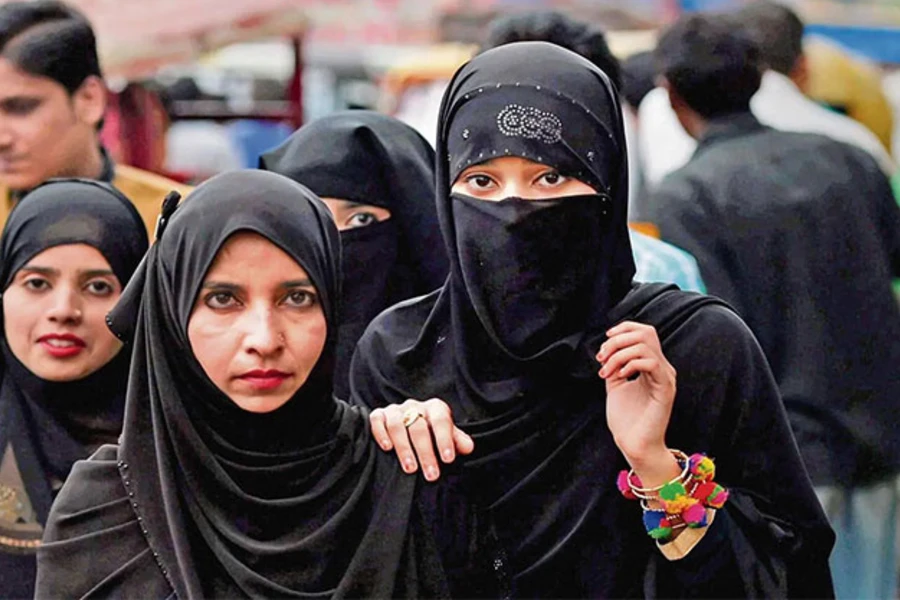 Muslim women
This article seeks to explore the issue of polygamy beyond these statistics, diving into the theological, legal, and social arguments that call for a change. It argues that banning or strictly regulating polygamy is not an attack on Islam, but rather a step toward fulfilling the Quranic mandate of justice and equality.
The argument against unregulated polygamy is first and foremost a humanitarian one, connected to the constitutional values of modern India. A 2022 report by the BBC brought to light the heartbreaking ordeal of Reshma, a 28-year-old from Delhi. Married in 2019, she was abandoned by her husband along with her infant child as he planned a second marriage. Instead of support, she faced domestic violence and harassment.
In her plea to the Delhi High Court, she rightly described the practice as "harsh, inhuman, and barbaric," a sentiment that echoes the reality of many abandoned first wives.
While historical justifications for polygamy often cite the care of war widows and orphans, the contemporary reality in India is vastly different. Today, the practice is rarely driven by charity; it is driven by a desire for sexual variety as a patriarchal entitlement. The consequences of this are borne entirely by the first wife and her children. When a man with limited means marries a second time, he inevitably dilutes the resources available to his first family. This "resource dilution" traps Pasmanda families in a cycle of backwardness.
The experience of Irfana Firoz Qureshi, covered by India TV during the release of the BMMA survey, illustrates this economic disaster. Upon discovering her husband's hidden prior marriages, she was evicted, cut off from necessities like food, and even faced physical violence. Her descent into financial ruin while raising children alone exemplifies how unregulated polygamy destroys the economic stability of the first family.
A study from Jordan (Al-Krenawi and Graham’s, 2006), often cited to defend the practice, actually reinforces this danger. It concluded that polygamy only works without harming children if the father is wealthy and strictly just. In India, where there is no legal mechanism to check a man’s financial status before he takes a second wife, the practice becomes a recipe for social and economic disaster.

Kerala High Court
Furthermore, the legal framework in India presents a glaring inequality that violates Article 14 of the Constitution. Currently, under the Bharatiya Nyaya Sanhita (BNS), bigamy is a strictly punishable offence for Hindus, Christians, and Parsis. However, Muslim men are exempt from this law due to the application of uncodified Muslim Personal Law. This creates a scenario where a Muslim woman is denied the same legal protection that her Hindu or Christian neighbour enjoys. Legal luminaries like the late Justice V.R. Krishna Iyer argued passionately against this disparity.
He believed that religious laws cannot override the constitutional morality of human dignity. If a personal law degrades the status of a woman or leaves her destitute, it violates the spirit of the Constitution. Just as the practice of 'Triple Talaq' was struck down for being arbitrary, unregulated polygamy must be recognised as a symbol of inequality that survives only because of a lack of political will to codify the law.
While social and legal arguments are powerful, the most compelling argument for reform actually comes from within Islamic theology itself. There is a profound misconception that Islam inherently prefers or encourages polygamy. To debunk this, we must look at the very beginning of creation. When Allah created the first human being, Prophet Adam, He created for him only one partner, Mother Eve (Hawwa). This act of creation is the ultimate sign of the Divine Will.
If polygamy were the natural state of mankind, or if having four wives was an essential part of the Islamic social structure, Allah would have created four Eves for Adam. The fact that the Creator ordained a pair—one man and one woman—establishes that Monogamy is the 'Fitrah' (the natural, original disposition) of humanity. Any deviation from this, such as polygamy, is an exception to the rule, not the rule itself.
This theological stance is further reinforced when we read the Quran with the lens of justice rather than patriarchy. The verse often cited to permit polygamy (Surah An-Nisa, 4:3) was revealed in the specific context of protecting orphans after a war, not to grant men a license for lust. Crucially, the Quran immediately binds this permission with a severe condition: "Justice." It states, "But if ye fear that ye shall not be able to deal justly (with them), then only one." Later in the same chapter (4:129), the Quran delivers the final verdict on human capability: "And you will not have it at all in your power to treat your wives alike, even if you fain would do so."
When these verses are analysed together, the message is clear: The Quran sets a standard of justice that is humanly impossible to meet in a polygamous union. Therefore, by declaring that justice is impossible, the Quran essentially advocates for monogamy. Scholars like Asma Barlas argue that the text of the Quran is egalitarian and protective of women, but it has been interpreted for centuries by men who ignored these restrictive clauses. This is why many Islamic countries have moved toward reform.
Tunisia, for instance, banned polygamy on this very theological ground. Other nations like Pakistan, Iraq, and Syria have used the Islamic legal principles of Takhayyur (selection) and Siyasa (state policy) to impose strict restrictions, requiring judicial permission and financial proof before a second marriage can occur.
The path forward for the Indian Muslim community lies in recognising that our current laws are out of sync with both our scriptures and our social reality. The refusal to reform is often portrayed as a defence of Islam, but in reality, it is a defence of a patriarchal custom that contradicts the divine design of Monogamy established with Adam and Eve.
ALSO READ: Mumtaz Khan's inspirational story as first TV professional from Mewat
The Pasmanda movement, which fights for the dignity of the oppressed, must champion this cause. We cannot demand justice from the state while allowing injustice in our homes. By enacting a law that strictly regulates or bans polygamy, we would not be abandoning our faith; we would be fulfilling the Quranic mandate of justice and ensuring that Muslim women in India are treated with the dignity and equality they deserve.
Dr. Uzma Khatoon, former faculty at Aligarh Muslim University