




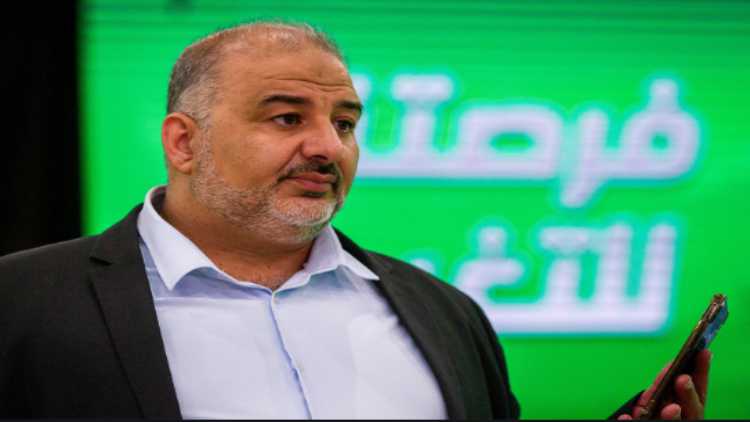
Arab-Muslim party to join Israeli government
Aasha Khosa
For the first time, an Islamist-Arab party, representing the Muslims living in Israel will be part of the Jewish State’s new coalition government that replaces the 12-year rule of Prime Minister Benjamin Netanyahu.
Ra’am, the Arab-Israeli party headed by Monsur Abbas, has signed the coalition agreement with seven other parties and formalized the process of joining the new government.
The new Israeli government scheduled to take oath on Sunday will be headed by Yamina Party’s Naftali Benett .
This is a historic step in Israel, the world’s only Jewish State where contrary to the public perceptions in India, 21 per cent of the population is Arab; of them 83 per cent are Muslims.
The eight parties have formalized the coalition agreement and, as it’s mandatory under law, applied to the Knesset Secretariat for the formation of a new government.
The coalition has been cobbled as the elections had thrown up complex results not giving a clear majority to any party. In the new coalition Bennett will serve as prime minister until August 2023, and then Lapid party’s candidate will take over from him until the end of the Knesset term in November 2025.
Ra’am is the smallest party in the coalition with four members in Knesset, Israeli parliament. The other parties are; Yesh Atid (17 seats), Blue and White (8), Yisrael Beytenu (7), Labor (7), Yamina (6 of its 7 MKs), New Hope (6) and Meretz (6).
The coalition has cobbled 61 member support in the 120-member Knesset.
Though the Arab enjoy the same rights as the Jews in Israel, on the social front, there is tension between the two communities and they have grown to live in segregated localities.
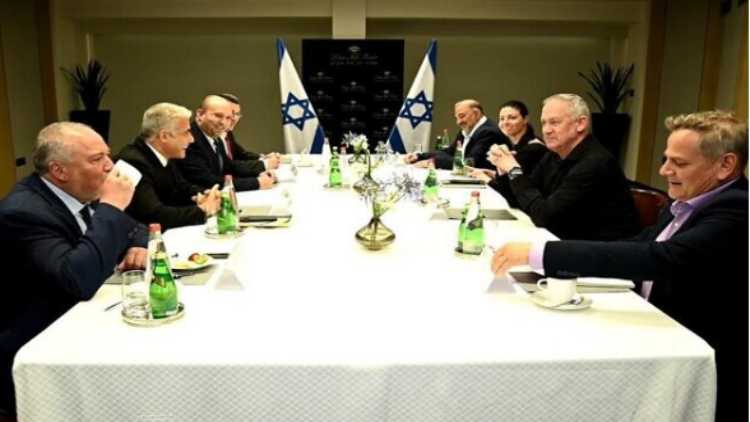
Monsur Abbas (fourth from right) in a discussion with coalition partners
The State of Israeli prides itself as the only Middle Eastern State where Muslim women have voting rights. Though Arabic along Hebrew were the official languages of Israel till 2018, Arabic was relegated to the position of “special language’ in 2018.
The major difference in the rights of the two under the Israeli law is about compulsory military training: while drafting is a fundamental duty for the Jews and all have to join the Israeli Defence Forces (IDF) at attaining the age of 18, it is voluntary for the Arabs.
According to Israeli media, last year a record number of 1,000 Arabs had volunteered for drafting in the IDF. This was due to the Covid-induced lockdown, where there were not too many jobs in the private sector.
The deal between Ra’am and the coalition parties includes a deputy ministerial post for Ra’am in the Prime Minister’s Office, chairmanship of the Knesset Interior Committee, a deputy Knesset speaker and chairmanship of the Arab Affairs Committee.
Many in the Arab community, and especially among the Bedouins, see Abbas emerging from this election as a victorious leader. He has recorded for himself and the Islamic movement several historical achievements on many important levels.
The deal also includes the government working to adopt a five-year economic development plan for the Arab community with a budget of 30 billion shekels, $US9.3 billion) as well as plans to combat crime and violence in the Arab community, to improve infrastructure, to advance Arab local authorities, and to review of the law that had led to increased demolitions of and eviction from the Palestinian properties.
The agreement also includes recognition of several Bedouin villages in the southern district of Israel where a majority of the country’s Bedouins live.
However, analysts feel the most important change is the acceptance of Arab parties in the Israeli political system.
Though Israeli law doesn't prevent the Arabs from joining the government, there has been an unwritten law that kept the Arab parties out of the government.
Yitzhak Rabin was the first Israeli Prime Minister who had sought an Arab party’s support in the passage of a crucial bill to endorse his peace effort with Palestine. He was opposed by the orthodox jews and finally assassinated.
Ra’am supports the two-State solution to the Israel-Palestinian conflict with the creation of a Palestinian state in the West Bank and Gaza Strip, with East Jerusalem as its capital.
The mandate of elections in Israel has been so fractured that in two years the country has seen four general elections. Also, there is a growing disenchantment against Netanyahu.
The new coalition has agreed to rework the law that allowed Netanyahu to continue as PM for 12 long years and cap it at eight.
The intended Lapid-Bennett government is backed by eight of the 13 parties that won seats in the March 23 election, for an expected total of 61 votes in the 120-member Knesset: Yesh Atid (17 seats), Blue and White (8), Yisrael Beytenu (7), Labor (7), Yamina (6 of its 7 MKs), New Hope (6), Meretz (6) and Ra’am (4).
Netanyahu had also tried to woo Abbas and tried to woo some defectors from other parties to retain Likud party’s rule.
The coalition’s guiding principles that all parties signed onto include a commitment to maintaining the status quo regarding religion and state affairs. Beneett's party Yamina will be able to veto any bill concerning matters of religion and state.











.webp "Representational image")

.webp "US President Donald Trump")

.webp)